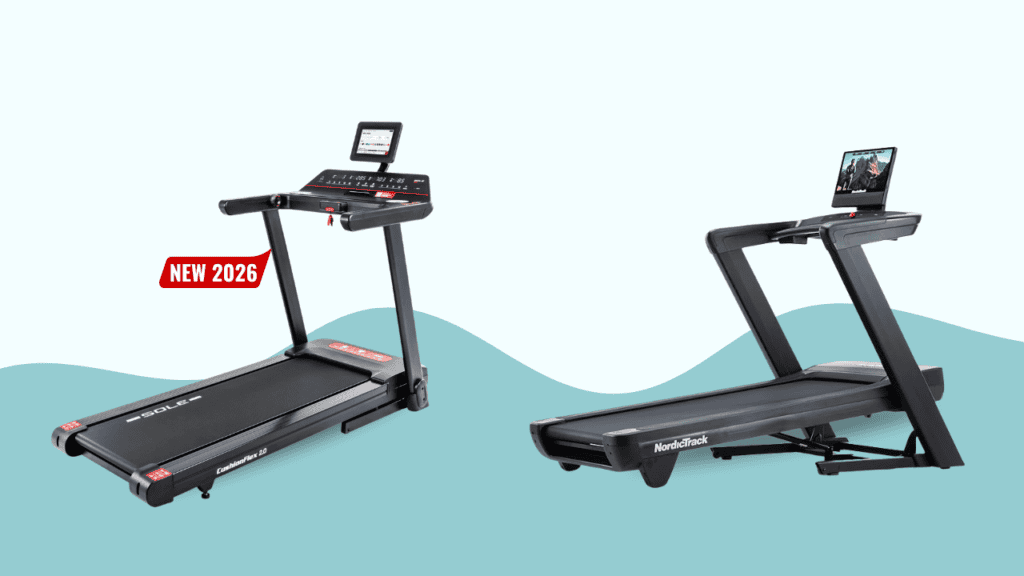
A 16-inch touchscreen, a decline, and a 4.25-horsepower motor. Or a brand-new brushless motor, a free app, and about $400 back in your pocket. The NordicTrack Commercial 1750 and the 2026 Sole F80 are two of the most popular treadmills between $1,600 and $2,000, and they’re built on completely different ideas.
This comparison covers the redesigned 2026 Sole F80, not the older model most reviews still describe. As a NASM-certified personal trainer, I compared them round by round, the way I’d help a client choose, and scored every round honestly.
Quick verdict
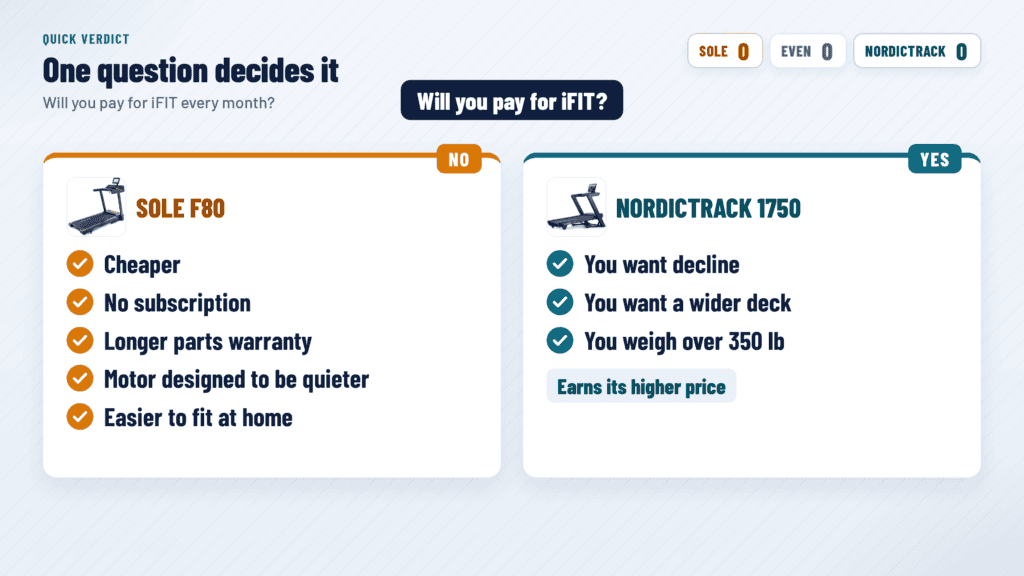
This one comes down to a single question: will you pay for iFIT?
If you won’t, the Sole F80 is the smarter buy. It’s about $400 cheaper up front, needs no subscription, has a longer parts warranty, a motor designed to be quieter, and it’s easier to fit in your home.
If you will, or you need any of these, the NordicTrack 1750 earns its higher price:
- Guided classes that automatically adjust your speed, incline, and decline
- A decline setting, or a wider 22″ deck
- More than 350 lb of capacity (it’s rated for 400)
Watch: Sole F80 vs NordicTrack 1750 Comparison
Sole F80 vs NordicTrack 1750: specs side by side
| Sole F80 (2026) | NordicTrack Commercial 1750 | |
|---|---|---|
| Motor | 3.25 HP brushless | 4.25 CHP |
| Speed | 0.5–12 mph | 0–12 mph |
| Incline | 0–15% | −3% decline to 12% |
| Running Deck | 20″ x 60″ | 22″ x 60″ |
| Cushioning | CushionFlex 2.0 | RunFlex |
| Screen | 10.1″ touchscreen, tilts and swivels | 16″ HD touchscreen, pivots |
| Smart Features | Free SOLE+ app, Wi-Fi, screen mirroring | iFIT Pro ($39/month) |
| Max User Weight | 350 lb | 400 lb |
| Weight | ~218 lb | ~266–307 lb (sources vary) |
| Size (L x W x H) | 75″ x 34″ x 52″ | 77″ x 37″ x 60″ |
| Folded (L x W x H) | 48″ x 36″ x 66″ | 44″ x 37″ x 69″ |
| Warranty | Lifetime frame and motor, 3 yr deck, electronics and parts, 1 yr labor | Lifetime motor, 10 yr frame, 2 yr parts, 1 yr labor, 1 yr tablet |
| Check Price | Check Price → | Check Price → |
The 1750’s weight varies by source: its Amazon listing says about 266 lb, and Best Buy Canada lists about 307 lb. Figures around 311–312 lb are the boxed shipping weight.
Heads-up: the 2026 F80 is a redesign
If you’ve read older reviews of the Sole F80, several key numbers have changed:
| Older F80 | 2026 F80 | |
|---|---|---|
| Motor | 3.5 HP | 3.25 HP brushless |
| Touchscreen | Previous design | New 10.1″, tilts and swivels |
| Running Surface | 22″ x 60″ | 20″ x 60″ |
Sole moved the wider 22″ x 60″ deck to a new model, the Sole F83 (3.5 HP). Every number in this comparison is for the new 2026 F80.
What they share
The list is short. Both top out at 12 mph, both have a 60″-long deck, both fold, both have touchscreens, and both cover the motor for life. Almost everything else is different.
Related: NordicTrack T Series 16 Review: Worth It Over the 1750?
Round by round
Nine rounds, scored honestly, with ties marked where the specs genuinely match.
Round 1: Price and true cost (winner: Sole)
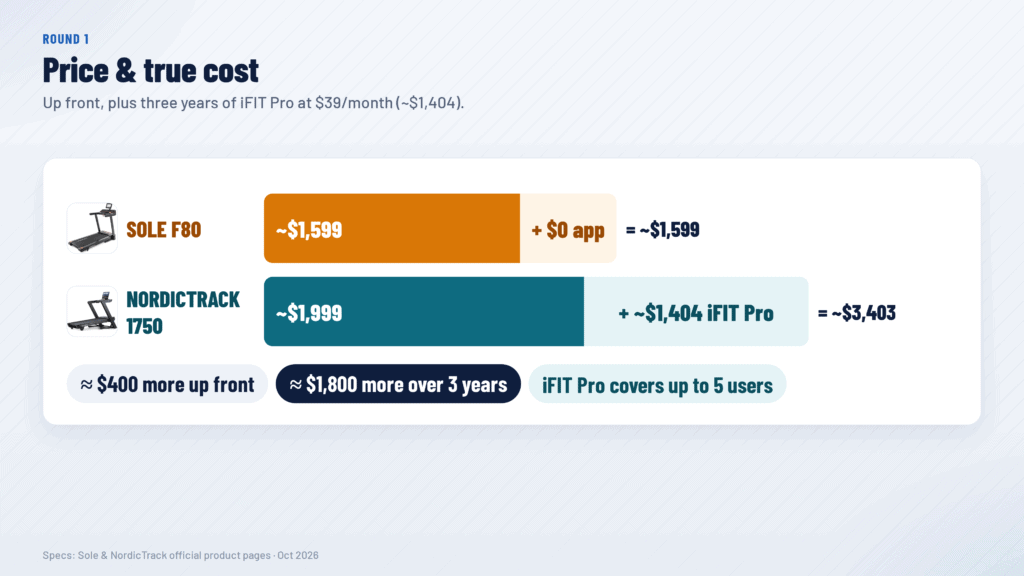
The Sole F80 typically sells for about $1,599, and the NordicTrack 1750 for about $1,999, so there’s roughly $400 between them up front. The bigger gap is monthly.
| Sole F80 | NordicTrack 1750 | |
|---|---|---|
| Typical Price | ~$1,599 | ~$1,999 |
| App or Membership | Free SOLE+ app | iFIT Pro, $39/month |
| 3 Years of Membership | $0 | ~$1,404 |
| 3-Year Total | ~$1,599 | ~$3,403 |
In fairness, iFIT Pro covers up to five users, so if several people in your home will use the classes, that money goes further. (iFIT lists $39 a month on its site; pricing through its app can be $39.99.)
There’s one more thing to know. iFIT’s terms say you need a free iFIT account and Wi-Fi to operate the equipment at all, and buying direct from NordicTrack may require an iFIT membership at purchase, so check the terms wherever you buy. The F80 doesn’t need a subscription to run.
Round 2: Screen and smart training (winner: NordicTrack)
This is where the 1750 shines. Its 16″ HD touchscreen pivots, and with iFIT, trainers automatically change your speed, incline, and even decline during classes. You get more than 10,000 workouts, and with iFIT Pro you can stream apps like Netflix and Spotify on the screen, using your own subscriptions.
The F80 has a 10.1″ touchscreen that tilts and swivels, built-in Wi-Fi, screen mirroring, and the free SOLE+ app. Sole also lists Kinomap, a separate subscription app, as a partner. It’s capable, but it isn’t the same guided, auto-adjusting experience.
Round 3: Power and capacity (winner: NordicTrack)
The 1750 has a 4.25 CHP motor and a 400 lb weight limit. The F80 has a 3.25 HP brushless motor and a 350 lb limit. The two brands rate horsepower differently, so those numbers aren’t directly comparable, but the weight limits are. If you weigh between 350 and 400 lb, or you’re a heavier runner who trains hard, the 1750 gives you more headroom.
Round 4: Noise (winner: Sole)
The brushless motor is Sole’s big 2026 upgrade. Sole says it runs quieter, lasts up to 10 times longer, and is 15% more efficient. Those are Sole’s claims, and the model is new, but if noise matters most, the F80 is the one designed around it.
Round 5: Deck, incline and decline (winner: NordicTrack)
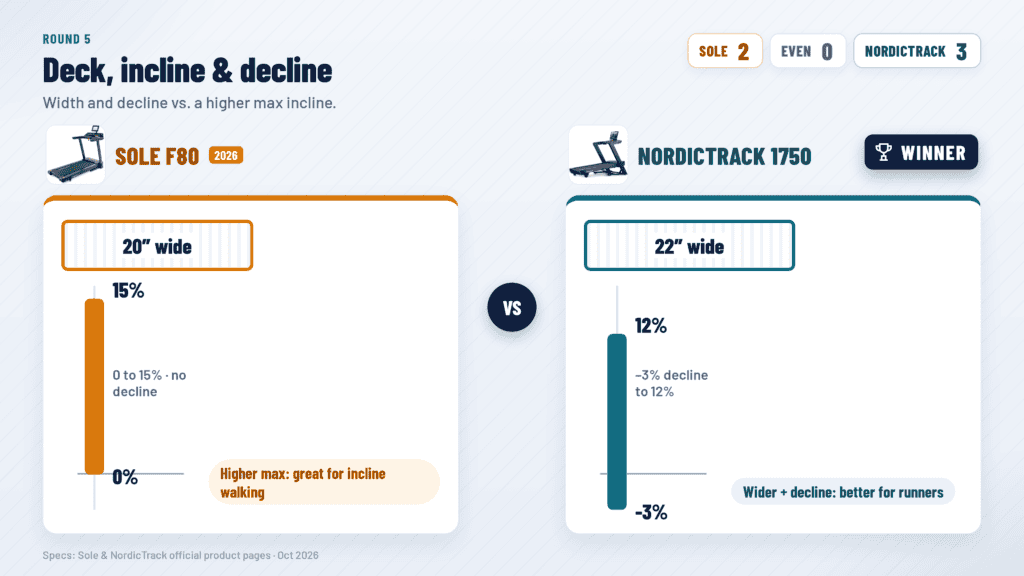
The 1750 has a 22″-wide deck and runs from 3% decline up to 12% incline. The F80 is 20″ wide with no decline, but it climbs higher, to 15%, which incline walkers will appreciate.
For runners, though, the 1750’s wider deck and decline win the round. Those two extra inches give you more room at speed, and decline lets you train for downhill races.
Round 6: Cushioning (even)
NordicTrack uses RunFlex cushioning, and Sole uses its CushionFlex 2.0 deck. Without a side-by-side test showing a real difference, this round is even.
Round 7: Warranty (winner: Sole)
| Sole F80 (2026) | NordicTrack 1750 | |
|---|---|---|
| Motor | Lifetime | Lifetime |
| Frame | Lifetime | 10 years |
| Deck, Electronics and Parts | 3 years | 2 years (parts) |
| Tablet (Touchscreen) | Not listed separately (electronics: 3 years) | 1 year |
| Labor | 1 year | 1 year |
Both cover the motor for life, but Sole also covers the frame for life and the deck, electronics, and parts for 3 years. Worth noting: NordicTrack covers the 1750’s tablet, its biggest selling point, for 1 year.
Round 8: Size and moving it (winner: Sole)
Set up, the F80 is about 75″ x 34″ and weighs about 218 lb. The 1750 is about 77″ x 37″ and weighs about 266 to 307 lb depending on the source, so roughly 50 to 90 lb more. Folded, the 1750 takes a little less depth (about 44″ versus 48″), but the F80 folds lower: 66″ tall versus 69″.
In fairness, a heavier frame generally feels more planted at speed. For fitting it into your home and moving it, though, the Sole wins.
Round 9: Track record (winner: NordicTrack)
The 1750 has been one of the most popular home treadmills for years, so there’s a lot of owner feedback to go on. The redesigned 2026 F80 is brand new. Sole’s own site shows an early rating of 3.7 out of 5 from 21 reviews, a small sample, but not a glowing start.
Final scoreboard
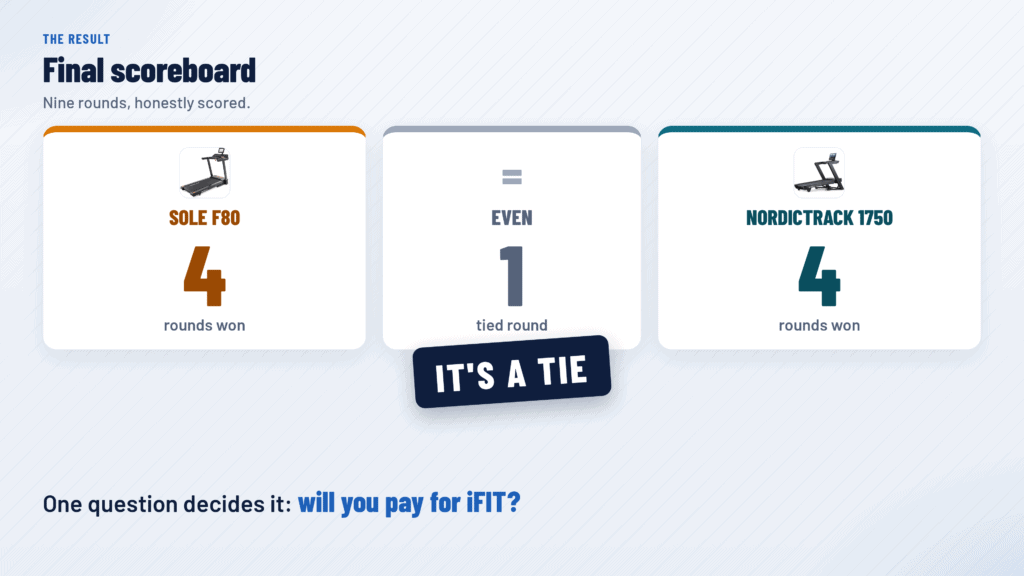
| Result | Rounds |
|---|---|
| Sole F80: 4 | Price and true cost, noise, warranty, size and moving it |
| NordicTrack 1750: 4 | Screen and smart training, power and capacity, deck and decline, track record |
| Even: 1 | Cushioning |
It’s a tie, because these treadmills are built for different buyers. One question decides which buyer you are: will you pay for iFIT?
A trainer’s take
From a training standpoint, here’s how I’d decide:
- If guided classes keep you consistent, choose the NordicTrack 1750. The auto-adjusting workouts do the thinking for you, and that consistency is worth paying for if it keeps you training.
- If you know your own workouts, choose the Sole F80. You get solid hardware without a monthly bill.
- If you’re a serious runner, choose the NordicTrack 1750 for its wider deck, decline, and heavier frame.
Before you buy
- Delivery. Both arrive by heavy freight, usually curbside, so have a helper ready. If you buy the F80 direct from Sole, you can upgrade to Room of Choice delivery for an extra $200, or Room of Choice plus assembly for an extra $350.
- Setup and power. Unless you pay for assembly, you’ll build it yourself. Plug it straight into a grounded wall outlet, not an extension cord.
- Returns. Buying on Amazon gives you a 30-day return window on either treadmill, but check the return shipping terms first, since bulky items usually aren’t free to send back. Buying the F80 direct from Sole comes with a 30-day satisfaction guarantee.
- iFIT trial. Some 1750 listings include a 30-day iFIT trial. If yours does, set a reminder to cancel if you don’t plan to keep it.
Which one is right for you? The 3-question test
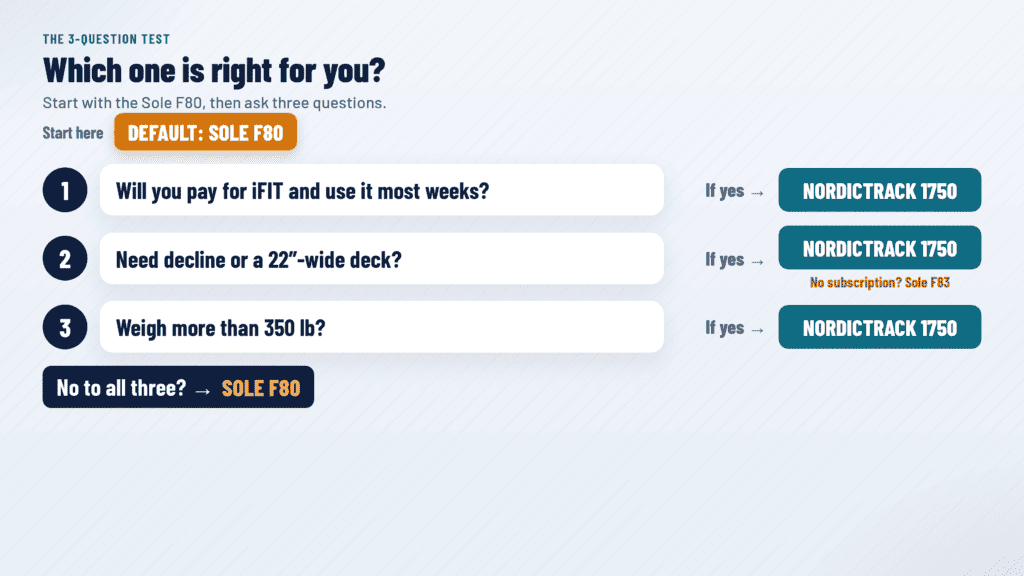
Start with the Sole F80 as your default, then ask three questions:
- Will you pay for iFIT and use it most weeks? If yes, get the NordicTrack 1750.
- Do you need decline or a 22″-wide deck? If yes, get the NordicTrack 1750. If you want that wider deck without a subscription, look at the Sole F83.
- Do you weigh more than 350 lb? If yes, get the NordicTrack 1750.
No to all three? Get the Sole F80.
Frequently asked questions
Is the Sole F80 or the NordicTrack 1750 better?
It depends on whether you’ll pay for iFIT. If you won’t, the Sole F80 is the better buy: about $400 less up front, about $1,800 less over three years once you count iFIT, a longer warranty, and a motor designed to be quieter. If you’ll use iFIT, need decline or a 22″ deck, or weigh more than 350 lb, the NordicTrack 1750 is worth the extra money.
Does the NordicTrack 1750 require an iFIT membership?
Its smart features (auto-adjusting classes, the workout library, and streaming apps on the screen) require iFIT Pro, $39 a month. iFIT’s terms also say a free iFIT account and Wi-Fi are required to operate the equipment, and buying directly from NordicTrack may require a membership at purchase.
How much does iFIT cost over three years?
At $39 a month, about $1,404. iFIT Pro covers up to five users in a household.
Does the Sole F80 need a subscription?
No. The F80 works with Sole’s free SOLE+ app and doesn’t need a subscription to run. Sole also lists Kinomap, a separate paid app, as a partner.
What changed in the 2026 Sole F80?
It gets a new 3.25 HP brushless motor and a new 10.1″ touchscreen that tilts and swivels. Its deck is now 20″ x 60″ instead of 22″ x 60″, and its motor is rated 3.25 HP instead of 3.5 HP. Sole moved the wider deck to the new F83.
Does the Sole F80 have decline?
No. The F80 inclines from 0 to 15% with no decline. The NordicTrack 1750 goes from 3% decline to 12% incline.
Which has the higher weight limit?
The NordicTrack 1750, at 400 lb versus 350 lb on the Sole F80.
Which has the better warranty?
The Sole F80: lifetime frame and motor, 3 years on the deck, electronics, and parts, and 1 year on labor. The 1750 has a lifetime motor, 10-year frame, 2-year parts, 1-year labor, and a 1-year tablet warranty.
Can you stream Netflix on these treadmills?
On the 1750, you can stream apps like Netflix and Spotify on the screen with iFIT Pro and your own streaming subscriptions. The F80 has screen mirroring, so you can cast content from your phone, though some streaming apps block mirroring on some devices.
Should I consider the Sole F83 instead?
If you want a 22″-wide deck without a subscription, yes. The F83 carries the wider 22″ x 60″ deck and a 3.5 HP motor.
Final verdict
If you won’t pay for iFIT, the Sole F80 is the smarter buy: about $400 less up front, about $1,800 less over three years once you count iFIT, a longer warranty, a motor designed to be quieter, and a smaller machine. If you’ll use iFIT, need decline or a wider deck, or weigh more than 350 lb, the NordicTrack 1750 is worth the extra money.
Still not sure? Leave a comment with how you’ll use it and whether you’d pay for iFIT, and I’ll tell you which one I’d pick.