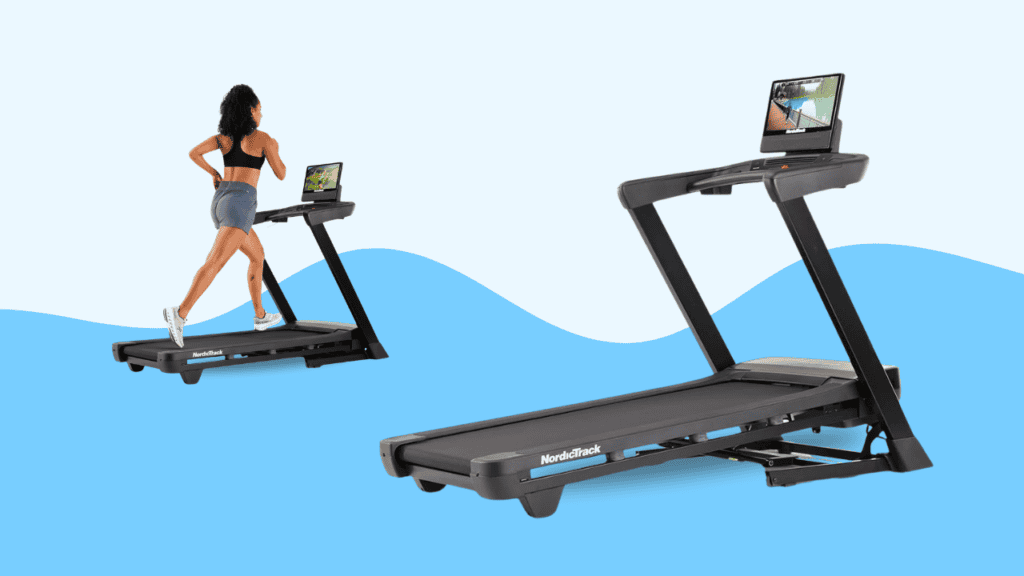
The NordicTrack T Series 16 has the same 16-inch HD touchscreen as NordicTrack’s Commercial 1750, which usually sells for around $2,000. The T Series 16 typically costs around $1,299. That raises the obvious question: what do you give up for roughly $700 less, and does it matter for the way you train?
I’m a NASM-certified personal trainer, so this review looks past the spec sheet. I’ll cover how the T Series 16 fits your body, your training style, and your home, and I’ll end with a simple three-question test that tells you whether to buy it, step up to the 1750, or choose a simpler treadmill with no subscription at all.
Quick verdict: NordicTrack T Series 16 Review
For most walkers and runners who want a big screen without spending around $2,000, the T Series 16 is one of the best values in NordicTrack’s lineup. The trade-offs are no decline, a smaller motor, a narrower deck, a 325 lb weight limit, and a short 2-year motor warranty. Those matter mostly for heavier runners who train hard and fast.
Best for: walkers, joggers, and runners who want an immersive screen, plan to use iFIT classes, and have comfortable headroom under 325 lb.
Skip it if: you’re a heavier runner doing frequent high-speed work, you want decline for downhill training, or you know you’ll never pay for iFIT.
Watch: NordicTrack T Series 16 Review
NordicTrack T Series 16 specs at a glance
| Screen | 16″ HD tilting touchscreen |
| Speed | 0–12 mph |
| Incline | 0–12% (no decline) |
| Motor | 3.6 CHP |
| Running Deck | 20″ x 60″ |
| Cushioning | SelectFlex (soft or firm) |
| Max User Weight | 325 lb |
| Footprint | 75.1″ L x 34.3″ W x 58.4″ H |
| Folded | 41″ L x 34.3″ W x 68.3″ H |
| Step-Up Height | 8.3″ |
| Warranty | 10 yr frame, 2 yr motor and parts, 1 yr labor and touchscreen |
| Extras | AutoBreeze fan, Bluetooth headphones and heart rate monitor, USB-C charging, two 2″ speakers |
Specs for the current US model (NTL16426), from NordicTrack’s spec sheet.
The 16-inch screen and iFIT
The headline feature is the 16-inch HD touchscreen, the biggest in the T Series. It tilts, so you can set the viewing angle for your height.
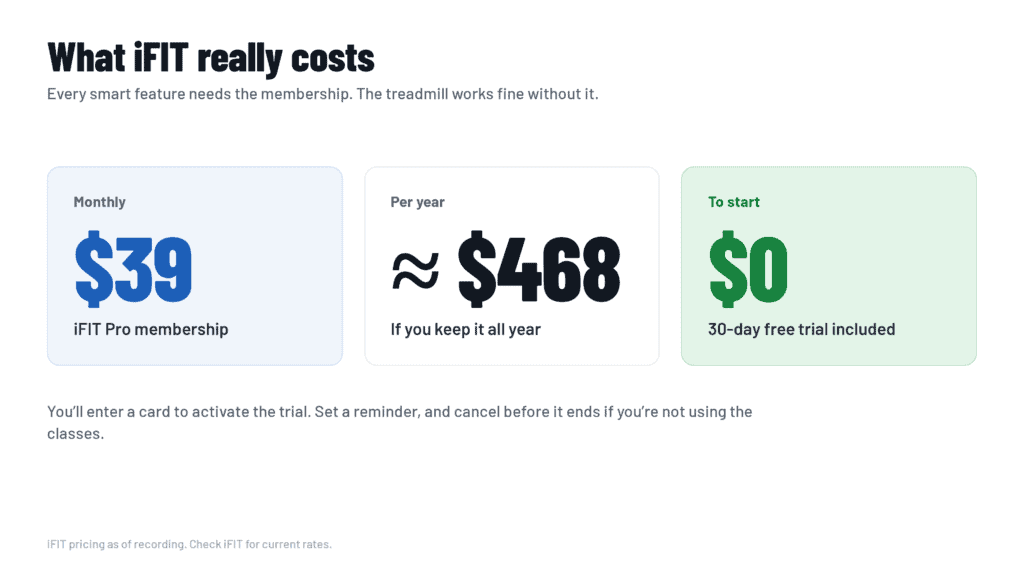
Pair it with an iFIT Pro membership, at $39 a month, and the treadmill becomes much more than a belt and a motor. During classes, the trainer adjusts your speed and incline automatically, so you’re not reaching for buttons mid-interval. You also get:
- 10,000+ workouts and streaming on the screen
- SmartAdjust, which tunes future workouts to your history
- ActivePulse, which adjusts speed and incline to keep you in your heart rate zone, with a compatible Bluetooth monitor
- Sync with Strava, Garmin Connect and Apple Health, so treadmill miles land alongside your outdoor runs
All of that requires the membership, which works out to about $468 a year. It’s optional: without it, you still get a fully working treadmill with manual speed and incline controls. But without iFIT, most of what you’re paying for in the screen goes unused.
The question that matters more than any spec
The most common treadmill regret isn’t a weak motor. It’s spending $1,300 on something that ends up holding laundry. From a training standpoint, the people who stick with home cardio are the ones who make starting easy: no planning the workout, no deciding the pace, just pressing start and following the trainer. That’s what this screen is really for.
The good news is that the T Series 16 includes a 30-day free trial of iFIT Pro. You’ll need to enter a card to activate it, so set a reminder. Use that month to see whether the classes actually get you on the treadmill. If they do, keep the membership. If not, cancel before the trial ends, and you won’t be charged.
Running performance: speed, incline, and deck
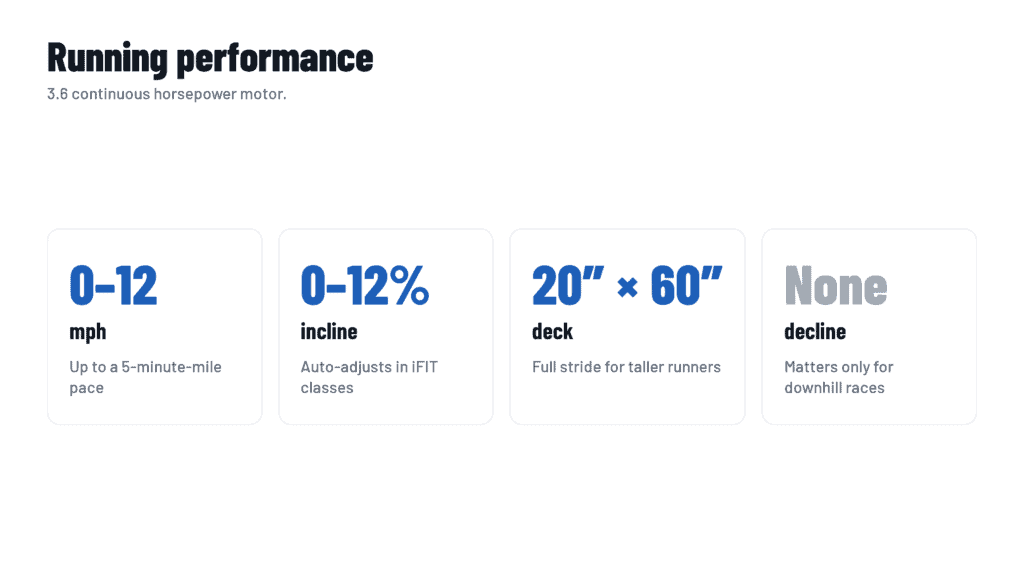
The T Series 16 uses a 3.6 continuous horsepower (CHP) motor with a 0–12 mph speed range. That’s up to a 5-minute-mile pace, which covers intervals, tempo runs and most people’s fastest sprints. Incline runs from 0 to 12% in half-percent steps, and it adjusts automatically during iFIT classes.
The running deck is 20 by 60 inches. The 60-inch length is what you want for running, since it gives taller runners room for a full stride at speed. The 20-inch width is standard for home treadmills, though narrower than the Commercial 1750’s 22 inches.
What it doesn’t have is decline. The incline starts at 0%, so there’s no downhill training. For most people, that’s a non-issue. If you’re training for a race with long descents, though, decline is genuinely useful, and it’s one of the reasons the 1750 exists.
SelectFlex cushioning: a trainer’s take
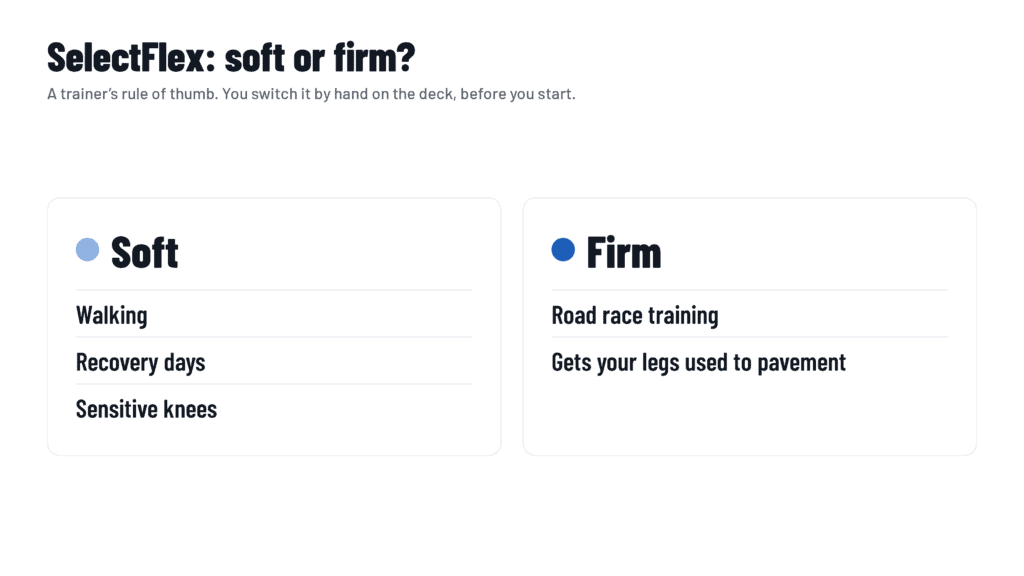
SelectFlex lets you switch the deck between soft and firm, and that’s more useful than it sounds. Here’s how I’d tell a client to use it:
- Soft for walking, recovery days, or sensitive knees
- Firm when you’re training for a road race, so your legs adapt to how pavement actually feels
A deck that’s always soft can leave you underprepared for race day. One catch: you change SelectFlex by hand on the deck, not from the screen, so set it before you start.
Weight capacity: the part most reviews skip
The T Series 16 is rated for 325 lb, which is solid for a folding treadmill and plenty for most users. But capacity isn’t a simple pass-or-fail number.
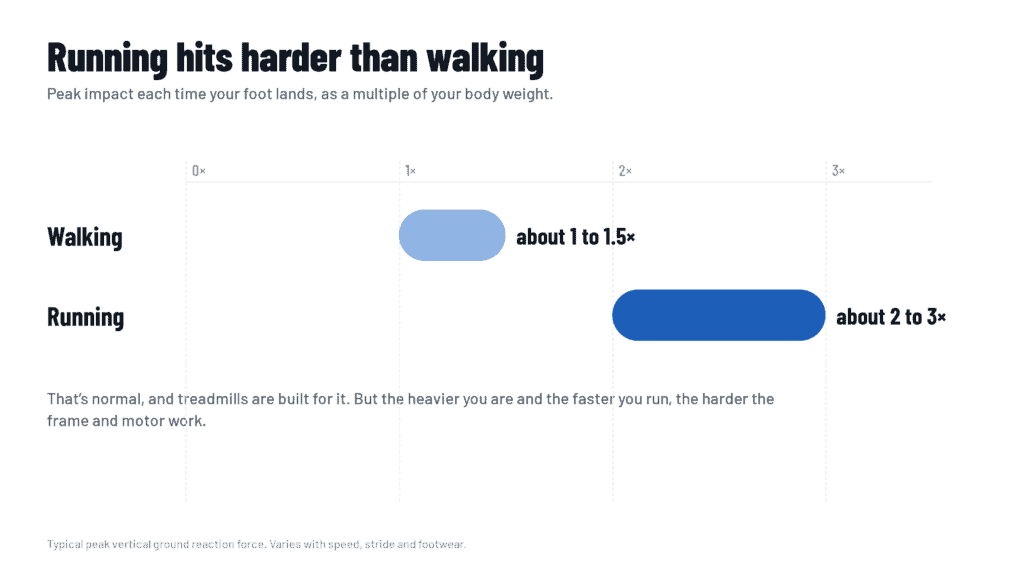
Running is different from standing still. Every time your foot lands, the impact peaks at roughly two to three times your body weight according to biomechanics research, compared with about one to one and a half times when walking. That’s normal, and treadmills are built for it. But the heavier you are and the faster you run, the harder the frame and motor have to work.
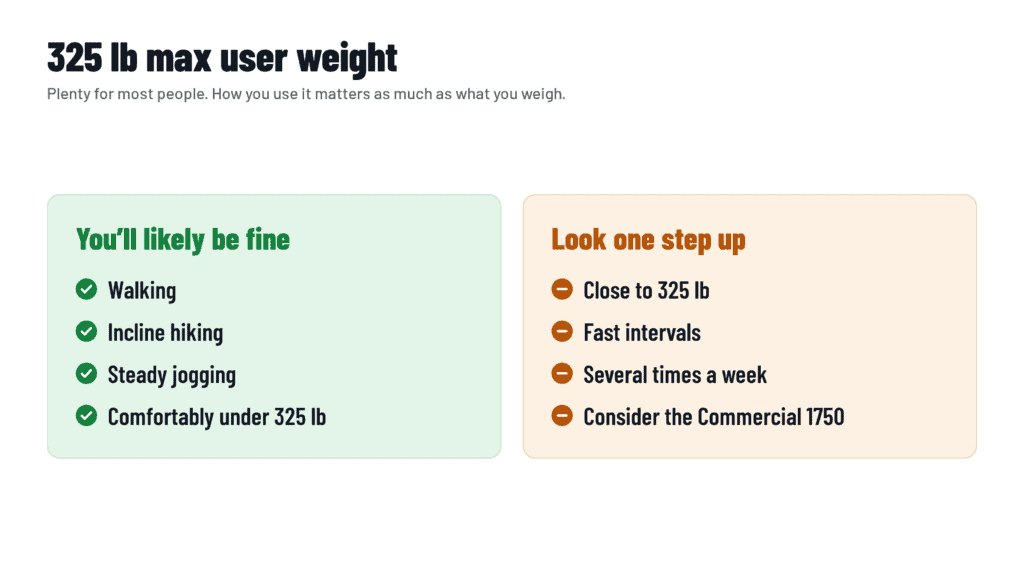
You’ll likely be fine if you mostly walk, hike on an incline, or jog at a steady pace, and you’re comfortably under 325 lb.
Look one step up if you’re close to 325 lb and plan fast intervals several times a week. That’s when you’re pushing a folding frame and its motor near their ceiling, and the Commercial 1750 becomes worth a look.
NordicTrack T Series 16 vs. Commercial 1750
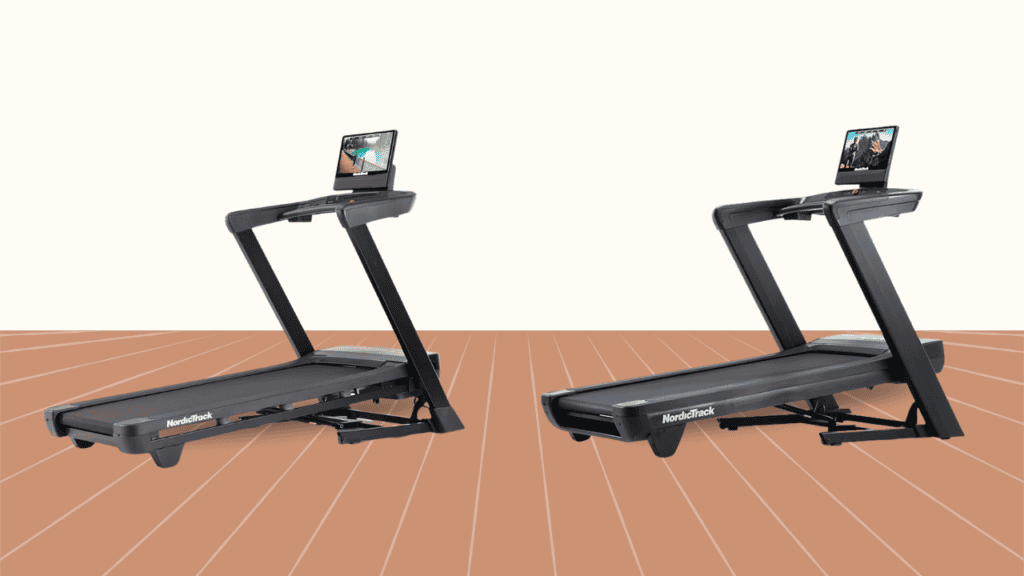
The step up from the T Series 16 is the NordicTrack Commercial 1750, typically around $2,000. Both have the same 16-inch touchscreen and the same 12 mph top speed. Here’s what the extra money buys:
| T Series 16 | Commercial 1750 | |
|---|---|---|
| Typical Price | ~$1,299 | ~$2,000 |
| Max User Weight | 325 lb | 400 lb |
| Motor | 3.6 CHP | 4.25 CHP |
| Running Deck | 20″ x 60″ | 22″ x 60″ |
| Incline Range | 0 to 12% | −3% to 12% |
| Motor Warranty | 2 years | Lifetime |
| Screen | 16″ tilting touchscreen | 16″ tilt-and-pivot touchscreen |
| Top Speed | 12 mph | 12 mph |
| Check Price | Check Price → | Check Price → |
Both motor figures are continuous-duty ratings, so it’s a fair comparison. In short, the 1750 gives you more weight capacity, more motor, a wider deck, decline, and far better motor coverage.
Does iFIT change the math?
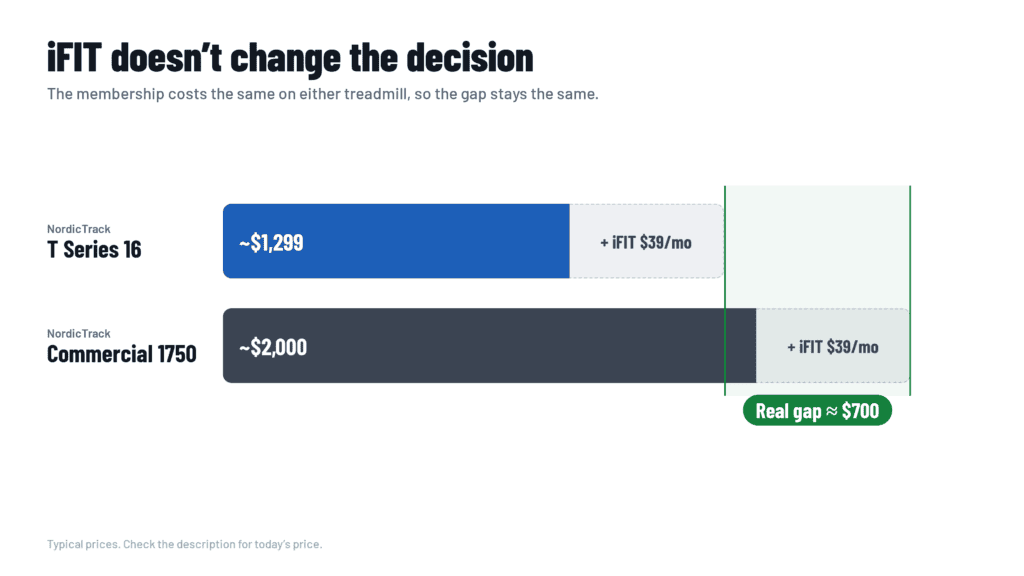
No. iFIT Pro costs the same $39 a month on either treadmill, so it doesn’t affect this decision. The real gap between them is still about $700.
Which one should you buy?
If you have comfortable headroom under 325 lb, the T Series 16 handles everything from walking to tempo runs and fast intervals. It’s the smarter buy: the same screen for about $700 less.
If you’re closer to that limit and run hard and fast often, or you want decline, the Commercial 1750 is worth the extra money.
Note: older versions of the Commercial 1750 had different specs, including a smaller screen. The figures above are for the current model.
Five checks before you buy
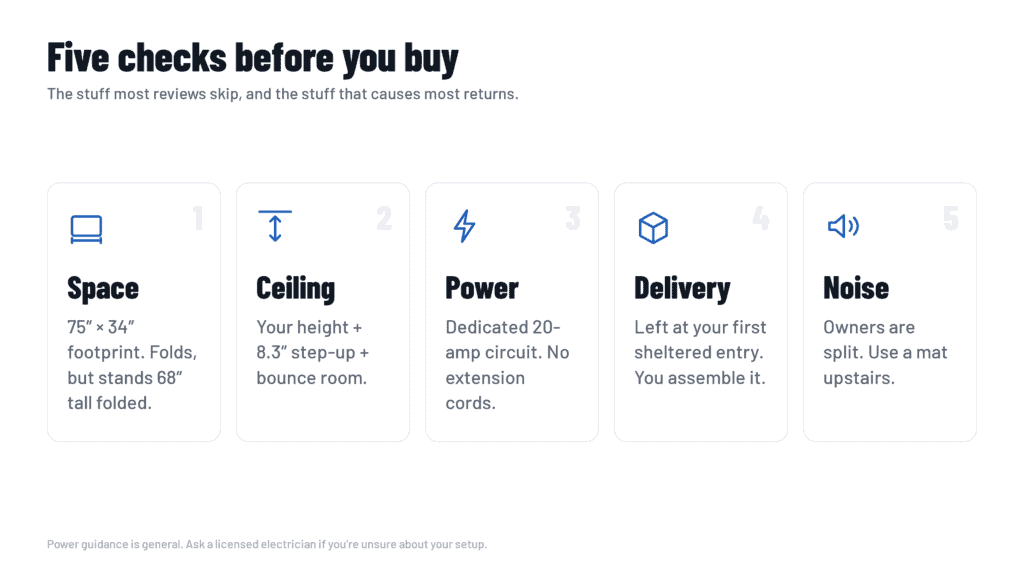
These are the practical questions that cause the most surprises after delivery.
1. Space. The T Series 16 takes up about 75 by 34 inches. It folds, and EasyLift Assist lowers the deck gently when you tap the foot bar. But folded, it stands about 68 inches tall, and it’s a heavy machine. Folding saves floor space; it doesn’t make it portable. Pick its spot and plan to leave it there.
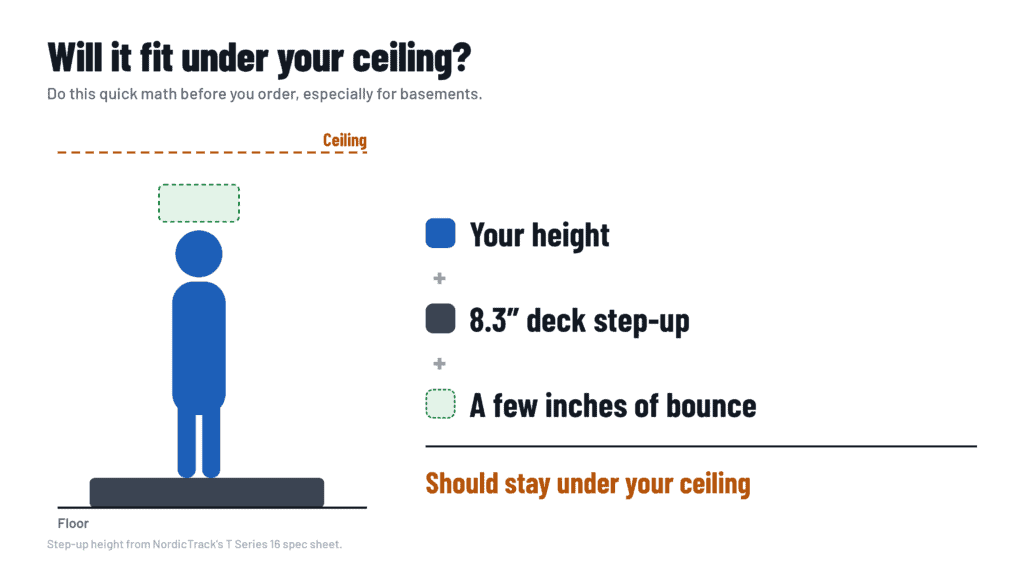
2. Ceiling height. This one catches people in basements. Add your height, the 8.3-inch step-up height, and a few inches for the natural bounce of running. If that number is close to your ceiling, measure before you order.
3. Power. Plan for a dedicated 20-amp circuit with a grounded, standard 120-volt outlet, and don’t share it with other appliances, since the motor’s startup draw can trip a breaker. Avoid extension cords. A surge protector designed for treadmills is a sensible add-on. If your outlet is only 15 amps, or the treadmill is going in a garage or basement, have a licensed electrician take a look first.
4. Delivery and assembly. Standard Amazon delivery leaves the treadmill at your first sheltered entry point, such as a garage or covered porch, not in your workout room. Assembly is on you, and most owners say it takes a couple of hours with a second person.
5. Noise. Owner reports are mixed: some find it surprisingly quiet for a treadmill, while others say it’s noisy. In an apartment or upstairs room, a treadmill mat underneath helps reduce vibration and sound for the people below.
Warranty and returns
The T Series 16 comes with a 10-year frame warranty, 2 years on the motor and parts, and 1 year on labor and the touchscreen. That’s typical at this price, but the 2-year motor coverage is the biggest gap compared with the Commercial 1750’s lifetime motor warranty. If that worries you, an extended protection plan is worth considering.
If you buy on Amazon, you have a 30-day return window. Keep in mind that Amazon’s free returns usually don’t cover heavy, bulky items like treadmills, so check the listing’s return shipping cost before you order. Knowing your exit plan makes this a much safer purchase.
The 3-question test: Is the T Series 16 right for you?
Answer these honestly:
- Are you comfortably under 325 lb, or, if you’re closer, mostly walking and moderate running?
- Can you live without decline?
- Will you actually use iFIT, for the classes or for streaming?
Three yeses? The T Series 16 is an easy buy. At around $1,299, it’s one of the best values in NordicTrack’s lineup.
A “no” on question 1 or 2? Look at the Commercial 1750.
A “no” on question 3? Go simpler with the Horizon 7.4 AT or 7.0 AT (see below).
Don’t want iFIT? Two no-subscription alternatives
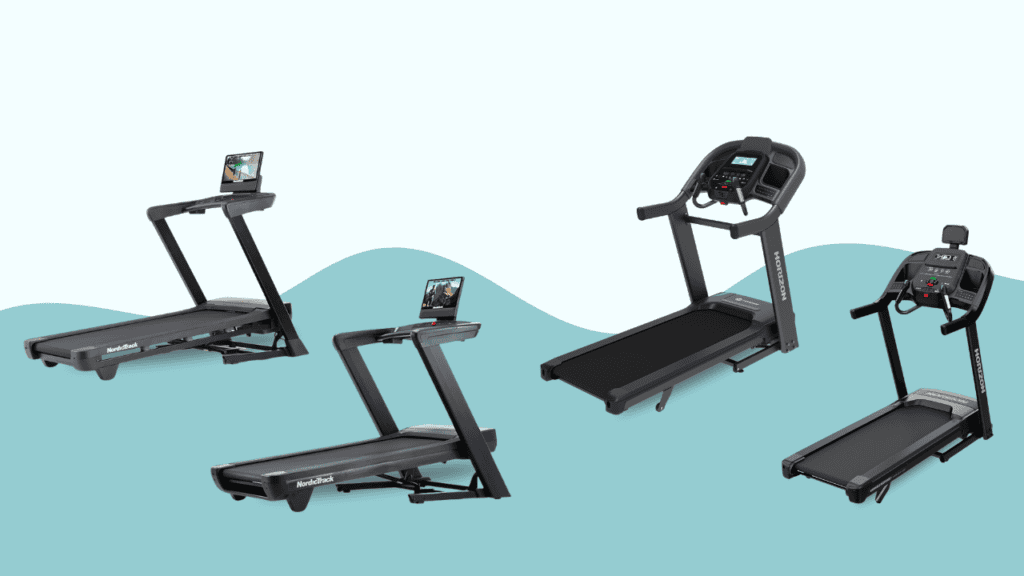
If you know you won’t use iFIT, you’d be paying for a screen whose best features sit behind a subscription. In that case, a simpler treadmill with no touchscreen and no membership makes more sense. Two worth considering:
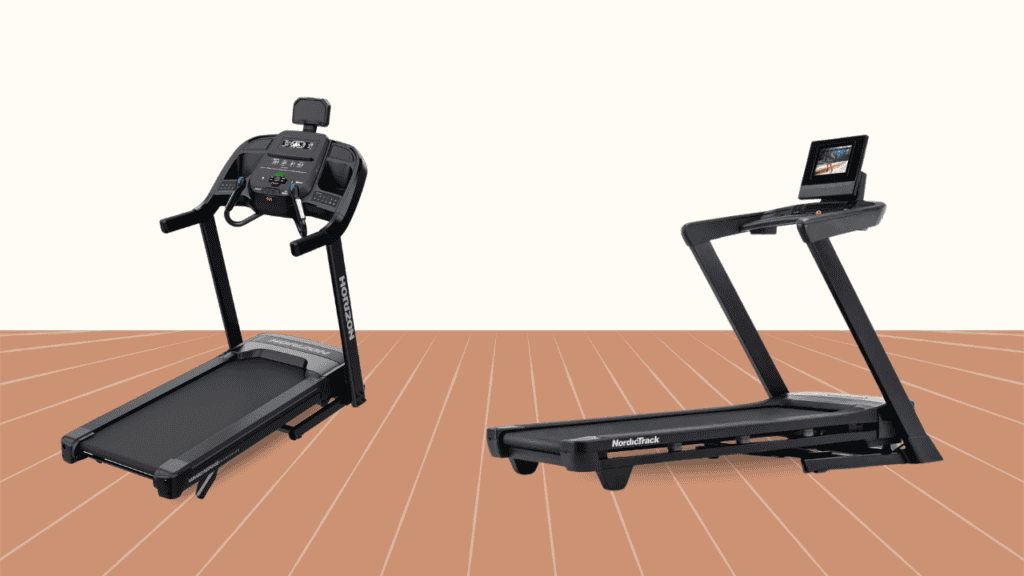
Horizon 7.4 AT (around $1,799): for serious runners. It costs more than the T Series 16, but the money goes into running hardware instead of a screen: a wider 22″ x 60″ deck, incline up to 15%, and a lifetime motor warranty. Read my full [Horizon 7.4 AT review]
Horizon 7.0 AT (around $1,099): to keep the budget down. It has a 60-inch deck, a 325 lb weight limit, a 15% max incline, and a simple LCD display. Read my full [Horizon 7.0 AT review].
Both connect over Bluetooth to apps like Zwift or Peloton on your own phone or tablet, so you can still follow classes; you just choose the app and decide whether to pay for it.
| Touchscreen + iFIT | No Touchscreen, No Subscription | |||
|---|---|---|---|---|
| T Series 16 | Commercial 1750 | Horizon 7.4 AT | Horizon 7.0 AT | |
| Typical Price | ~$1,299 | ~$2,000 | ~$1,799 | ~$1,099 |
| Screen | 16″ touchscreen | 16″ touchscreen | LCD display | LCD display |
| Subscription | iFIT optional, $39/mo | iFIT optional, $39/mo | None needed | None needed |
| Max Incline | 12% | 12% | 15% | 15% |
| Decline | None | Down to −3% | None | None |
| Motor | 3.6 CHP | 4.25 CHP | 3.5 CHP | 3.0 CHP |
| Running Deck | 20″ x 60″ | 22″ x 60″ | 22″ x 60″ | 20″ x 60″ |
| Max User Weight | 325 lb | 400 lb | 350 lb | 325 lb |
| Motor Warranty | 2 years | Lifetime | Lifetime | Lifetime |
| Check Price | Check Price → | Check Price → | Check Price → | Check Price → |
Frequently asked questions
Does the NordicTrack T Series 16 require an iFIT membership?
No. The treadmill works without iFIT using manual speed and incline controls. But the auto-adjusting classes, streaming on the screen, SmartAdjust, and ActivePulse all require iFIT Pro, which costs $39 a month. A 30-day free trial is included.
Does the T Series 16 have decline?
No. Its incline range is 0 to 12%. If you want decline for downhill training, the Commercial 1750 goes down to –3%.
What is the T Series 16 weight limit?
325 lb. That’s plenty for most users, but heavier runners who do frequent fast intervals should consider the Commercial 1750, which is rated for 400 lb.
Is the T Series 16 good for running?
Yes, for most runners. It reaches 12 mph (a 5-minute-mile pace), has a 60-inch deck for a full stride, and lets you firm up the cushioning for race training. The main limits are the lack of decline and the 20-inch deck width.
Does the T Series 16 fold?
Yes. It folds with EasyLift Assist, which lowers the deck gently. Folded, it measures about 41 inches long and 68 inches tall. It’s still heavy, so folding saves floor space rather than making it easy to move.
What outlet does the T Series 16 need?
Plan for a dedicated 20-amp circuit with a grounded 120-volt outlet. Avoid extension cords, and ask a licensed electrician if you’re unsure about your setup.
Is the NordicTrack T Series 16 worth it?
For most people who want a big screen and will use iFIT, yes. You get the same 16-inch screen as the Commercial 1750 for about $700 less. It’s less worth it if you’re a heavy runner who trains hard, want a decline, or won’t pay for iFIT. If iFIT isn’t for you, a no-subscription treadmill like the [Horizon 7.0 AT] is a simpler choice.
Final verdict
A full-size 16-inch screen, real running capability, and about $700 less than the Commercial 1750. If you passed the three-question test, the NordicTrack T Series 16 is an easy recommendation.
Still stuck between the T Series 16 and the 1750? Leave a comment with how often you run, how fast, and your weight range if you’re comfortable sharing, and I’ll tell you which one I’d pick.