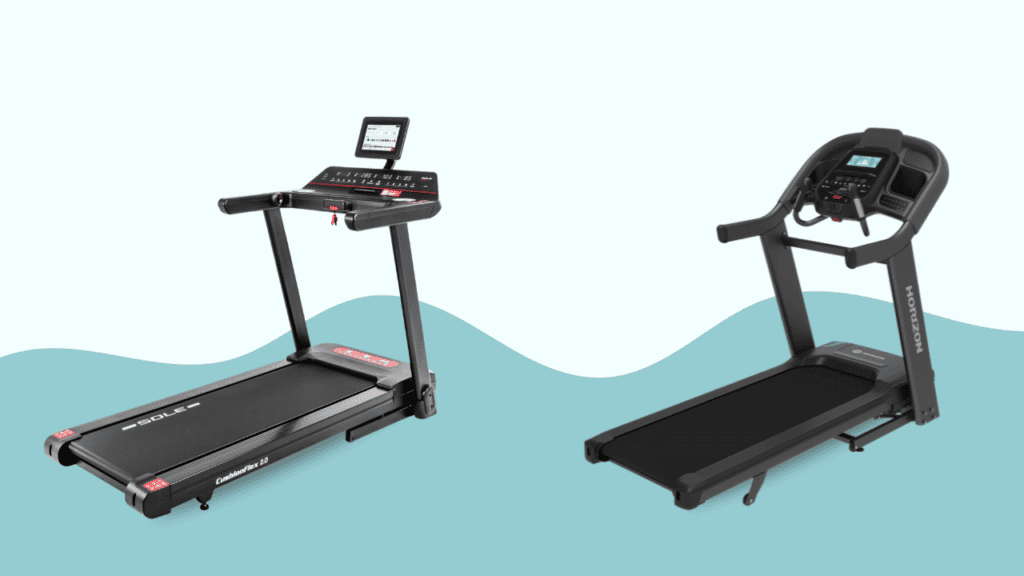
The new Sole F80 and the Horizon 7.4 AT have the same top speed, the same incline, the same weight limit, and both fold. On Amazon, the Sole usually sells for about $1,599 and the Horizon for about $1,799. So the real question in this Sole F80 vs Horizon 7.4 AT comparison is simple: what does the extra $200 buy you, and is it worth it for the way you’ll use it?
I’m a NASM-certified personal trainer, so I’ll compare them the way I’d help a client choose.
Quick verdict: Sole F80 vs Horizon 7.4 AT
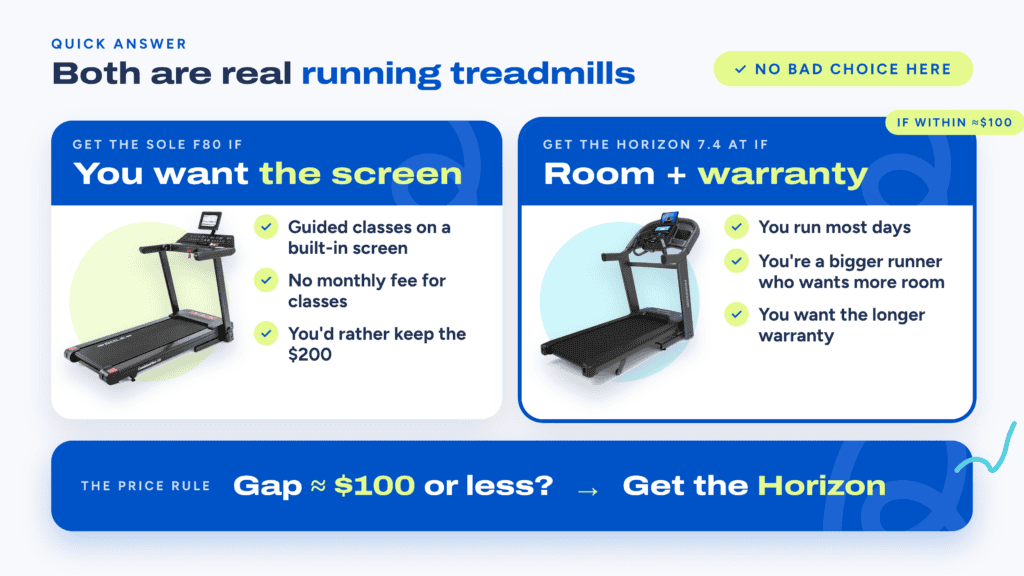
Both are real running treadmills, so you can’t make a bad choice here.
- Get the Sole F80 (2026) if you want guided classes on a built-in touchscreen without paying monthly, and you’d rather keep the $200.
- Get the Horizon 7.4 AT if you run most days, you’re a bigger runner who wants more room, or you want the longer warranty.
- Price rule: if the two are ever within about $100 of each other, get the Horizon. At that point it’s simply the better treadmill for the money.
Sole F80 vs Horizon 7.4 AT at a glance
The first four rows are where the $200 goes. Prices change often; check today’s prices.
| Spec | Sole F80 (2026) | Horizon 7.4 AT |
|---|---|---|
| Typical Amazon price | ≈ $1,599 | ≈ $1,799 |
| Deck | 20″ × 60″ | 22″ × 60″ |
| Motor | 3.25 HP brushless (continuous or peak not stated) | 3.5 CHP (continuous) |
| Warranty | Lifetime frame and motor; 3 yr deck, electronics and parts; 1 yr labor | Lifetime frame and motor; 5 yr parts; 2 yr labor |
| Screen | 10.1″ touchscreen, tilts and swivels, built-in classes, phone mirroring | 8.25″ LCD + tablet holder |
| Apps | Sole app, no monthly fee for classes | Bluetooth to Peloton, Zwift, Kinomap (paid apps) |
| Speed / incline | 0.5–12 mph, 0–15% | 0.5–12 mph, 0–15% |
| Max user weight | 350 lb | 350 lb |
| Suits runners up to | About 325 lb | About 325 lb |
| Treadmill weight | 223 lb | 318 lb |
| Size set up | 77″ L × 36″ W × 59″ H | 76″ L × 37″ W × 63″ H |
| Size folded | 48″ L × 36″ W × 66″ H | 42″ L × 37″ W × 71″ H |
| Folding | Hydraulic assist | Hydraulic assist |
| Controls | Speed and incline dials + quick-select keys | Speed and incline dials + quick-select keys |
| Extras | Bluetooth soundbar, fan, USB-C | Bluetooth speakers, fan, USB-A |
| Check price | Check Price → | Check Price → |
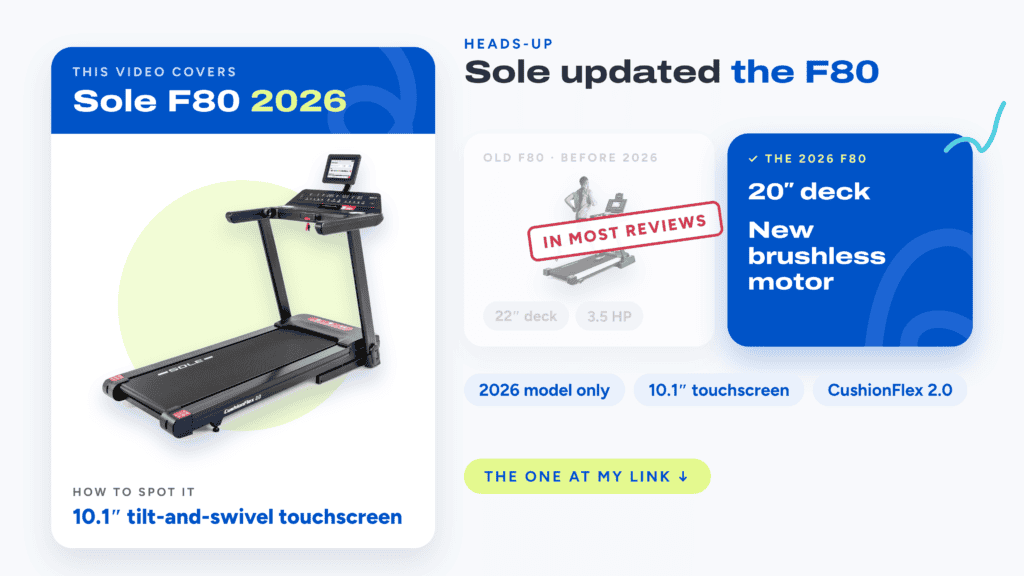
Make sure you’re buying the 2026 F80
Sole updated the F80 for 2026, and most reviews online still describe the old one, with a 22″ deck and a 3.5 HP motor. The new F80 has a 20″ deck and a new 3.25 HP brushless motor. This article covers the 2026 model. The easiest way to spot it: the 10.1″ tilt-and-swivel touchscreen on an arm above the console.
What’s the same on both
On the specs that decide whether a treadmill can handle running, these two match.
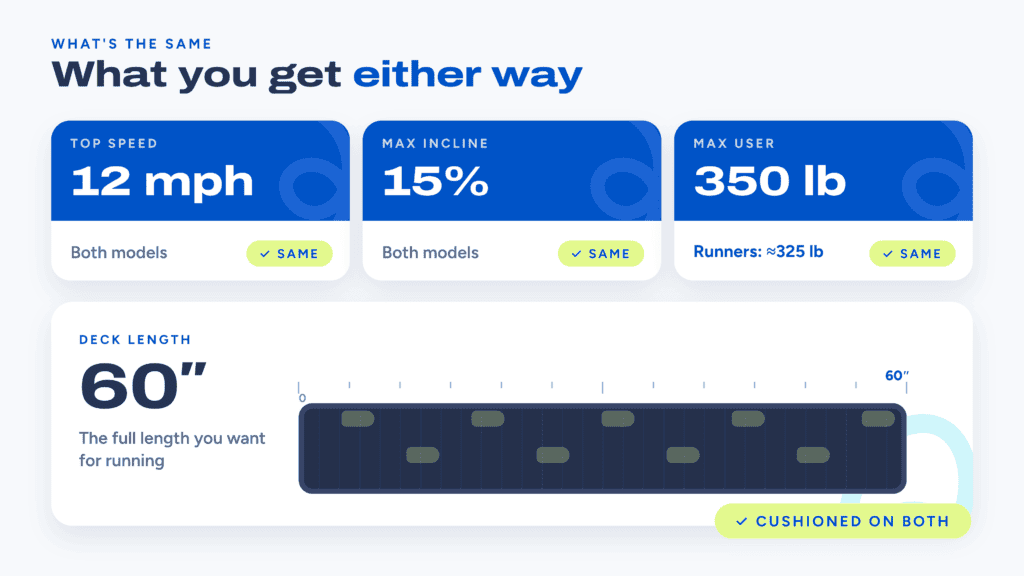
- Speed and incline: both go up to 12 mph and 15% incline.
- Deck length: both have a 60″ deck, the full length you want for running. Both decks are cushioned to take some of the pounding off your joints.
- Weight limit: both are rated for 350 lb, so I’d keep runners to about 325 lb.
- Controls: both have dial controls for speed and incline, plus quick-select buttons, so intervals are easy on either one.
- Folding and extras: both fold up with hydraulic assist, with Bluetooth speakers and a fan built in.
- No subscription needed: neither one needs a subscription to work. You get built-in programs on both.
Trainer’s test: if your plan is steady runs, hill walks and simple intervals, both machines do the job. So the decision really comes down to what the extra $200 gets you, and what the Sole gives you back.
What the extra $200 buys with the Horizon 7.4 AT
The Horizon’s extra $200 gets you three things: a wider deck, a motor with a clearer rating, and a longer warranty.
1. A wider deck: 22″ vs 20″
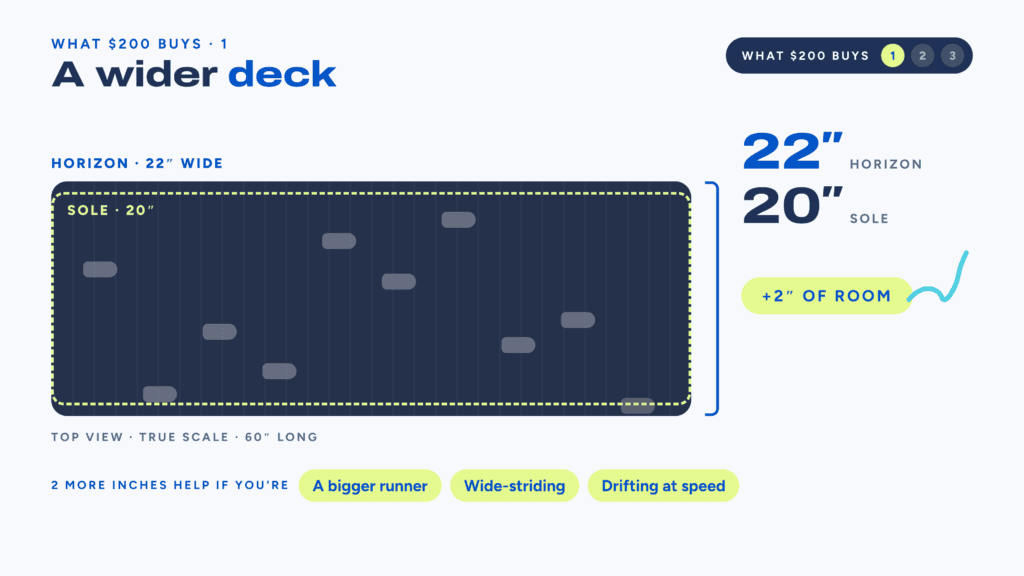
The Horizon’s running surface is 22″ wide, versus 20″ on the Sole. Twenty inches is the standard width, and it’s plenty for most people.
Trainer’s test: if you’re a bigger runner, you have a wide stride, or you tend to drift side to side when you run fast, those extra two inches make every run feel less cramped. If none of that is you, 20″ is fine.
2. A motor with a clearer rating
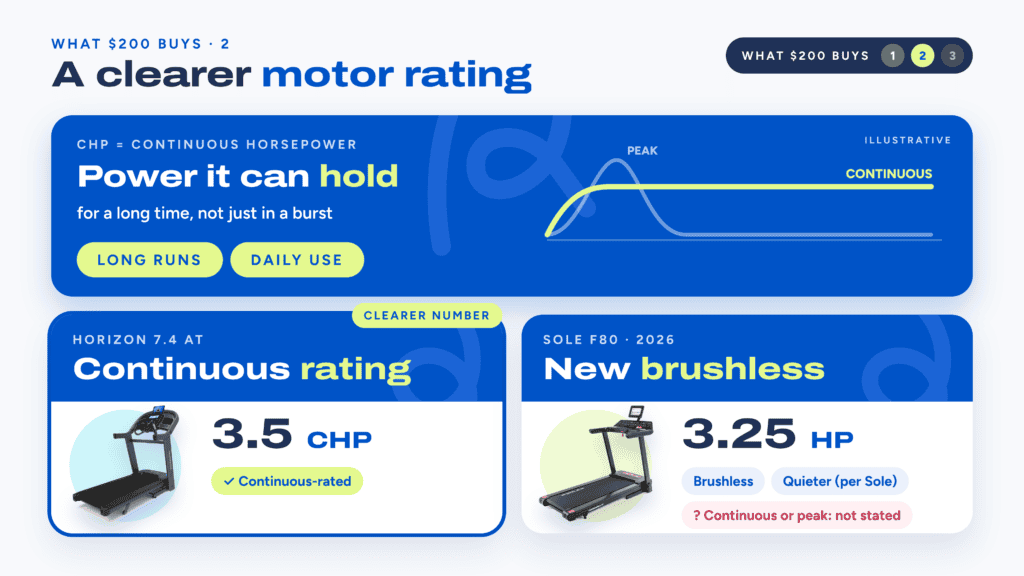
The Horizon has a 3.5 CHP motor. CHP means continuous horsepower: the power it can hold for a long time, which is the number that matters for long runs and daily use.
The Sole has a new 3.25 HP brushless motor, and Sole says it runs quieter. But Sole doesn’t say whether that’s a continuous or a peak rating. So on paper, the Horizon’s is the clearer, more trustworthy number. That doesn’t make the Sole’s motor weak; it just means you can’t compare the two numbers directly.
Trainer’s test: if you’ll run most days or do long runs, the Horizon’s continuous rating is the safer bet.
3. A longer warranty
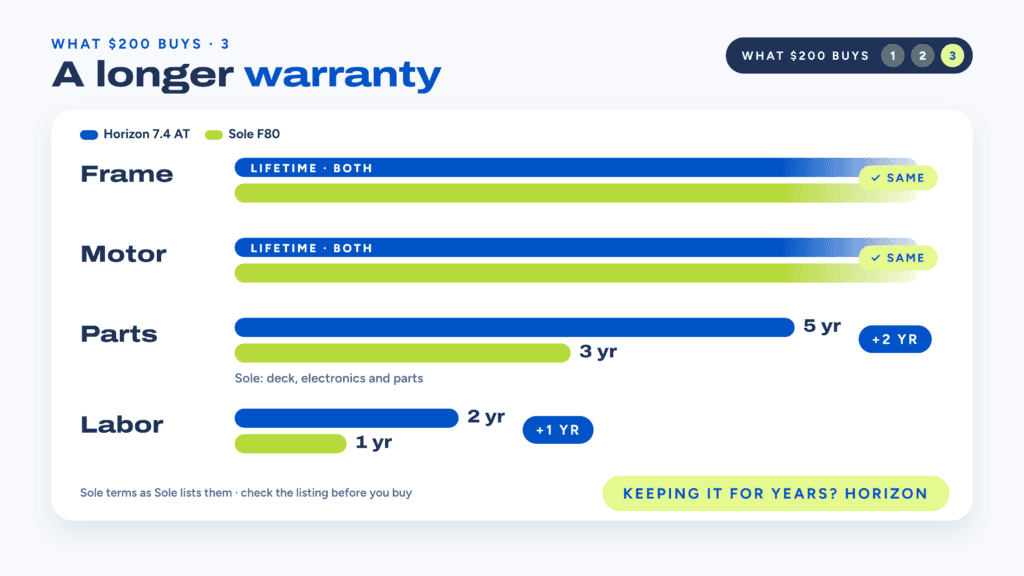
Both cover the frame and the motor for life, so the Sole’s motor is protected just as long. The difference is everything else.
| Warranty | Sole F80 (2026) | Horizon 7.4 AT |
|---|---|---|
| Frame | Lifetime | Lifetime |
| Motor | Lifetime | Lifetime |
| Parts | 3 years (deck, electronics and parts) | 5 years |
| Labor | 1 year | 2 years |
Sole terms are as Sole lists them; check the warranty section of the listing before you buy.
Trainer’s test: if you plan to keep your treadmill for a long time, two extra years on parts and one extra year on labor is real peace of mind.
What the Sole F80 gives you for $200 less
The Sole’s big win is the screen, and it’s also about 95 lb lighter.
Built-in screen with classes, no monthly fee
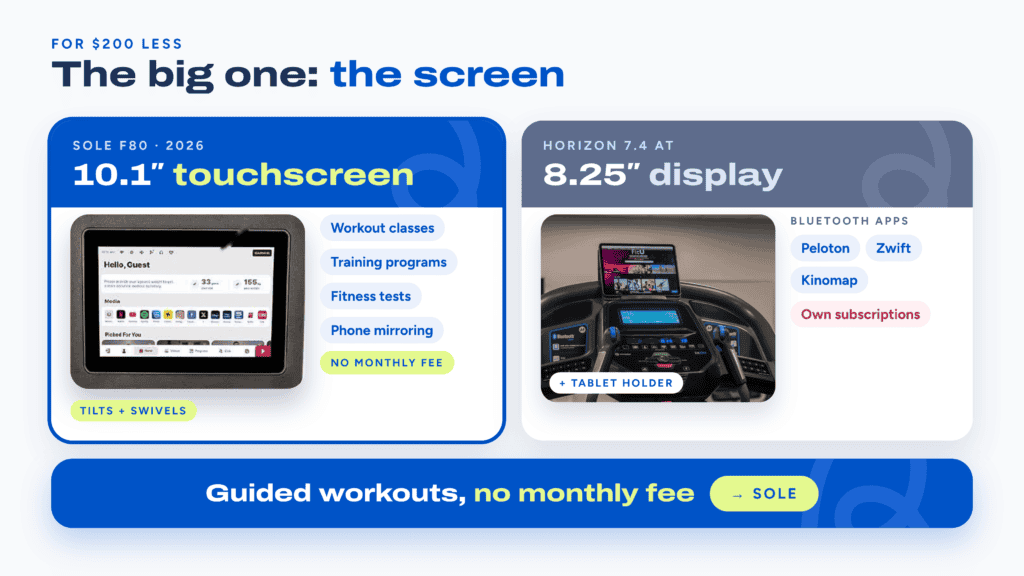
The F80 has a 10.1″ touchscreen that tilts and swivels, with built-in workout classes, training programs and fitness tests. You can even mirror your phone onto it. And Sole’s classes come with no monthly fee.
The Horizon has a simpler 8.25″ display and a tablet holder. It connects by Bluetooth to apps like Peloton, Zwift and Kinomap, but those apps have their own subscriptions. Both treadmills work fine without any app; the difference is only in guided classes.
Trainer’s test: if guided workouts are what keep you consistent and you don’t want another monthly bill, the Sole makes that easy. If you’d rather just press start and run, the screen matters less.
Want a big touchscreen with built-in classes instead? See my Sole F80 vs NordicTrack Commercial 1750 comparison.
About 95 lb lighter
The Sole weighs 223 lb versus 318 lb for the Horizon. That makes it easier to get into your home and to move later if you need to.
Trainer’s test: if it has to go up stairs or you move often, that difference counts.
The price rule
The right pick changes with the price gap, so check today’s prices before you decide.
| Price gap today | My pick | Why |
|---|---|---|
| Same price | Horizon 7.4 AT | Wider deck, continuous-rated motor and longer warranty at no extra cost |
| About $100 or less | Horizon 7.4 AT | You get all three for very little extra |
| The usual $200 or more | Decide by use (see the test below) | The Sole does everything most people need for less |
The 2-question test: Sole F80 or Horizon 7.4 AT?
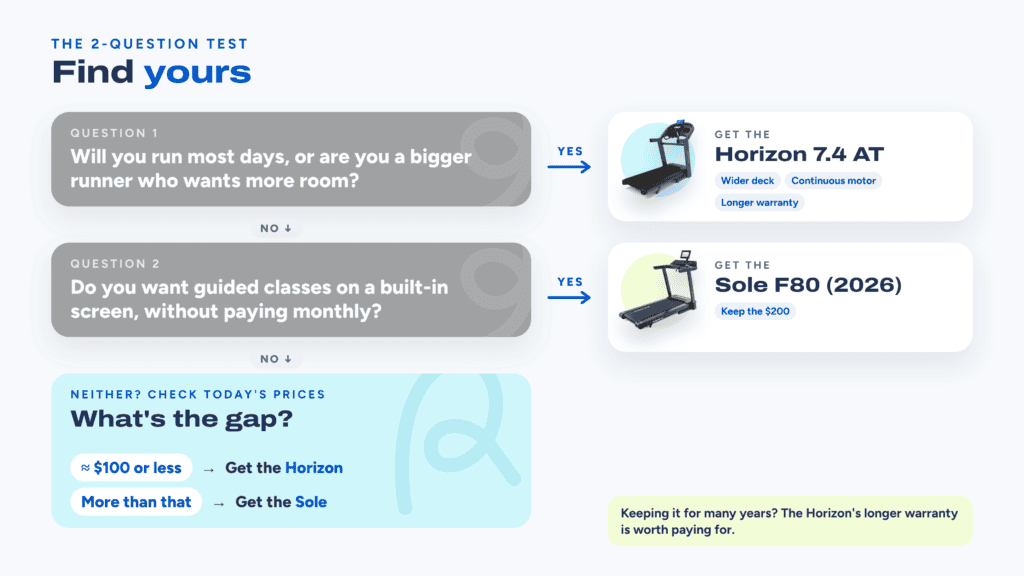
- Will you run most days, or are you a bigger runner who wants more room? If yes, get the Horizon 7.4 AT. The wider deck, the continuous-duty motor, and the longer warranty are worth the extra $200 for you.
- Do you want guided classes on a built-in screen, without paying monthly? If yes, get the Sole F80 and keep the $200.
If neither one really matters to you, check today’s prices. If the gap is about $100 or less, get the Horizon: you’re getting the wider deck, the continuous-duty motor, and the longer warranty for very little extra. If it’s more, the Sole does everything you need for less, unless you plan to keep your treadmill for many years, in which case the Horizon’s longer warranty is worth paying for.
Who should buy which
Sole F80 (2026) is for you if:
- You want guided classes and programs on a built-in screen with no monthly fee
- You’d rather keep the $200
- It has to go upstairs, or you move often (it’s 95 lb lighter)
Skip the Sole if: you’re a bigger runner, run most days, or plan to keep the treadmill for many years.
Horizon 7.4 AT is for you if:
- You run most days or do long runs
- You’re a bigger runner, have a wide stride, or drift at speed
- You want 5 years on parts and 2 years on labor
Skip the Horizon if: you want classes built in without a paid app, or $200 matters more to you than the extras.
If built-in classes are your top priority and you don’t mind a membership, my best NordicTrack treadmills guide covers the iFIT models.
Frequently asked questions
Can the Sole F80 handle running?
Yes. It goes up to 12 mph with a 60″ cushioned deck and suits runners up to about 325 lb. The Horizon is the better pick only if you run most days, need more width, or want the longer warranty.
Is the Horizon 7.4 AT worth $200 more?
It is if you’ll use what the money buys: a 22″ deck instead of 20″, a continuous-rated 3.5 CHP motor, and 5 years on parts instead of 3. If the gap shrinks to about $100, it’s worth it for almost everyone.
Do I need a subscription for either treadmill?
No. Both work without one, with built-in programs. The Sole’s built-in classes come with no monthly fee. On the Horizon, guided classes come from apps like Peloton, Zwift or Kinomap, which charge their own subscriptions.
What’s the weight limit?
Both are rated for 350 lb. For running, I’d keep users to about 325 lb on either one.
Which one takes up less space?
They’re close when set up: 77″ × 36″ for the Sole, 76″ × 37″ for the Horizon. Folded, the Horizon is shorter in length (42″ vs 48″) but taller (71″ vs 66″).
Which has the better warranty?
The Horizon. Both cover the frame and motor for life, but the Horizon covers parts for 5 years and labor for 2, versus 3 years and 1 year on the Sole.
Final verdict
At the usual $200 gap, both are good buys, and how you’ll use it decides. If you run most days or you’re a bigger runner who wants room, buy the Horizon 7.4 AT. If you want guided classes on a built-in screen without paying monthly, buy the Sole F80 and keep the $200. And if the gap ever drops to about $100, get the Horizon.
Still not sure? Tell me in the comments how often you run and what you weigh, and I’ll tell you which one I’d pick.