
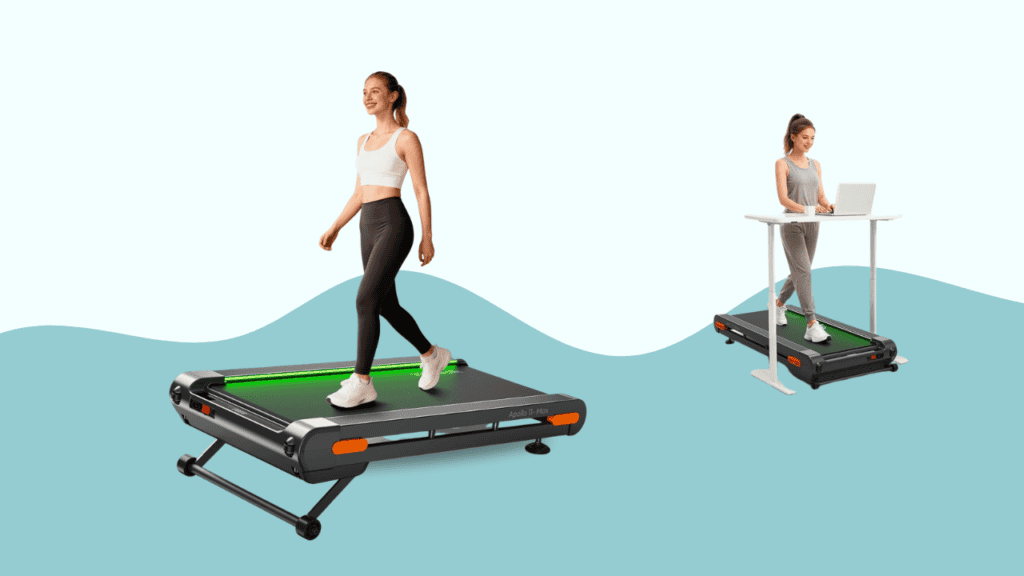
Most walking pads that offer incline at all top out around 10 to 12%. As a personal trainer, incline is usually the first spec I check, because it’s the difference between a walking pad that helps someone keep making fitness progress and one that just counts steps. The Vitalwalk Apollo 11 Max claims a 20% auto incline — nearly double what most competitors offer — along with a 5-year frame warranty in a category where 1 year is the norm.
In this review, we break down the official specs, verify the claims that hold up against named competitors, and call out the one marketing number that doesn’t.
At a Glance: Vitalwalk Apollo 11 Max Review
| Motor | 3.5 HP, brushless, hidden-motor design |
| Top Speed | 5 mph (0.6 mph minimum) |
| Auto Incline | 20%, 20 adjustable levels |
| Weight Capacity | 400 lbs |
| Frame Weight | 74 lbs |
| Deck Size | 43″ x 18″ |
| Noise Level | ~35 dB (manufacturer-rated) |
| Warranty | 5 years (frame), 2 years (motor), lifetime tech assistance |
| Connectivity | Vitalwalk app, FitShow, Zwift; syncs to Apple Health & Strava |
Pros and Cons of Vitalwalk Apollo 11 Max
Build Quality and Motor
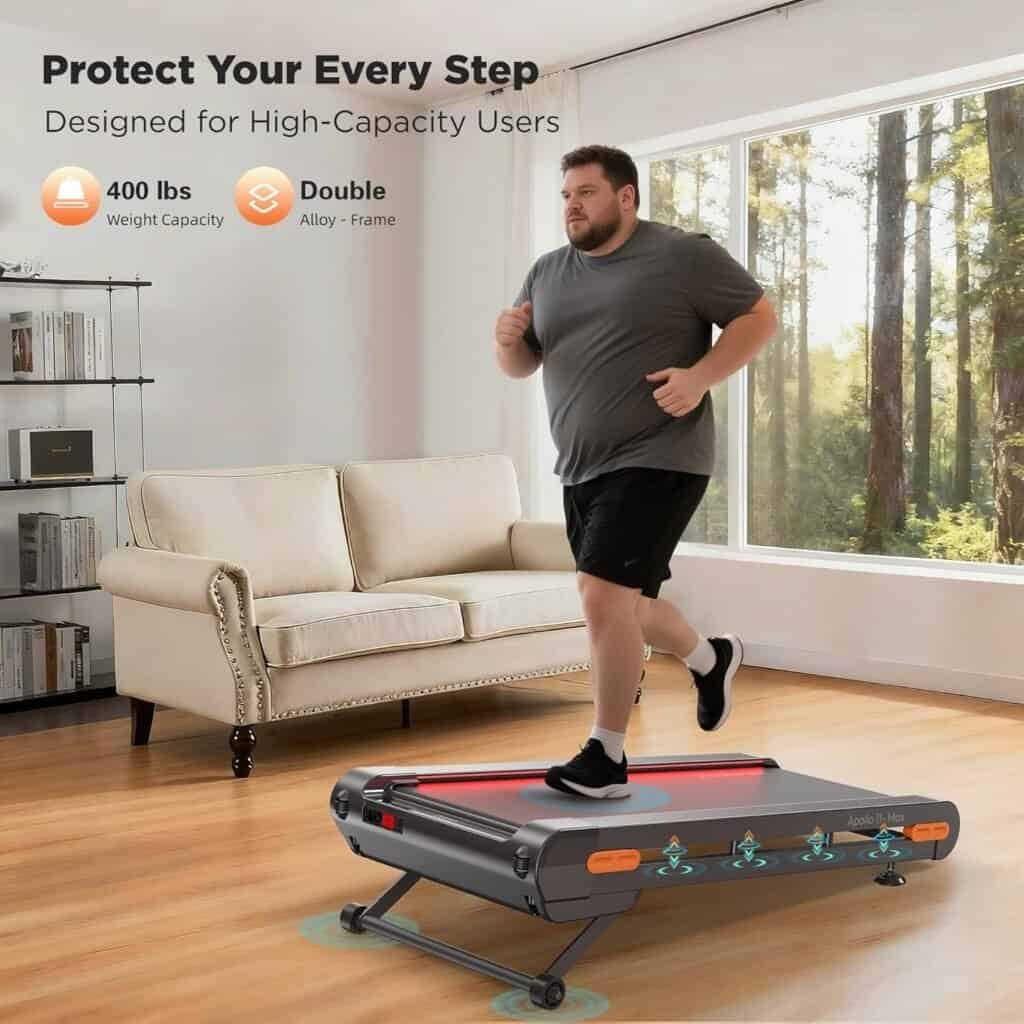
The Apollo 11 Max runs a 3.5 horsepower brushless motor rated for up to 8 hours of continuous use — a notably higher sustained-use rating than most walking pads in this category are built for. Vitalwalk uses a full-deck, belt-to-body design with the motor hidden inside the frame rather than housed in a bulky front hump, which is what allows for the larger deck covered in the next section.
Top speed is 5 mph, with a range down to 0.6 mph. That stretches into light-jogging pace for some users, though it’s still best classified as a walking-focused machine rather than a running-treadmill replacement — dedicated runners should look elsewhere.
The 20% Auto Incline: How It Actually Compares
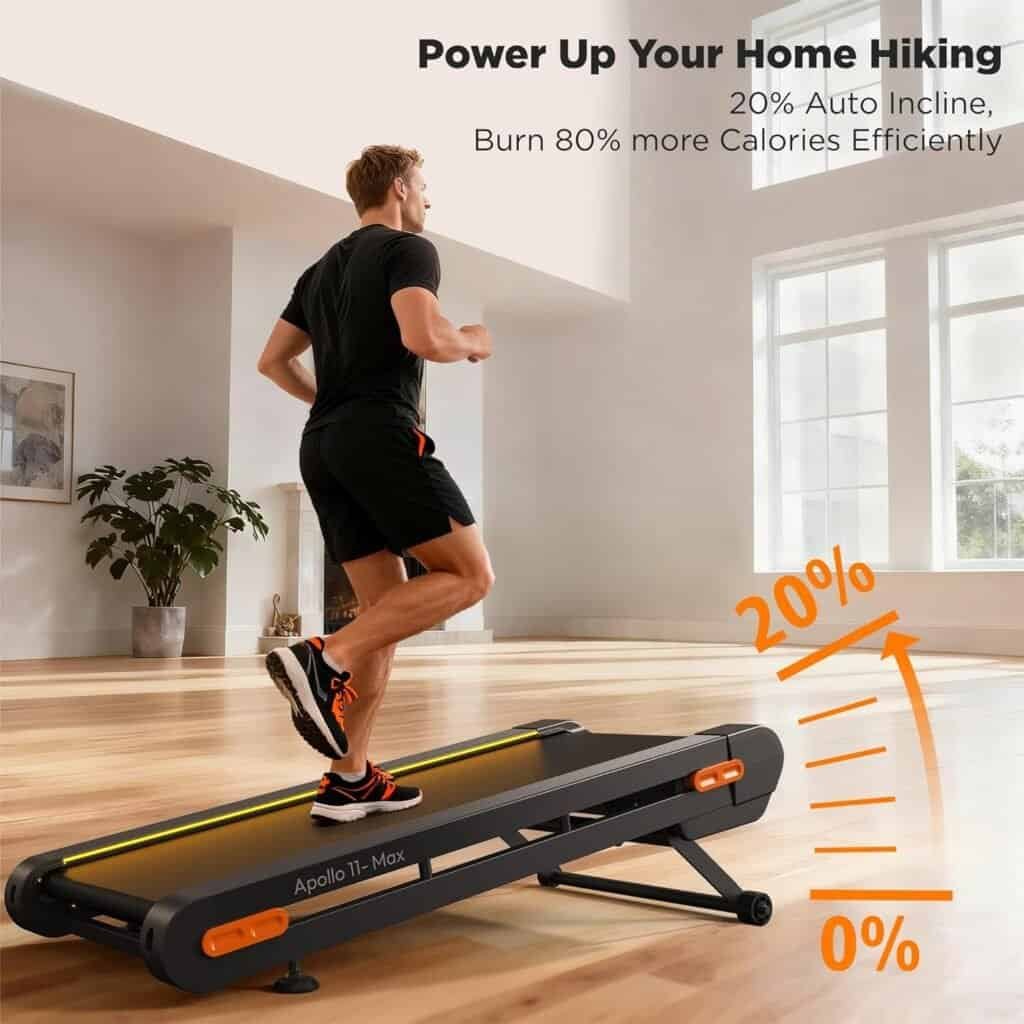
This is the Apollo 11 Max’s headline feature, and it holds up under scrutiny. We checked it directly against two named competitors: the MERACH UltraWalk W60 Plus, which tops out at 12%, and the UREVO CyberPad Office, which reaches 14%. At 20% across 20 adjustable levels, the Apollo 11 Max is meaningfully ahead of both — this isn’t a marketing exaggeration; it’s a verifiable spec advantage.
From a training standpoint, incline range matters more than most buyers realize. Incline walking activates the glutes and calves significantly more than flat walking, raises heart rate faster, and increases calorie burn without adding the joint impact of running — which is exactly why it’s often the tool that helps a client break past a plateau on a flat walking pad, especially for anyone managing joint issues or returning from injury.
One claim worth correcting: Vitalwalk markets this incline as capable of burning up to 480 calories in a 10-minute session. That works out to 48 calories per minute. To put that in perspective, using the ACSM metabolic equation for walking energy expenditure, an 80 kg (176 lb) person walking at 2 mph on a 20% grade burns roughly 11 calories per minute; at 3 mph on the same grade, that rises to roughly 16 calories per minute. Heavier individuals burn somewhat more at the same pace, and faster paces push the number higher still.
A realistic real-world range at max incline is roughly 10 to 20 calories per minute, depending on body weight and speed. This equation is generally cited as reasonably accurate up to somewhere around a 20–25% grade, per published summaries of ACSM’s methodology, so applying it at this pad’s 20% max incline is a fair estimate rather than a lab measurement. Either way, that’s nowhere near 48 calories per minute. The incline range itself is genuinely impressive and verified against real competitors; this specific calorie figure isn’t.
A Trainer’s Take: How to Use 20% Incline Safely
A spec sheet won’t tell you this, but it matters: the Apollo 11 Max, like most walking pads, has no handrails. That’s fine at a flat or gentle incline, but at max incline, balance mechanics change — your center of gravity shifts forward, and it’s common to instinctively reach for the edge of a desk for support. That’s not necessarily dangerous, but it does change your gait and reduces the actual training benefit, since you’re now offloading some of your bodyweight onto your arms instead of your legs. If you find yourself needing to hold onto something at a given incline level, that’s a sign to dial the incline back, not push through it.
Most users should not start anywhere near max incline. A reasonable progression looks like starting around 3–5% for your first week or two, then increasing incline in small increments — roughly 2–3% every few sessions — as your calves, ankles, and balance adapt. Jumping straight to steep grades is one of the more common ways people end up with calf tightness or Achilles strain, since incline walking loads the calf and Achilles tendon considerably more than flat walking, and that tissue needs time to adapt to new demands.
A few groups should get clearance from a doctor or physical therapist before using steep incline settings at all: anyone with a history of Achilles tendinopathy, plantar fasciitis, or lower back issues, since incline walking changes loading patterns on all three in ways that can aggravate an existing issue if introduced too aggressively. If that describes you, flat walking or a very gradual incline introduction — well below this pad’s max setting — is the safer starting point.
Deck Size, Stability, and Cushioning
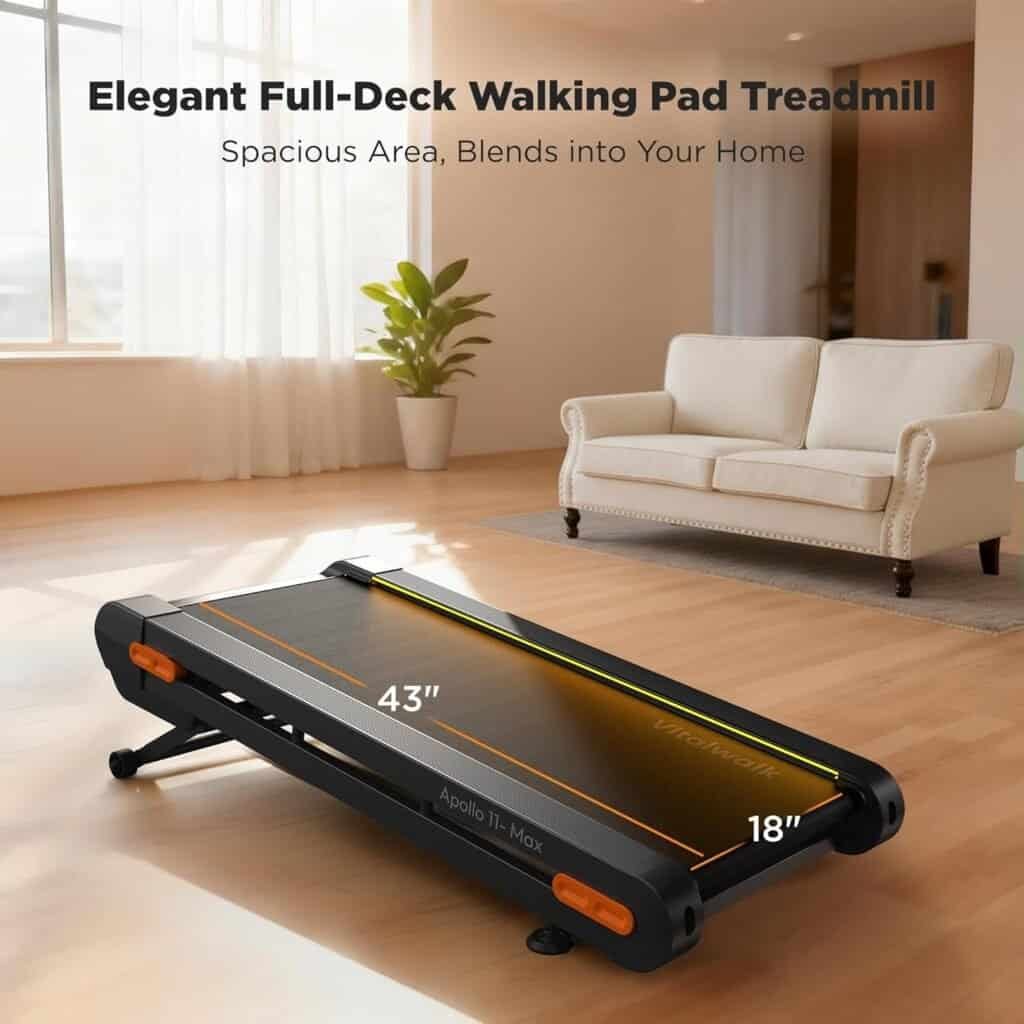
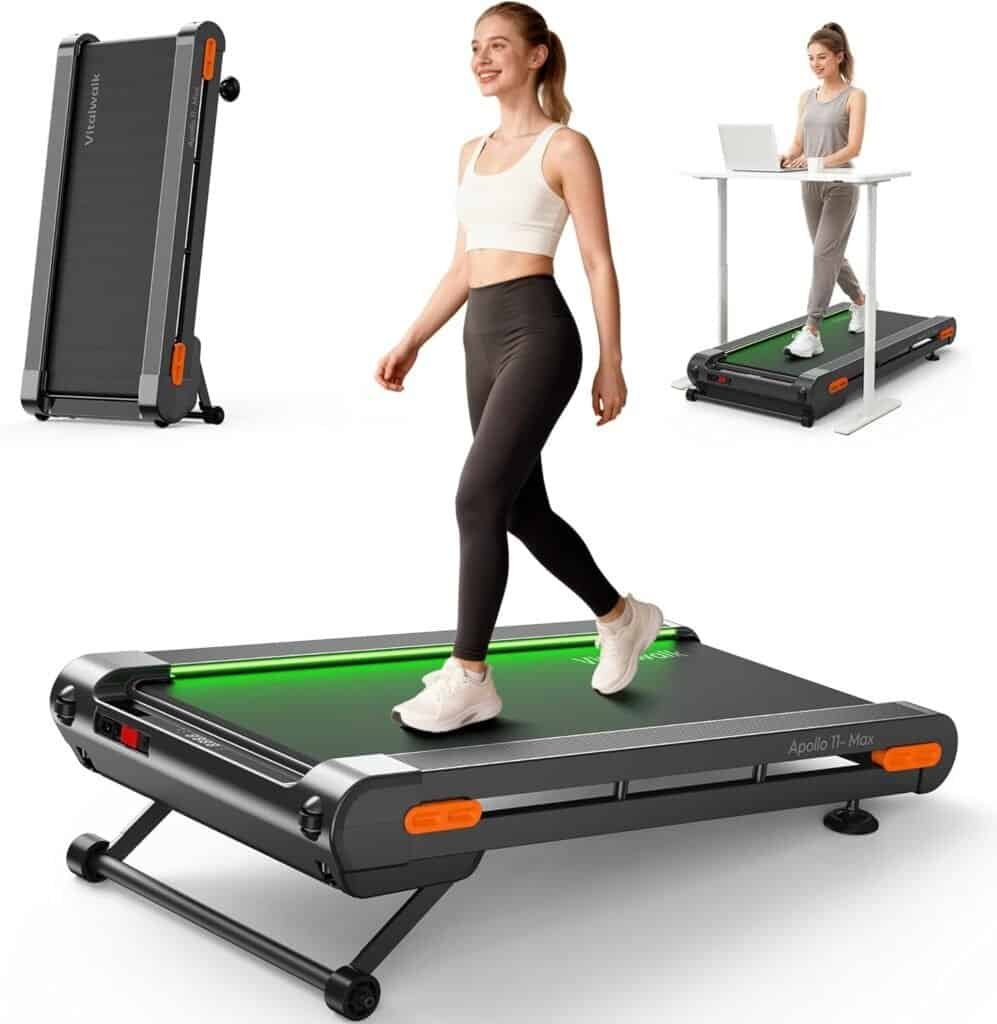
The deck measures 43″ x 18″, noticeably wider than the roughly 16″ to 16.5″ width common on competing pads, including both the MERACH and UREVO models referenced above. That extra width matters most for taller users or anyone who’s felt cramped on a narrower deck before. It folds to store vertically in about 2.1 square feet with four wheels, small enough to tuck under a bed or sofa.
The frame is rated for 400 lbs on a double-alloy, reinforced steel structure. Vitalwalk states the frame has undergone over 200,000 impact tests and claims that’s double the industry standard — that’s the manufacturer’s own testing claim rather than an independently verified figure, but the 400-lb capacity itself is a real, meaningful number for larger users.
One detail that’s easy to miss on a spec sheet: this isn’t a rigid deck. It uses an 8-point shock-cushioning array with four exposed rubber dampening columns, designed to reduce knee and ankle impact with every step — a feature most budget walking pads skip entirely.
Noise Level and Smart Features
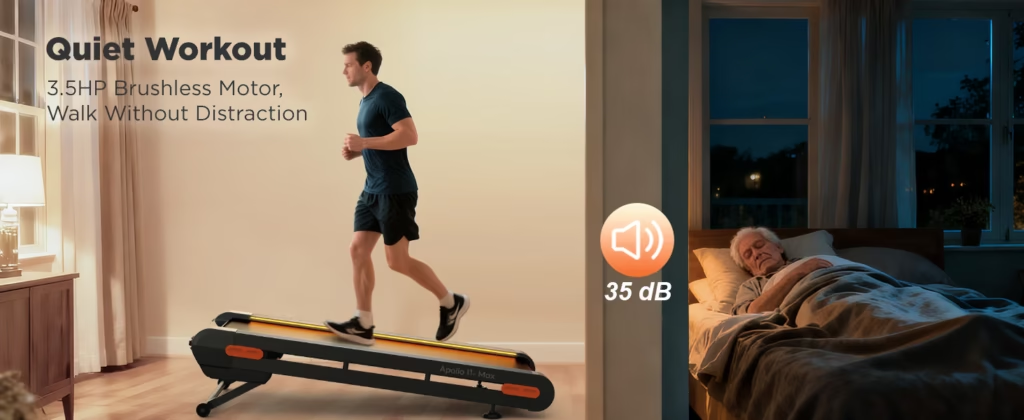
Vitalwalk rates the Apollo 11 Max at approximately 35 decibels, close to library-quiet, with a dedicated mute button that silences workout beeps during calls. As always, treat manufacturer decibel ratings as best-case numbers — actual noise depends on your flooring, and it tends to rise somewhat at higher incline levels as the motor works harder.
On the smart-features side, it connects to the Vitalwalk app with FitShow and Zwift compatibility, syncing to Apple Health and Strava. A speed-sensing ambient light shifts between green, orange, and red based on workout intensity, and a 15-second auto-pause halts the belt when no one’s detected — a genuine safety feature around kids or pets, not just a gimmick.
Warranty: The Real Standout
This might be the most underrated part of the Apollo 11 Max. It ships with a 5-year warranty on the frame and 2 years on the motor, plus lifetime technical assistance through Amazon’s seller contact system. For comparison, the MERACH UltraWalk W60 Plus offers 2 years (extending from a 1-year base with registration), and the UREVO CyberPad Office offers 1.5 years with registration. A 5-year frame warranty is genuinely rare in this category, where many competing brands default to just 1 year of base coverage.
If you’re evaluating this as a long-term piece of equipment rather than something you expect to replace in a year or two, this warranty structure is one of the strongest arguments in the Apollo 11 Max’s favor.
Where It Falls Short
To keep this balanced, a few things worth knowing before buying:
At $539, this sits well above entry-level walking pads, so it isn’t the choice for anyone who just wants the cheapest flat pad. The 5 mph top speed, while higher than most competitors, still isn’t built for serious or sustained running. And at 74 lbs, moving it between rooms solo on a regular basis is a workout in itself.
It’s also worth checking owner feedback directly before buying: some buyers have reported units developing motor noise — squeaking or scratching sounds — within the first few days of use, along with friction navigating Amazon’s return process on defective units. This doesn’t appear to be the norm based on the volume of feedback available, but it’s a real, reported risk, and buying through a retailer with an easy return policy is a reasonable precaution regardless of which walking pad you choose.
Who Should Buy the Vitalwalk Apollo 11 Max?
From a training perspective, this walking pad makes the most sense for people who want walking to genuinely contribute to a fitness goal — not just background movement during the workday.
This is a strong fit if you:
- Want incline training for calorie burn and glute/calf activation without buying a full treadmill
- Value joint-friendly cushioning, particularly if you’re managing knee or ankle sensitivity
- Are shopping for a long-term investment rather than a disposable purchase
- Have limited space and want a unit that stores vertically
Consider a different option if you:
- Need a dedicated running treadmill — the 5 mph cap rules this out
- Want the lowest possible price point
- Need something lightweight to move between rooms frequently
Frequently Asked Questions
What incline does the Vitalwalk Apollo 11 Max offer?
Up to 20%, across 20 adjustable levels — notably higher than competitors like the MERACH UltraWalk W60 Plus (12%) and UREVO CyberPad Office (14%).
Is the Vitalwalk Apollo 11 Max good for running?
No. Its top speed is 5 mph, which stretches into a light-jogging pace for some users but isn’t built for sustained running. Buyers who want to run should look at a dedicated treadmill instead.
How much weight can the Vitalwalk Apollo 11 Max hold?
It’s rated for up to 400 lbs on a reinforced double-alloy steel frame.
What warranty does the Vitalwalk Apollo 11 Max come with?
It includes a 5-year warranty on the frame and 2 years on the motor, plus lifetime technical assistance — longer than most competing walking pads, which commonly default to 1 to 2 years.
Does the Vitalwalk Apollo 11 Max really burn 480 calories in 10 minutes?
That’s Vitalwalk’s own marketing claim, and it doesn’t hold up to scrutiny. 480 calories in 10 minutes works out to 48 calories per minute — using the standard ACSM walking metabolic equation, a realistic range at max incline is roughly 10 to 20 calories per minute, depending on body weight and speed. Treat Vitalwalk’s specific number as marketing rather than a realistic expectation.
Is it safe to use the Apollo 11 Max at max incline?
It can be, but not from day one. Since it has no handrails, most users should start around 3–5% incline and increase gradually over several sessions rather than jumping to 20% right away, which helps avoid calf and Achilles strain. Anyone with a history of Achilles, plantar fascia, or lower back issues should get clearance from a doctor or physical therapist before using steep incline settings.
Final Verdict
The Vitalwalk Apollo 11 Max earns its price with three verifiable strengths: a 20% incline range that beats named competitors, a 5-year frame warranty that’s rare in this category, and a wider, more cushioned deck than most alternatives. The one asterisk is its calorie-burn marketing claim, which is best ignored entirely. Viewed as a long-term investment rather than a disposable purchase, it holds up especially well against buying a full-size treadmill just for walking and incline training.


