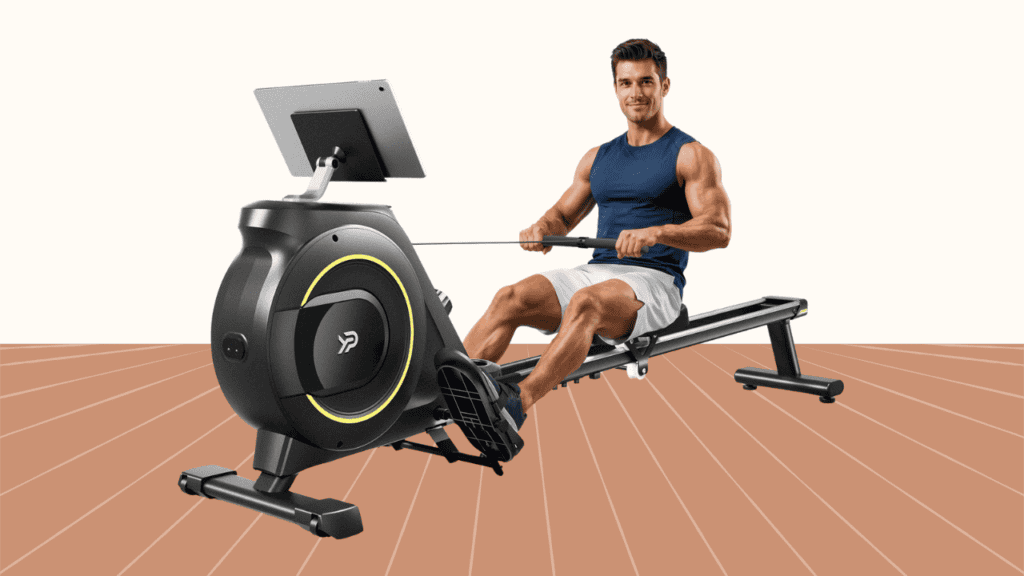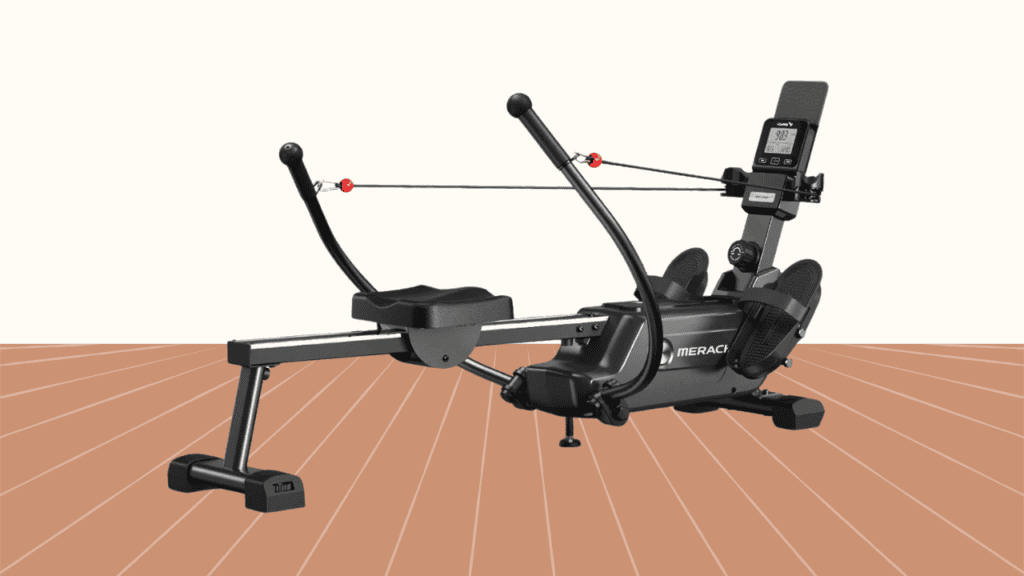
Most rowing machines move one way: pull straight back, push straight forward, repeat. The Merach RS3 doesn’t. It’s built around a scull-style motion — your arms pull outward at a 120-degree angle instead of straight back, closer to how competitive scullers actually row.
I’m a NASM-certified personal trainer, and that mechanical detail is what made me want to dig into this machine rather than skip past it as another budget rower. Arm path changes which muscles do the work, not just how hard a workout feels — and that’s an unusual design choice for a machine priced under $350.
This review is a trainer’s analysis of the RS3’s mechanics, specs, and design trade-offs, based on the manufacturer’s engineering and specifications rather than my own time on the machine, so you know exactly what you’re getting from it.
Watch: Merach RS3 Review
Quick Take: Merach RS3 Scull Rowing Machine
Best for: Lifters and rowers who want real upper-back and rear-delt engagement, apartment dwellers who need quiet equipment, anyone who wants magnetic resistance without paying premium-rower prices.
Not ideal for: Anyone who wants a fold-flat machine for tight storage, or app-based coaching as a permanent, ongoing feature.
Why the Scull Motion Actually Matters
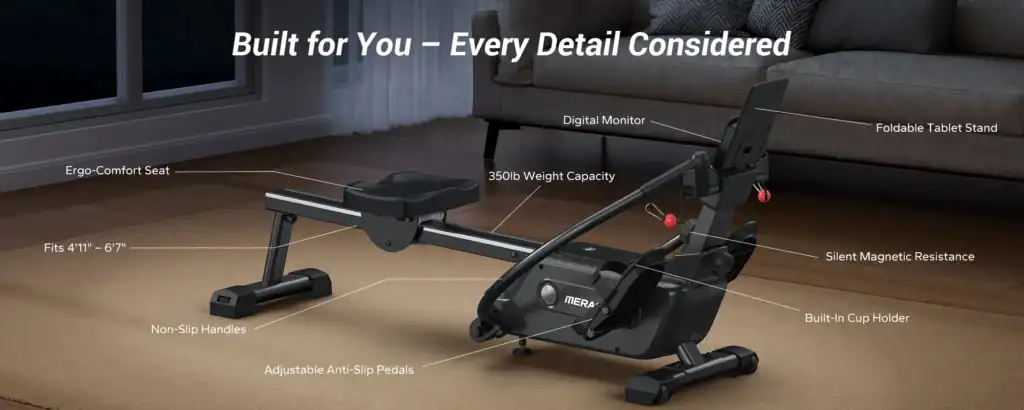
A standard rower pulls your arms straight into your chest, mostly loading the lats and biceps in a narrow, repetitive path. The RS3’s outward arm motion opens the chest at the top of the stroke, which brings the rear delts, rhomboids, and upper back into the movement in a way a straight-pull rower simply doesn’t reach.
From a training standpoint, that matters beyond just variety — rear-delt and rhomboid work is exactly what most desk-bound lifters are missing, and it’s a common weak point behind rounded-shoulder posture. A machine that builds that in by default, rather than requiring a separate accessory movement, is doing double duty.
It also supports three distinct stroke patterns — one-arm rows, alternating strokes, and synchronized dual-arm pulls — so a session doesn’t lock you into one repetitive motion for 30 straight minutes.
Some rowers solve the “beyond a straight pull” problem differently, with adjustable grip width instead of a fixed outward angle. That’s a trade-off, not a flaw on either side — but the RS3’s approach is closer to how scullers actually train on the water, and it’s a genuine mechanical distinction, not a marketing angle.
Worth knowing: if you’ve used a standard rower before, this will feel different at first. The outward angle isn’t hard to learn, but it is a different muscle-memory pattern, so don’t expect it to feel instantly familiar just because you’ve rowed before.
Resistance and Noise
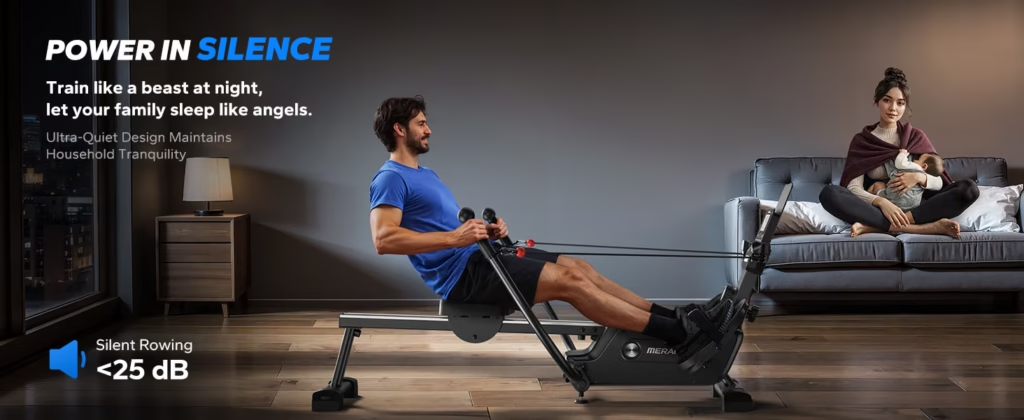
The RS3 uses magnetic resistance instead of hydraulic pistons — the more meaningful spec upgrade here. Hydraulic rowers, common at this price point, tend to feel inconsistent stroke to stroke and lose resistance as the pistons wear down. Magnetic resistance stays consistent throughout the stroke and doesn’t degrade the same way over time.
It goes up to 80 pounds of resistance across 16 adjustable levels — wide enough to take a beginner from an easy warm-up to a genuinely difficult session without needing to upgrade machines later. It also runs under 25 decibels, quiet enough for an early morning session in an apartment or shared space.
One caveat: manufacturer resistance and noise figures are measured under controlled conditions, so real-world feel can vary slightly from machine to machine.
App and Content

It connects over Bluetooth to the MERACH app, unlocking over 1,000 workouts plus six months of premium membership with purchase — coach-designed programs and structured plans, not just a library of random videos. That access is free for six months only; after that, staying on the paid tier is a recurring cost that isn’t part of the sticker price, worth factoring in if the app content is a big part of the appeal.
Build, Monitor, and Setup
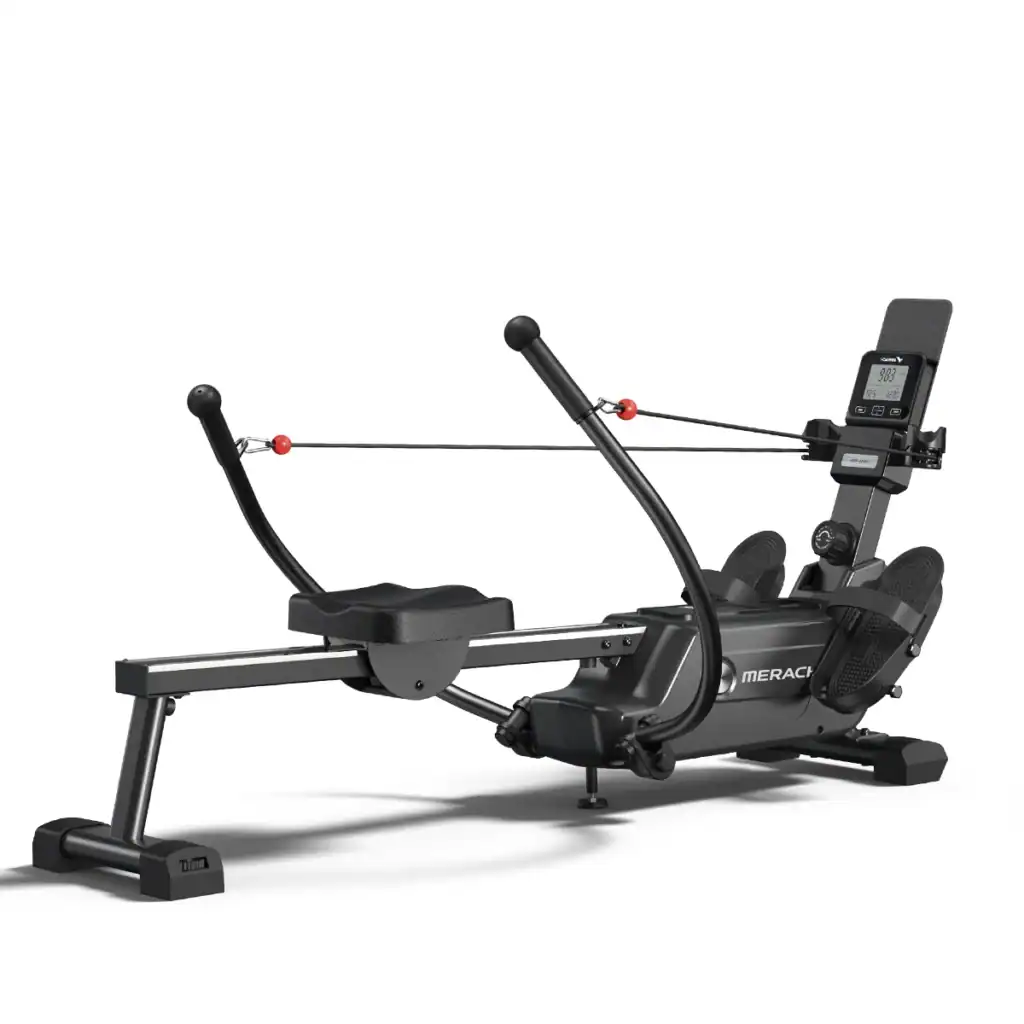
The RS3 ships 85% pre-assembled, with Merach quoting about 20 minutes to finish setup — reasonable for a category where full assembly is often the worst part of unboxing. The performance monitor is a basic LCD screen tracking calories, distance, speed, stroke count, and time, powered by two AAA batteries rather than rechargeable. It’s functional but not a touchscreen — if you’re picturing a Peloton-style display, you’ll likely lean on the phone app for anything more visual than raw numbers.
Size and Who It’s For
At 60.6 inches long, 29.5 inches wide, and rated for users up to 6’4″ and 350 pounds, the RS3 is built for a genuine range of body types, not just smaller apartment users. That 6’4″ rating isn’t just a weight-capacity number — at that height, a rower with a short slide rail can cut your stroke short mid-pull. The RS3’s listed dimensions suggest enough rail length to avoid that, though it’s worth confirming against feedback from taller users before buying.
The spec sheet doesn’t mention a fold-flat storage design, so budget a dedicated footprint of roughly five feet if space is tight.
Warranty and Price
Merach backs the RS3 with a 12-month warranty — standard for the category, but on the shorter end, since some competitors in this price range offer two years. At its typical selling price, it undercuts many premium magnetic-resistance rowers (some of which run $400 and up) while beating a number of budget magnetic rowers on resistance levels and top-end tension. That gap is the RS3’s core pitch: magnetic resistance and a scull-style motion, at a price closer to a hydraulic rower than a premium one.
Pros and Cons: Merach RS3 Scull Rower
Who Should Skip This Rower
If you specifically want a flat-storage machine that disappears into a closet between sessions, this isn’t it. If ongoing app-based coaching matters to you as a permanent feature, factor in the cost after the six-month free window before committing. And if you’ve never used a rower before and want the most familiar, straight-pull motion to start, the scull angle’s learning curve — while not steep — is a real adjustment.
Frequently Asked Question
Is the Merach RS3 good for beginners?
Yes, though the scull motion is a different pattern than a standard straight-pull rower. It’s not hard to learn, but give yourself a few sessions to adjust if you’ve used a different machine before.
Is magnetic resistance better than hydraulic for a rowing machine?
Generally yes, for consistency. Magnetic resistance holds steady throughout the stroke and doesn’t degrade with wear the way hydraulic pistons can.
Does the Merach RS3 fold flat for storage?
No — budget a dedicated footprint of roughly five feet.
Is the MERACH app subscription required to use the RS3?
No, the machine works without it, but the LCD monitor is basic. The app is free for six months before becoming a recurring cost.
Final Verdict
The RS3 isn’t trying to be a premium rowing machine — the 12-month warranty and basic LCD monitor make that clear. But the spec that matters most on any rowing machine — how resistance feels stroke to stroke — is handled by real magnetic resistance instead of the hydraulic systems most rowers at this price settle for. And as a trainer, the scull motion is the detail I’d point clients toward: it’s a legitimate mechanical difference that changes which muscles you’re training, not just a spec for a product page.
Based on the engineering and specs, this is a rowing machine worth serious consideration if the scull motion and multiple stroke patterns are something you’d actually use — not a spec you’d try once and ignore.