Most rowing machines under $200 use hydraulic pistons, not magnetic resistance — that’s just where the price point usually lands you. As a certified trainer, that distinction matters more to me than most spec-sheet numbers, because resistance type affects stroke consistency and how a workout feels in your joints over repeated sessions, more than resistance level does.
So when I saw a fully magnetic rower at $199, I wanted to actually pull apart whether the rest of the machine holds up, or whether the resistance system is the only thing worth talking about.
Quick Verdict: YPOO Rowing Machine Review
Best for: Apartment dwellers, early-morning rowers, and anyone who wants real magnetic resistance without paying $270+.
Not ideal for: Anyone who wants app-based coaching as a core feature, or a flat (zero-incline) rowing stroke.
Our rating: A strong value pick in the sub-$200 category, with two real trade-offs (see below).
YPOO vs. Sunny Health & Fitness SF-RW522016
The most common comparison shoppers make in this price range is against the Sunny SF-RW522016, a well-known magnetic rower built on Sunny’s popular SF-RW5515 platform. Its price has moved around noticeably across retailers and over time — recent listings put it anywhere from roughly $270 to $315+ — so treat the number below as a ballpark rather than gospel, and check current pricing on both machines yourself before buying.
| YPOO (~$199) | Sunny SF-RW522016 (~$270–$315) | |
|---|---|---|
| Resistance Type | Magnetic | Magnetic |
| Resistance Levels | 16 | 8 |
| Max User Weight | 350 lb | 250 lb |
| Slide Rail | 46″ | 53.4″ |
| Monitor Tracks | Time, SPM, distance, calories, stroke count | Time, count, total count, calories |
| Incline | 6.5% (fixed) | Not listed |
| Noise Level | Under 25 dB | Not published |
| Check Price | Check Price → | Check Price → |
Even with the Sunny’s price moving around, the YPOO consistently comes in cheaper while offering double the resistance levels and a higher weight capacity. That spread holds up across the range, not just at one price snapshot.
Resistance and Noise: The Actual Standout
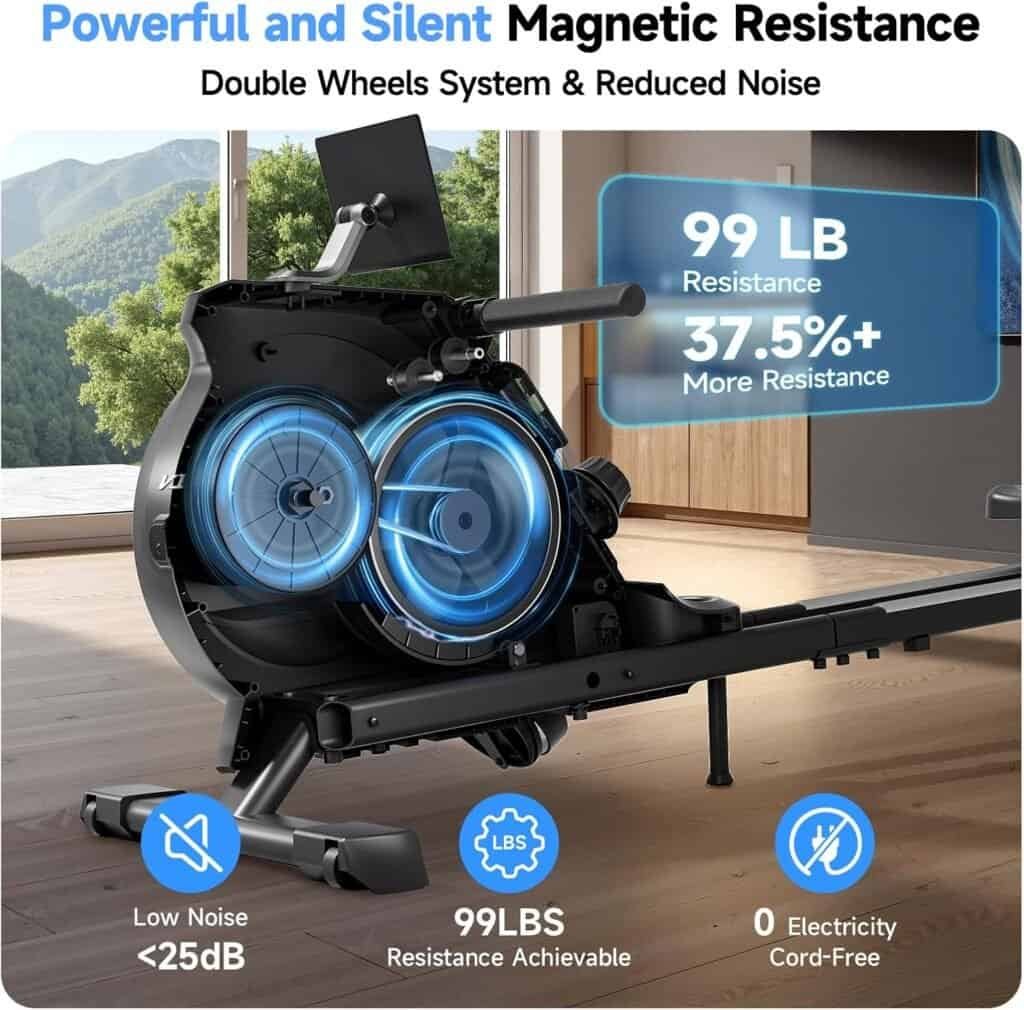
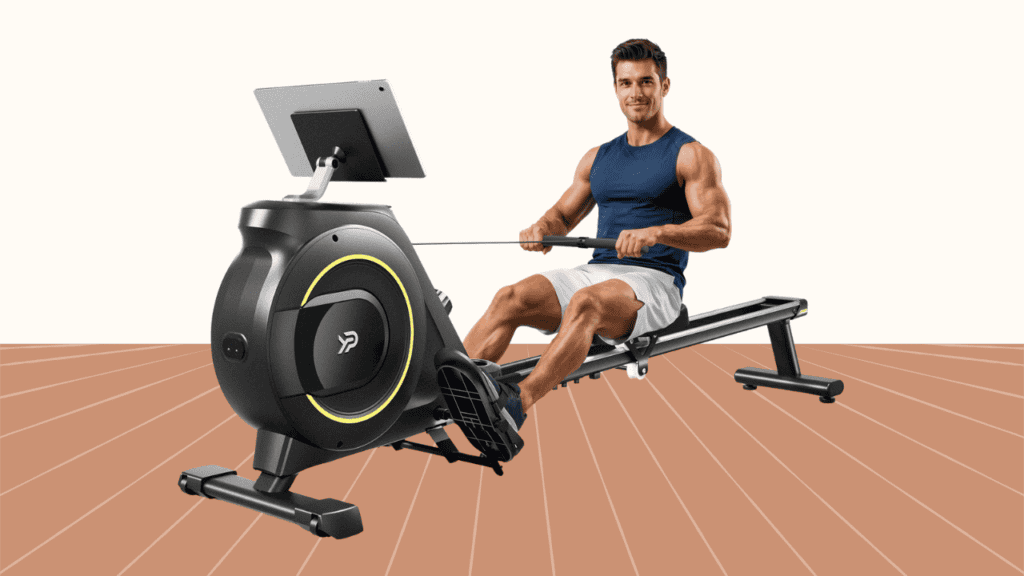
The YPOO’s magnetic system offers 16 adjustable resistance levels, topping out around 99 lbs of resistance, and runs under 25 decibels.
As a trainer, this is the detail I care about most: magnetic resistance delivers a smooth, consistent pull through the entire stroke, which many rowers find easier on the joints during higher-volume sessions compared to hydraulic pistons, which tend to feel jerkier at the catch and finish.
That’s a reasonable expectation based on how the two systems work mechanically — not a clinical claim, so if you have an existing joint condition, that’s a conversation for your doctor or physical therapist, not a rowing machine review.
The sub-25dB rating also means this is realistically usable at 5 a.m. in an apartment without disturbing anyone else — a small thing, but it’s often the difference between a habit that sticks and one that quietly stops.
One honest caveat: manufacturer resistance and noise figures are measured under controlled conditions, so your real-world experience may vary slightly.
Related: How to Know if Your Muscles are Growing (Not Fat)?
Build Quality and Comfort
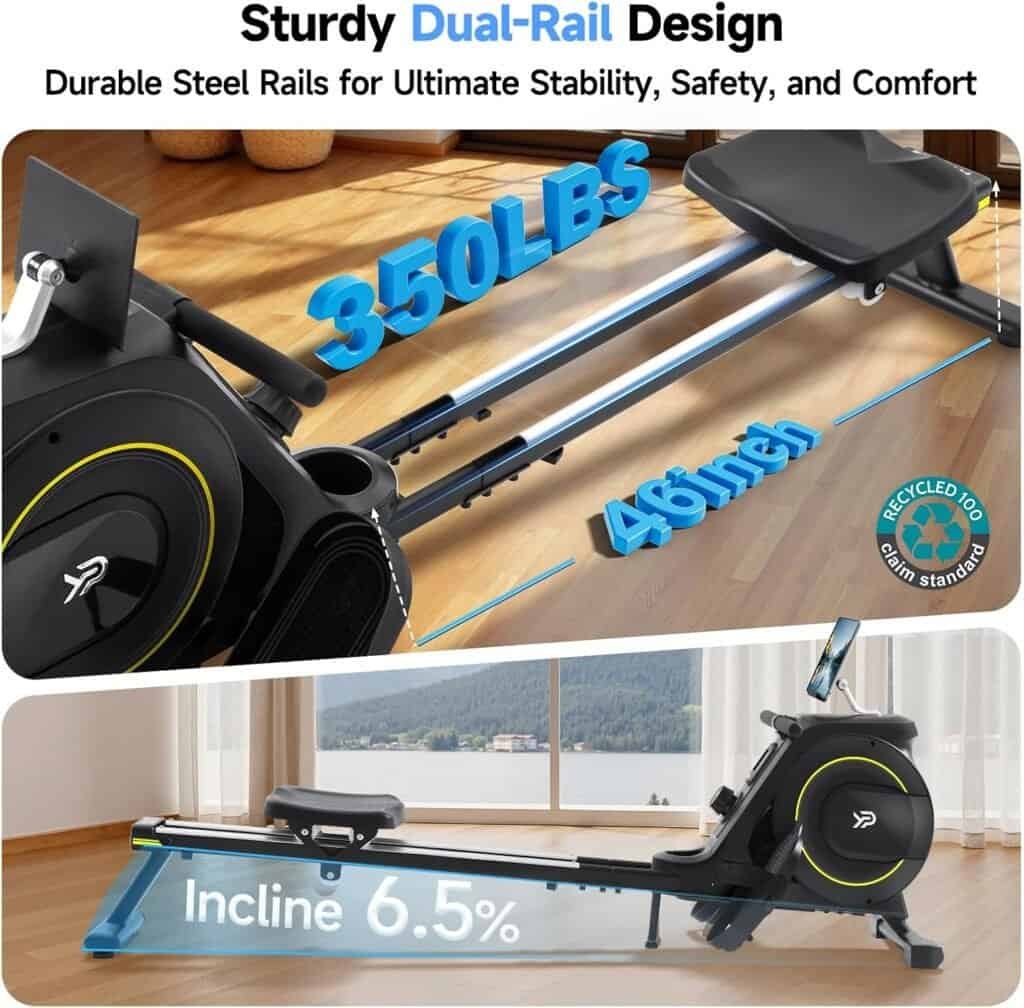
The frame is steel-built and rated for up to 350 lbs, with a 46-inch dual slide rail designed to fit users from 4’5″ to 6’3″. That’s a wider accommodation range on the shorter end than most compact rowers bother with — a detail I’d flag for shorter users specifically, since a cramped stroke length is one of the most common, and most avoidable, form issues on budget rowers.
Round that out with a firm seat, a non-slip grip handle, adjustable foot straps, and a built-in bottle holder — none of these are flashy, but they’re the details that matter three weeks in, not on day one.
The 6.5% Incline: A Real Differentiator, With a Trade-Off
This is the feature that actually separates the YPOO from a typical budget rower: a 6.5% incline built directly into the frame. Instead of a flat pull, you’re rowing slightly uphill, which adds resistance through the entire stroke instead of relying on the tension dial alone.
And from a coaching perspective, this naturally reinforces a full-body pull (legs, core, then arms) instead of letting form break down into an arm-dominant row, which is a common technique drift I see on flat-frame machines as people fatigue.
The trade-off: that incline is fixed. There’s no way to row flat on this machine. If a zero-incline stroke is a hard requirement for you, this isn’t the right rower.
Display, App, and What’s Unclear
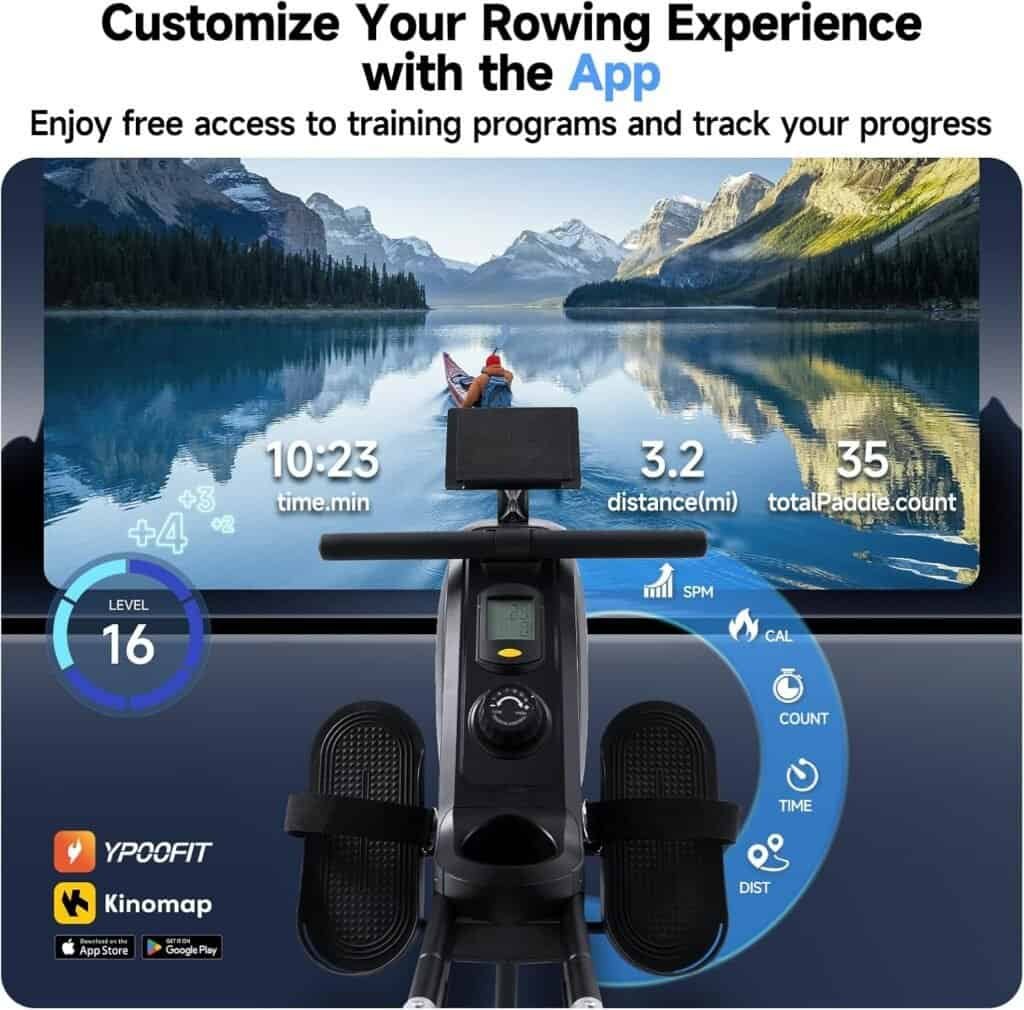
The LCD monitor tracks time, strokes per minute, distance, calories, and stroke count — everything you actually need mid-workout. It also pairs with the YPOOFIT and Kinomap apps for guided training.
What YPOO doesn’t specify: whether either app requires a paid subscription. That’s a real gap next to the competition — Sunny’s SF-RW522016 comes bundled with its SunnyFit app, which Sunny states outright is free with no subscription or hidden fees.
If app-based coaching is a big part of why you’re considering this machine, confirm current YPOOFIT and Kinomap pricing before you buy — don’t assume it’s free just because Sunny’s is.
Space-Saving Design
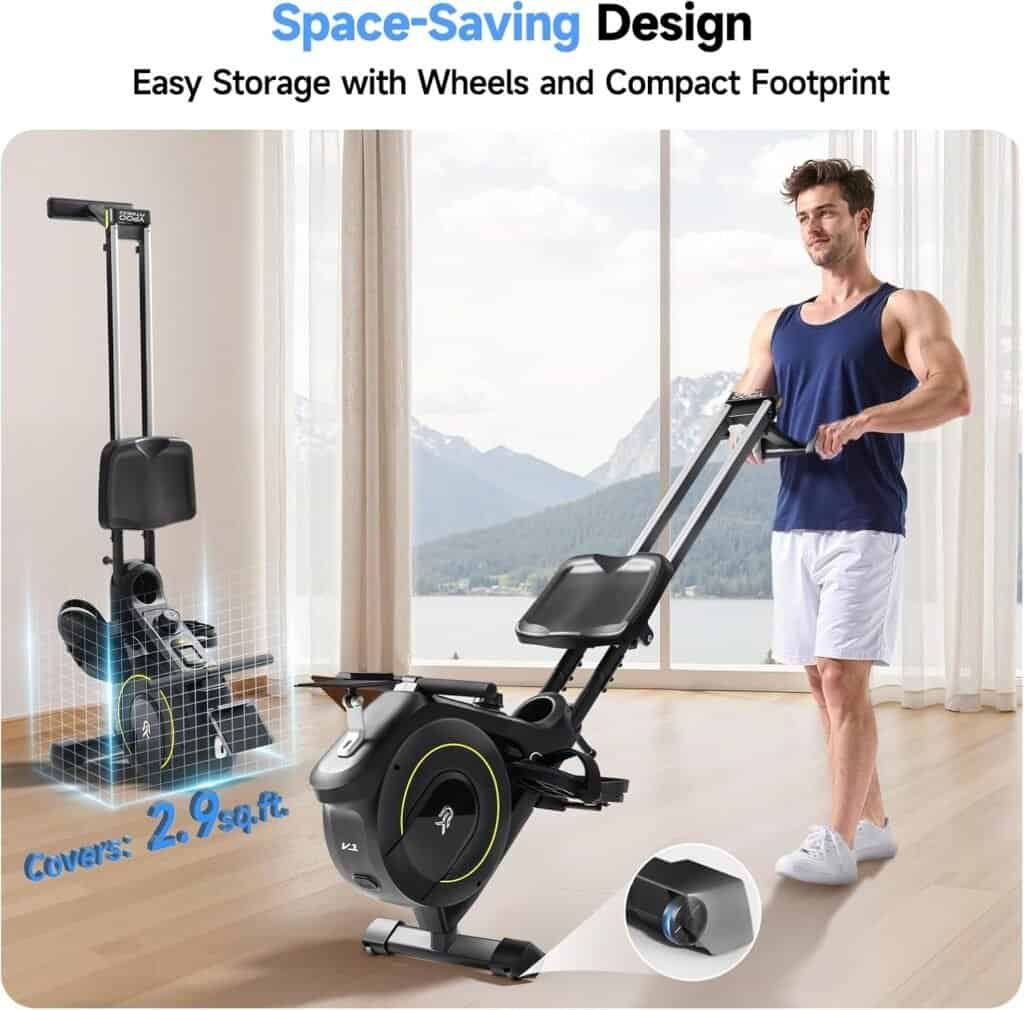
At a 2.9 sq ft footprint and built to store vertically, the YPOO claims to save over 70% of floor space compared to storing it flat — that figure is YPOO’s own, not independently verified. At 44.3 lbs with built-in transport wheels, it’s also genuinely easy to move out of the way after a workout on your own, without needing help.
Assembly, Warranty, and Price
Assembly is DIY from compact packaging, and YPOO doesn’t list an assembly time — so don’t expect the ten-minute setup some pre-assembled rowers advertise. It’s fully cordless, backed by a 12-month warranty, and YPOO states a 24-hour support response window.
At $199, it undercuts the Sunny SF-RW522016’s typical price by a meaningful margin, while offering double the resistance levels and a higher weight capacity.
Pros and Cons of YPOO Rowing Machine
Who Should Skip This Rower
If app-based coaching is the main reason you’re buying a rower, hold off until you’ve confirmed YPOOFIT or Kinomap’s actual pricing. If you specifically want a flat, zero-incline stroke, this machine won’t give you that — the incline is permanent. And if you’re expecting a fast, pre-assembled setup out of the box, adjust that expectation; this is a DIY build.
Frequently Asked Questions
Is the YPOO Rowing Machine good for beginners?
Yes — the legs-core-arms resistance sequence and incline design naturally reinforce correct form, which is genuinely helpful if you’re new to rowing specifically.
Is a magnetic rowing machine quieter than a hydraulic one?
Generally yes. Magnetic resistance doesn’t rely on fluid-filled pistons, which tend to produce more noise and a less consistent pull throughout the stroke.
Can you turn off the incline on the YPOO rower?
No. The 6.5% incline is built into the frame and can’t be adjusted or removed.
Does the YPOO rowing machine need a power outlet?
No — it’s fully manual and power-free, so it works indoors, in a garage, or on a balcony.
Final Verdict
As a trainer, the thing I look for first in budget equipment isn’t the flashiest spec — it’s whether the fundamentals (resistance consistency, frame stability, and form support) hold up under repeated use. The YPOO’s magnetic system and incline design both genuinely support that, at a price where you’d normally be stuck with hydraulic pistons. The subscription-cost ambiguity and fixed incline are real trade-offs, not dealbreakers, but they’re worth knowing going in.
If quiet, space-saving, and full-body engagement matter more to you than app coaching or a flat stroke, the YPOO is a legitimately strong pick in the budget range.