Everyone shopping for a hiking treadmill knows to check incline. The problem is that almost every “hiking treadmill” sold today still tops out around 12–15% — the exact same ceiling as a regular running treadmill with better marketing. Real trails don’t stay that gentle. Sections of the Appalachian Trail, the Pacific Crest Trail, and plenty of local mountain routes hit 20%, 30%, even 40% grades. Train on a 12% incline, and you’ll show up undertrained for the actual hike.
So instead of listing every treadmill with an incline setting, we picked five — each one solving a different version of the same problem: a full trail simulation, a subscription-free setup, a small-space fit, the steepest incline available, and a genuine budget entry point. Which one is right for you comes down to your actual constraint, not which one has the flashiest spec sheet — walk through the five below, and you’ll know which is yours by the time you’re done.
The Best Treadmill for Hiking
- Best Overall: NordicTrack X24
- Best Without Subscription: SOLE TT8
- Best Value: Vitalwalk Foldable Treadmill
- Best Steepest Incline: Sunny Incline Treadmill
- Best Budget: Sunny Smart Treadmill
How We Evaluated These Treadmills
As a NASM-Certified Personal Trainer and Precision Nutrition Level 1 Coach, I’ve spent years helping clients build training routines around home equipment that actually holds up to real, repeated use — not just the routines themselves. For this guide, every treadmill was researched and compared across five criteria that matter most for hiking-specific training:
- Incline range with real headroom — not just whether a treadmill has an incline setting, but whether it goes meaningfully past the 12–15% ceiling that running treadmills already offer, since that’s the actual line between “hiking treadmill” in name and in function.
- Motor power and sustained load capacity — a motor that can spike to a steep grade briefly is a different machine than one that can hold it for a full session; horsepower rating under continuous load is what predicts which one you’re buying.
- Decline capability — most treadmills only train the climb. Downhill hiking loads the knees differently, and a genuine negative-incline setting is one of the more overlooked specs in this category.
- Frame stability and weight capacity — a frame that flexes or shakes at a steep incline isn’t a comfort issue, it’s a safety one, especially the steeper the grade gets.
- Deck size versus footprint — a wider, longer belt is more comfortable at incline, but it’s a real trade-off against the compact, foldable designs that fit smaller homes.
This guide is based on manufacturer specifications, published motor and frame ratings, and independent review data cross-referenced across sources — not first-hand testing of these five specific units. Where I have personally tested a product, that’s noted directly in the write-up.
Compare the Best Treadmills for Hiking
|
01 · Best Overall
Trail Mapping
NordicTrack X24
4.8/5
Check Price →
|
02 · Best Without Subscription
No Subscription
SOLE TT8
4.6/5
Check Price →
|
03 · Best Value
Folds Flat
Vitalwalk Foldable
4.1/5
Check Price →
|
04 · Steepest Incline
45% Incline
Sunny Premium Incline/Decline
4.3/5
Check Price →
|
05 · Best Budget
Budget Pick
Sunny Smart Treadmill
4.1/5
Check Price →
|
|
|---|---|---|---|---|---|
| Motor | 4.25 CHP | 4.0 HP continuous-duty | 3.5 HP brushless | 2.5 HP rear-drive brushless | 2.5 HP brushless |
| Belt / Deck Size | 22″ x 60″ | 22″ x 60″ | 18″ x 49″ | 20″ x 51″ | 20″ x 53″ |
| Top Speed | 12 mph | 12 mph | 10 mph | 10 mph (auto-limited by incline) | 10 mph |
| Incline / Decline | 40% / -6% | 15% / -6% | 20% / none | 45% / -3% | 15% / none |
| Weight Capacity | 400 lb | 400 lb | 350 lb | 300 lb | 300 lb |
| Subscription | iFIT Pro required for trail mapping | None required | None — free app | None — free SunnyFit TV | None — free SunnyFit |
| Folds for Storage | No | No | Yes — one-touch | No | Yes — one-click |
| Warranty | Lifetime motor, 10-yr frame | Lifetime frame & motor | 5-yr frame, 2-yr motor | 1-yr frame | 3-yr frame |
| Ideal For | Simulating a specific mapped trail | Serious training, no ongoing fees | Small apartments, limited space | Max incline on a budget | First-time hiking-training buyers |
VIDEO: Best Treadmill for Hiking
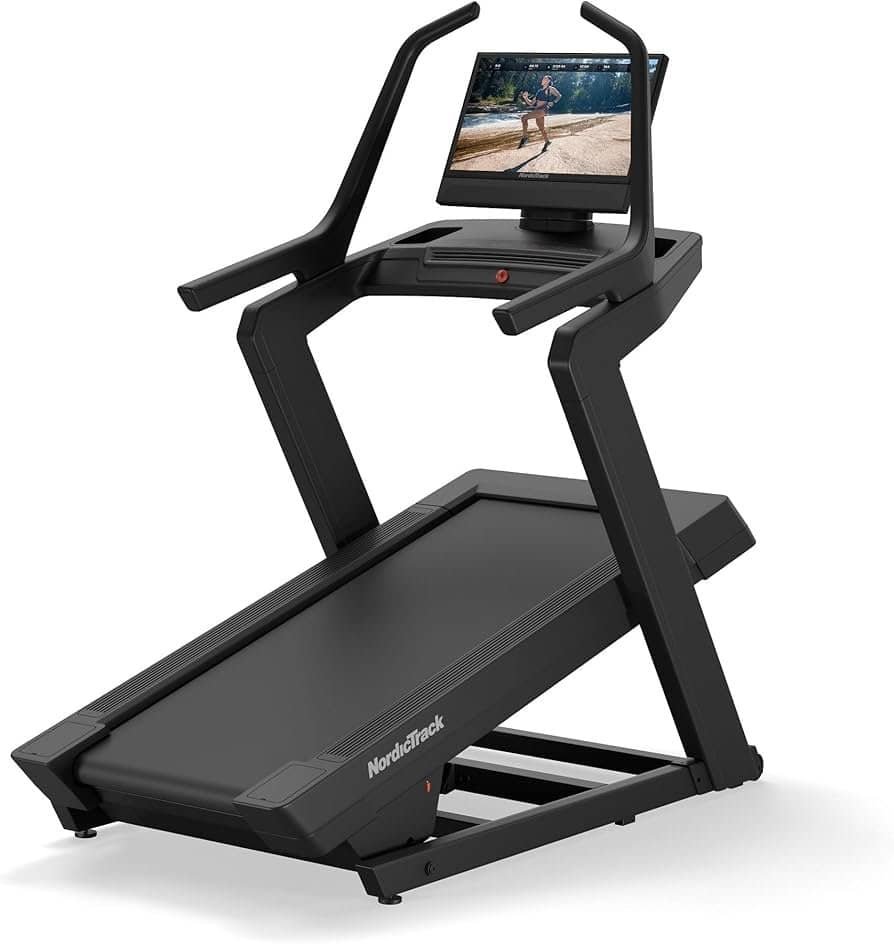
1. NordicTrack X24 — for full mountain-trail simulation
| Motor | 4.25 CHP |
| Belt / Deck Size | 22″ W x 60″ L |
| Top Speed | 12 mph |
| Incline / Decline | 40% incline / -6% decline |
| Weight Capacity | 400 lb |
| Warranty | Lifetime motor, 10-yr frame, 2-yr parts, 1-yr tablet & labor |
| Subscription | iFIT Pro required to unlock trail-mapping & auto-adjust features |
| Folds | No |
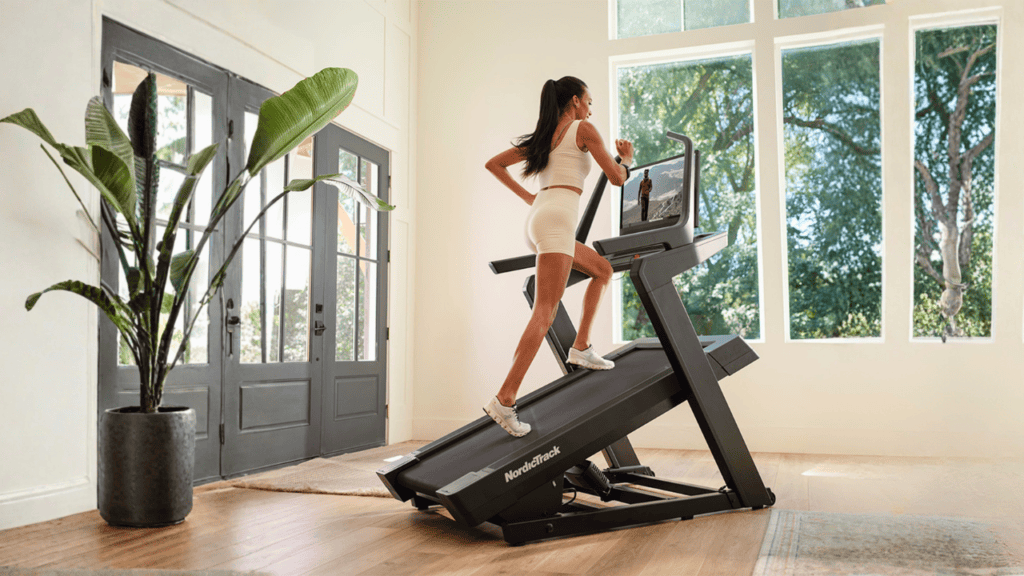
The X24 is the only treadmill on this list that can pull real trail elevation data and turn it into the belt’s grade in real time, rather than a generic hill setting. Through iFIT, the machine reads the elevation profile of an actual mapped route and adjusts incline automatically as the workout progresses — climbing when the trail climbs, easing off when it flattens, dropping into the -6% decline range on the way back down. That’s a meaningfully different experience from setting a fixed grade and holding it for 30 minutes; it’s closer to walking the terrain than simulating an average of it.
At 40% incline, the X24 has more headroom than almost any section of trail you’d actually encounter — even the steepest sustained pitches on long-distance routes like the Pacific Crest Trail or Continental Divide Trail typically run in the 20–30% range, so a 40% ceiling isn’t just matching real trails, it’s giving you room to overtrain past them.
That headroom matters because a motor working near its limit tends to strain, and the 4.25 CHP (continuous horsepower) rating here is what lets the machine hold a steep grade for a full session rather than just spiking to it briefly. Continuous horsepower, as opposed to peak horsepower, is the number that predicts whether a motor bogs down under sustained load — which is exactly the demand a 30–40 minute incline-heavy hiking workout places on it.
The 400 lb frame capacity is worth noting too, since a treadmill flexing or shifting at a steep incline isn’t just uncomfortable; it’s a stability concern — more mass under load at a steep angle means more force on the frame joints than the same weight on a flat deck.
The catch is the price and the ongoing subscription needed to unlock the trail-mapping feature — without it, you’re paying for hardware that can outclimb almost anything but isn’t using its best feature. In manual mode without iFIT, the X24 is still a genuinely capable high-incline treadmill; it just stops being a trail simulator and becomes an expensive hill-mode machine.
“Average treadmill” figures are aggregated from published market data and buying guides for residential machines — not one single source.
| Spec | NordicTrack X24 | Average Treadmill |
|---|---|---|
| Top Incline | 40% | 12% |
| Top Speed | 12 mph | 12 mph |
| Belt Size | 22″ x 60″ | 18″ x 55″ |
| Weight Capacity | 400 lb | 300 lb |
| Warranty | Lifetime motor | 1–2 yr limited |
You’re training for a specific steep route — not general hiking fitness — and want the treadmill to mirror that trail’s actual elevation profile rather than a fixed hill setting. You have the budget and the space, and you’re fine paying for iFIT to get the full experience.
Check Price on Amazon →2. SOLE TT8 — no subscription, real incline and decline
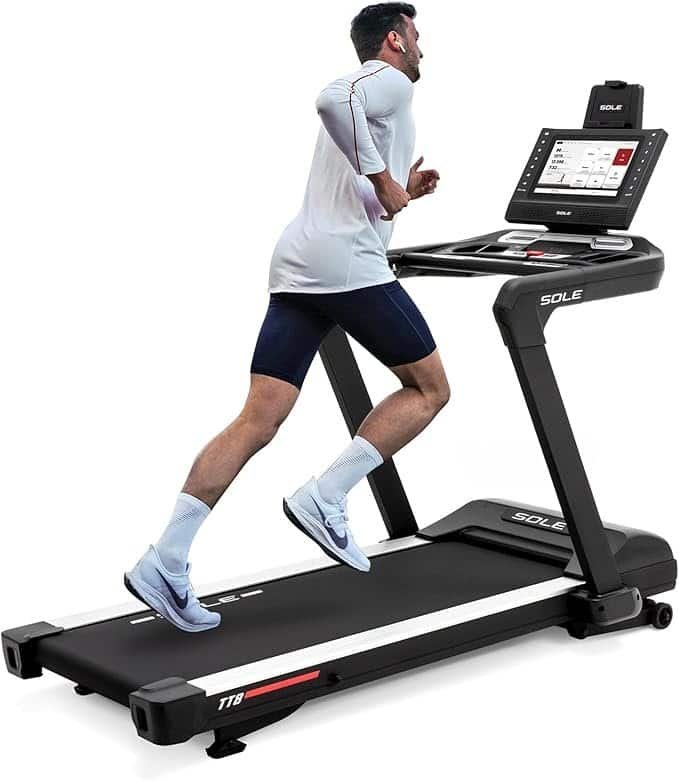
| Motor | 4.0 HP continuous-duty |
| Belt / Deck Size | 22″ W x 60″ L |
| Top Speed | 0.5–12 mph |
| Incline / Decline | 15% incline / -6% decline |
| Weight Capacity | 400 lb |
| Warranty | Lifetime frame & motor, 5-yr electrical & deck, 2-yr labor |
| Subscription | None required; third-party app subscriptions (Zwift, Strava) optional |
| Folds | No |
It has enough incline range to cover the average grade of most real trails — most hiking trails run 8–12%, with only the steepest sections pushing past 20% — and it’s one of the only machines at this price with a genuine decline setting, which matters more than people expect. Downhill walking loads the knees eccentrically, meaning the muscles are lengthening under tension rather than shortening, and that’s a mechanically different stress than climbing. Most treadmills never train for it at all, which means the first time someone’s knees encounter real downhill hiking, it’s on the trail itself. A -6% decline gives you a controlled way to build tolerance for that in advance.
The 22″ x 60″ deck is on the larger end for a treadmill in this price range, which matters more than it sounds at incline — a narrower deck feels tighter the steeper the grade gets, since your natural stride shifts slightly to compensate for the angle. A 4.0 HP motor and 0.5–12 mph speed range mean the TT8 isn’t purely a hiking-pace machine either; it covers slow, sustained climbing through the entire range up to a genuine run, which is useful if you want to cross-train speed work and incline work on the same machine instead of owning two.
The Manual, Hill, Fat Burn, and Cardio program modes give you pre-built structure if you don’t want to hand-program every session, streamed through a 15.6″ touchscreen that works with whatever service you already subscribe to — or nothing at all.
Worth flagging: the Vitalwalk pick below has a higher incline ceiling — 20% versus 15% — at a third of the price. It doesn’t take the top spot because it has no decline setting and a narrower belt (18″ versus the TT8’s 22″). Incline-and-price alone favor Vitalwalk; decline-and-comfort favor the TT8. Pick based on which of those actually matters more for you.
Against the X24 above, the gap is bigger than a footnote: $500 more gets you 15% jumping to 40% incline, plus real-time trail mapping — the right call if you’re training a known steep route, overkill if you just want solid general hiking fitness.
“Average treadmill” figures are aggregated from published market data and buying guides for residential machines — not one single source.
| Spec | SOLE TT8 | Average Treadmill |
|---|---|---|
| Top Incline | 15% | 12% |
| Top Speed | 12 mph | 10 mph |
| Belt Size | 22″ x 60″ | 18″ x 55″ |
| Weight Capacity | 400 lb | 300 lb |
| Warranty | Lifetime frame & motor | 1–2 yr limited |
You want serious, general hiking fitness — including real downhill training — without ever paying a monthly fee to use the machine’s full feature set. You have room for a permanent, non-folding treadmill and don’t need incline past 15%.
Check Price on Amazon →3. Vitalwalk Foldable Treadmill — for small spaces
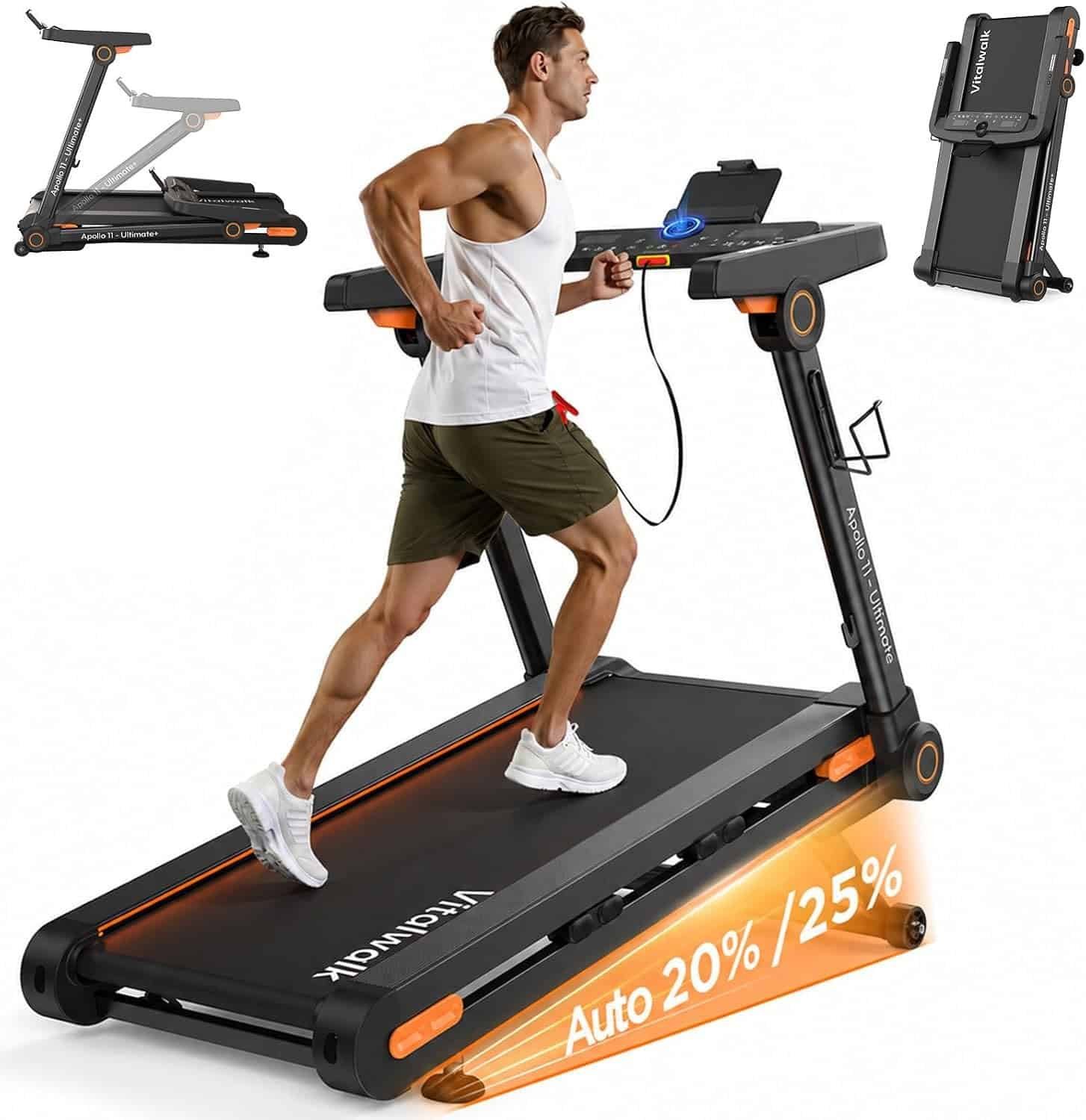
| Motor | 3.5 HP brushless |
| Belt / Deck Size | 18″ W x 49″ L |
| Top Speed | 0.6–10 mph |
| Incline | 0%–20%, 20 auto levels (no decline) |
| Weight Capacity | 350 lb |
| Warranty | 5-yr frame, 2-yr motor, lifetime technical assistance |
| Subscription | None — free app with all programs included |
| Folds | Yes — one-touch auto fold, no assembly |
Every other pick on this list assumes a dedicated spot for a treadmill that stays put. This one doesn’t. Its Z-shaped frame tucks the motor into the base rather than the front housing most treadmills use, which is what lets it fold flat and stand upright in under 3 square feet — closer to storing an ironing board than a piece of gym equipment. There’s no assembly out of the box either, which matters more than it sounds like for a treadmill this size, since assembly is often the actual barrier to getting a folding machine set up and used regularly rather than left in a box.
The 20-level, 20% auto incline is a real, usable range for hiking-grade training — not a token gesture bolted onto a compact frame. A 3.5 HP brushless motor drives it at a claimed 40dB, which is roughly library-quiet; brushless motors run quieter than brushed ones because they don’t rely on physical contact brushes generating friction and electrical noise, which is the mechanical reason compact folding treadmills can now be this quiet where older models weren’t.
That’s a genuine consideration for early-morning or late-night sessions in a shared space or thin-walled apartment. The frame carries a 350 lb rating and is tested through 200,000 impact cycles, backed by a 5-year frame and 2-year motor warranty — reasonable numbers for a machine built around portability rather than commercial-grade bulk.
The belt is 18″ wide, noticeably narrower than the TT8’s 22″, so it’s worth confirming that fits your stride before buying if you’re on the taller side — a narrow belt becomes more noticeable the steeper the incline, since your foot placement naturally drifts as your body leans into the grade. Worth noting: at 20%, this actually beats the SOLE TT8’s incline ceiling — but it has no decline setting, which is the trade you’re making for the smaller footprint and lower price.
“Average treadmill” figures are aggregated from published market data and buying guides for residential machines — not one single source.
| Spec | Vitalwalk | Average Treadmill |
|---|---|---|
| Top Incline | 20% | 12% |
| Top Speed | 10 mph | 10 mph |
| Belt Size | 18″ x 49″ | 18″ x 55″ |
| Weight Capacity | 350 lb | 300 lb |
| Warranty | 5-yr frame | 1–2 yr limited |
You’re in an apartment or a room without space for a permanent machine, and you don’t want to sacrifice incline range to get there. A 20% incline in under 3 square feet folded is hard to beat if downhill training isn’t a priority for you.
Check Price on Amazon →4. Sunny Health & Fitness Premium Incline/Decline Treadmill — the steepest incline available
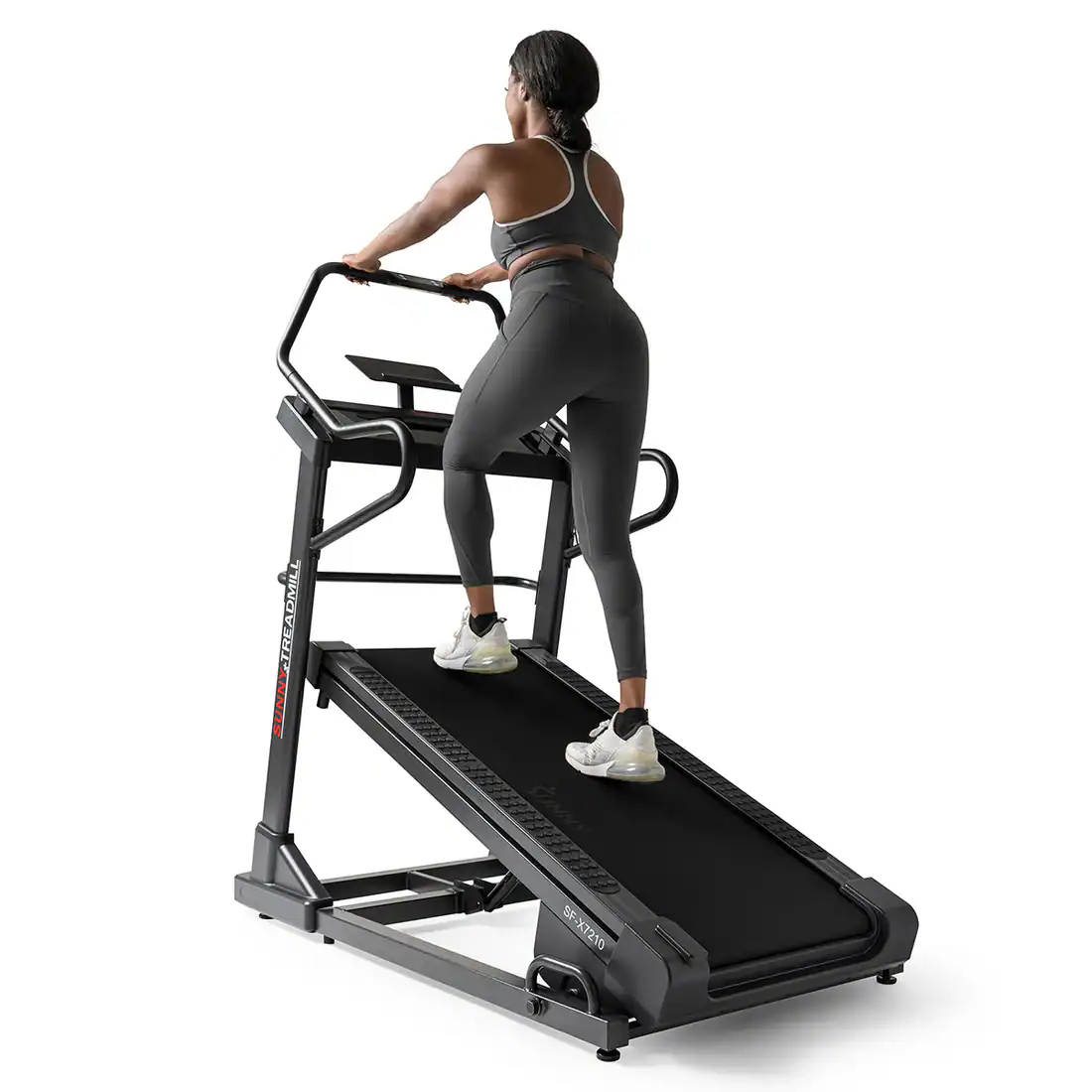
| Motor | 2.5 HP rear-drive brushless, with Climb Mode |
| Belt / Deck Size | 20″ W x 51″ L |
| Top Speed | 0.5–10 mph, auto-limited by incline (e.g. ~3.7 mph at 45%) |
| Incline / Decline | 45% incline / -3% decline |
| Weight Capacity | 300 lb |
| Warranty | 1-yr structural frame, 180-day other parts |
| Subscription | None — SunnyFit TV app is free |
| Folds | No |
This is the outlier: it beats even the $2,999 NordicTrack above on raw incline, at roughly two-thirds the price — the highest incline ceiling on this list. A 45% grade is a genuinely different physical experience than anything in the 15–20% range most treadmills offer; for reference, a 45-degree angle would be a near-vertical wall, but a 45% grade (rise over run) works out to roughly a 24-degree slope — still steep enough that your center of gravity shifts noticeably forward, and steep enough that most people instinctively reach for something to hold onto.
That’s exactly what the multi-grip handrail setup is built around — high, mid, and dual-low grip positions, rather than the single handrail height most flat treadmills get away with. At a shallow incline, handrails are mostly optional. At 45%, they’re closer to load-bearing, especially early on while your body adjusts to the grade.
The treadmill also commits fully to that use case rather than compromising for a dual purpose: top speed caps around 5 mph with a dedicated 0.3–5 mph range, meaning the whole machine — motor, gearing, control software — is tuned for sustained slow-speed, steep-grade climbing instead of splitting its design between that and a running mode it doesn’t need. The SunnyFit TV app streams scenic, trainer-led routes to a connected smart TV over Wi-Fi, with Bluetooth available for a quicker phone pairing if you’d rather bring your own audio or training app.
The trade-off is speed — it’s capped around 5 mph, built purely for climbing rather than running, so it’s not the machine if you also want to jog on it. If your training goal is specifically maximum incline for the lowest price on this list, though, nothing else here gets you steeper.
“Average treadmill” figures are aggregated from published market data and buying guides for residential machines — not one single source.
| Spec | Sunny Premium | Average Treadmill |
|---|---|---|
| Top Incline | 45% | 12% |
| Top Speed | 10 mph | 10 mph |
| Belt Size | 20″ x 51″ | 18″ x 55″ |
| Weight Capacity | 300 lb | 300 lb |
| Warranty | 1-yr frame | 1–2 yr limited |
Your training goal is specifically maximum incline for the lowest price — not running speed. This machine commits fully to steep, slow-speed climbing rather than splitting its design between hiking and jogging.
Check Price on Amazon →5. Sunny Health & Fitness Smart Treadmill — the budget entry point
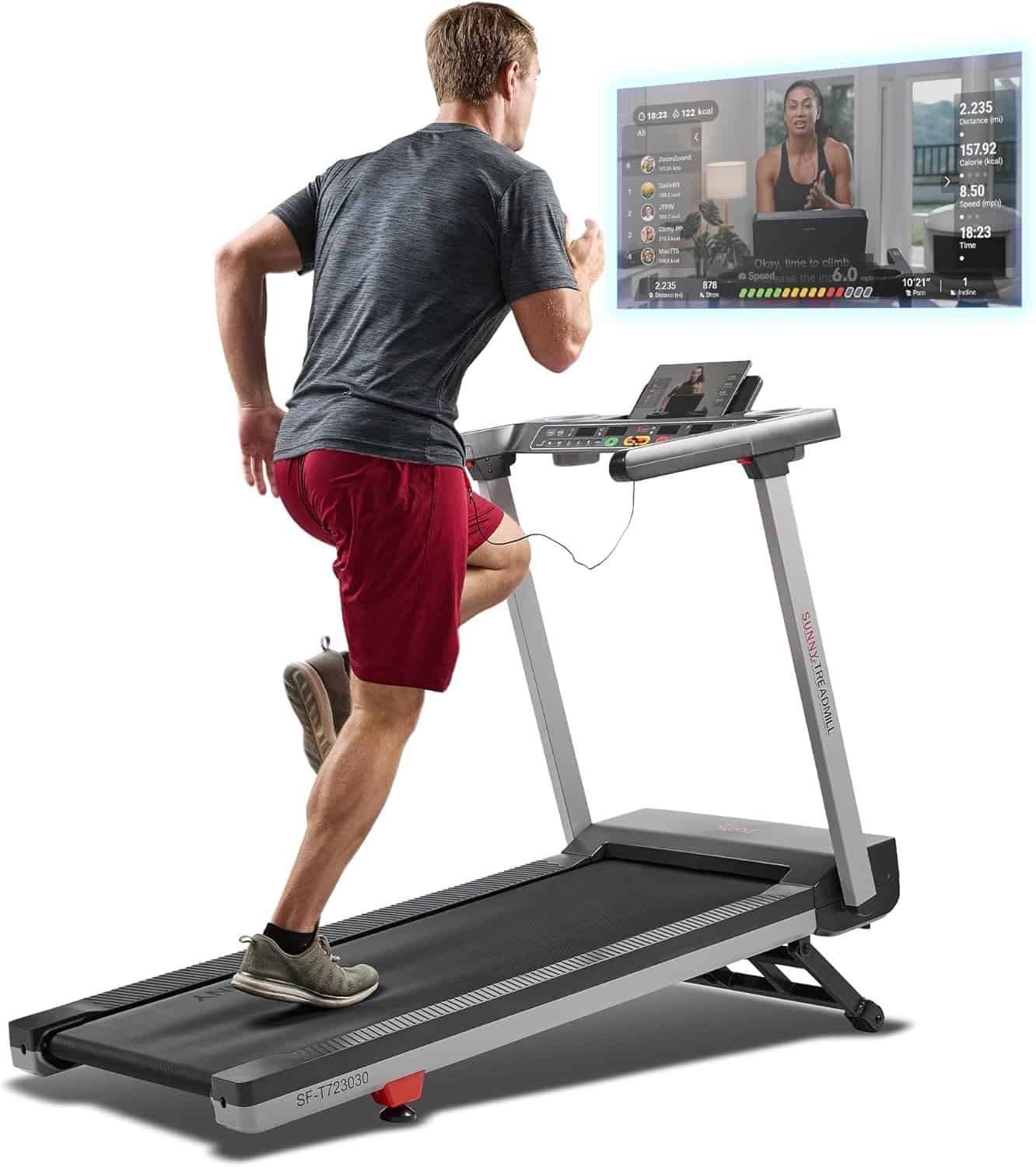
| Motor | 2.5 HP brushless |
| Belt / Deck Size | 20″ W x 53″ L |
| Top Speed | 0.6–10 mph |
| Incline | 0%–15%, 15 auto levels (no decline) |
| Weight Capacity | 300 lb |
| Warranty | 3-yr structural frame, 180-day other parts |
| Subscription | None — free SunnyFit app |
| Folds | Yes — one-click fold, fully assembled out of box |
At $699, this is the lowest-cost entry point on this list. It won’t replicate a steep alpine trail, but a 15% incline is a genuine starting point for hiking training, not a token gesture — at less than a third of the SOLE TT8’s price.
The 20″ x 53″ running surface is close to the 20″ x 60″ decks on the pricier picks in width, though noticeably shorter in length — a difference that matters more for longer running strides than for hiking-pace walking, where stride length is naturally shorter anyway. A 2.5 HP brushless motor covers up to 15 auto-incline levels and a 10 mph top speed, which leaves real headroom above hiking pace if you also want to jog occasionally, without being built specifically for it the way a dedicated running treadmill would be.
The one-click fold mechanism and fully assembled out-of-box setup matter for the same reason they do on the Vitalwalk above: a folding treadmill that’s annoying to fold tends to just stay unfolded, defeating the point of buying a compact machine in the first place.
Double-deck shock absorption — a layered cushioning system between the belt and the frame, rather than a single foam layer — softens impact more than a basic flat deck, which is worth having at any incline level since the joint loading from walking uphill compounds with however much cushioning (or lack of it) is underneath you. 24 built-in programs and the free SunnyFit app round out the package without requiring any ongoing subscription cost.
“Average treadmill” figures are aggregated from published market data and buying guides for residential machines — not one single source.
| Spec | Sunny Smart | Average Treadmill |
|---|---|---|
| Top Incline | 15% | 12% |
| Top Speed | 10 mph | 10 mph |
| Belt Size | 20″ x 53″ | 18″ x 55″ |
| Weight Capacity | 300 lb | 300 lb |
| Warranty | 3-yr frame | 1–2 yr limited |
You’re finding out whether hiking training is worth investing in, not committing to a specific steep route yet. This is the lowest-friction way to start building incline fitness before spending more on a higher-grade machine.
Check Price on Amazon →How to Actually Decide (Buying Guide)
Two questions get you to the right pick faster than comparing every spec:
Question 1: Do you already know you’re serious about hiking training, or are you finding out? Finding out → the $699 Sunny Smart Treadmill. Already serious → question 2.
Question 2: What’s your actual constraint — budget, space, or a specific steep goal?
- No real constraint, want the deepest trail simulation → NordicTrack X24 ($2,999)
- No specific constraint, want the smartest all-around value → SOLE TT8 ($2,499)
- Space is tight → Vitalwalk Foldable (~$800)
- Your goal is the single steepest incline available → Sunny Premium Incline/Decline (~$2,000)
A few things worth knowing regardless of which one you land on:
- Incline range matters more than top speed — but “enough incline” depends on your actual trail. Most trails average 8–12% grade; a 15–20% ceiling covers that comfortably. Only the steepest specific sections push to 20–40%, which is a real consideration if you’re training for one known trail, and largely irrelevant if you’re training for general hiking fitness.
- Decline settings train something incline can’t — the downhill impact that causes most hiking-related knee soreness.
- Check whether the full incline range requires a subscription before comparing sticker prices. A cheaper machine with a paywalled feature set can cost more over a year than a pricier standalone one.
Frequently Asked Questions
Can you actually train for hiking on a treadmill?
Yes — especially for cardiovascular endurance and incline-specific leg strength. It won’t replace uneven trail terrain, altitude, or weather, so treat it as training that complements real hikes, not a full substitute for them.
What incline should I use to simulate hiking?
Most trails average an 8–12% grade, with steeper sections reaching 20–40%. Start around 8–12% and build from there as your fitness improves.
Do I need decline for hiking training?
Not strictly, but it’s worth having if your hike includes serious descents — downhill walking loads your knees differently than climbing does, and training for it in advance genuinely helps.
Is a 40%+ incline treadmill overkill?
Not if you’re training for a trail that actually hits that grade. It’s unnecessary if your hiking is mostly moderate terrain — a 15–20% incline ceiling covers that fine.
Can I run on a hiking-specific treadmill?
Depends on the model. The SOLE TT8 and NordicTrack X24 both support a full running speed range. The Sunny Premium Incline/Decline is built purely for climbing and caps speed low on purpose.
The Bottom Line
The incline range determines whether a treadmill actually trains you for hiking. Everything else — price, space, subscriptions — decides which incline treadmill fits your life. Match the pick above to your actual constraint, and you’ll be training on real trail grades within the week.