
Most marathon-training treadmill guides rank machines on specs that don’t actually matter much for an 18-week block — top speed, screen size, which app ecosystem you get locked into. What actually separates a treadmill that survives marathon training from one that doesn’t comes down to three questions:
- Will the motor hold up under an hour of continuous load, week after week — not the peak-horsepower number printed in bold on the box, but continuous horsepower (CHP), the number that tells you what the motor can sustain without straining.
- Is the belt long enough that your stride doesn’t shorten mid-run — a shorter deck is a quiet, common cause of form breakdown over a long training cycle, and most runners never trace it back to the treadmill.
- Are you the kind of runner who needs a coach’s voice to get through a solo 16-miler, or someone who’d rather be left alone with a manual console and their own playlist — because this, more than any spec, determines which machine you’ll actually keep using.
Everything below is organized around those three questions. The picks fall out of the reasoning — not the other way around.
Best Treadmill for Marathon Training in 2026
- Best Overall: Horizon 7.4 AT
- Best for Guided Training: NordicTrack Commercial 1750
- Best Heavy-Duty: SOLE TT8
- Best Without Subscription: 3G Cardio Pro Runner
- Best Budget: Horizon 7.0 AT
How We Picked the Best Treadmills
I haven’t personally logged marathon-training miles on every model here. What I have done is stand on display units to check deck stability and step-up height against my own stride, and cross-reference that against manufacturer specs, verified long-term owner reviews, and independent testing data — including a multi-year in-house test of the Horizon 7.0 AT run out of Runner’s World’s own office.
Where a claim comes from someone else’s hands-on experience rather than a spec sheet, I’ve said so directly. The injury-prevention claims are grounded in published exercise physiology research rather than general fitness advice, since that’s the part of this guide closest to my own background as a trainer. Pricing and specs were last checked in 2026 and are subject to change — confirm current figures before buying.
VIDEO: Best Treadmills for Marathon Training
Compare the Best Treadmills for Marathon Training
|
01 · BEST OVERALL
No trade-offs
Horizon 7.4 AT
Check Price →
|
02 · GUIDED TRAINING
Coached runs
NordicTrack Commercial 1750
Check Price →
|
03 · HEAVY-DUTY
Built to last
SOLE TT8
Check Price →
|
04 · NO SUBSCRIPTION
Own it outright
3G Cardio Pro Runner
Check Price →
|
05 · BEST BUDGET
Lowest entry
Horizon 7.0 AT
Check Price →
|
|
|---|---|---|---|---|---|
| CHP Motor | 3.5 CHP | 4.25 CHP | 4.0 CHP | 3.0 CHP | 3.0 CHP |
| Belt Size | 22 × 60″ | 22 × 60″ | 22 × 60″est. commercial deck | 22 × 60″ | 20 × 60″ |
| Top Speed | 12 mph | 12 mph | 12 mph | 12 mph | 12 mph |
| Incline / Decline | 0–15% | -3–12% | -6–15%widest range here | 0–15%no decline | 0–15% |
| Weight Capacity | 375 lb | 400 lb | 400 lbtied for highest here | 350 lb | 325 lb |
| Subscription | None req. | ~$39/moiFIT — 30-day trial included | None req. | None — everFreeSync + your own app | None req. |
| Folds for Storage | Yes | Yes | Nofixed frame — needs dedicated space | Yes | Yes |
| Warranty | Lifetimeframe + motor | Standardtiered by component | Lifetimeframe | Lifetimemotor + frame · 5yr parts · 1yr labor | Lifetimeframe + motor |
| Ideal For | Runners who want zero compromises & zero recurring cost | Runners who need a coach’s voice to stay consistent | Heavy, multi-year training & hill/downhill-heavy courses | Runners who never want to depend on an app or fee | New marathoners testing commitment without overbuying |
What is Continuous Horsepower (CHP), & Why Does It Matter for Marathon Training?
Continuous horsepower (CHP) is the amount of power a treadmill motor can sustain for an entire run, without straining, overheating, or losing power partway through. It’s different from peak horsepower, which a motor can only hit for a few seconds and which is usually the bigger, bolder number printed on the box.
For most everyday walking or short jogs, this distinction barely matters. But marathon training means running for an hour or more at a time, week after week, for months — exactly the kind of sustained load that separates a treadmill built for it from one that isn’t. A CHP rating of at least 3.0 is generally considered the floor for serious marathon training; anything lower risks the motor straining or losing power mid-run.
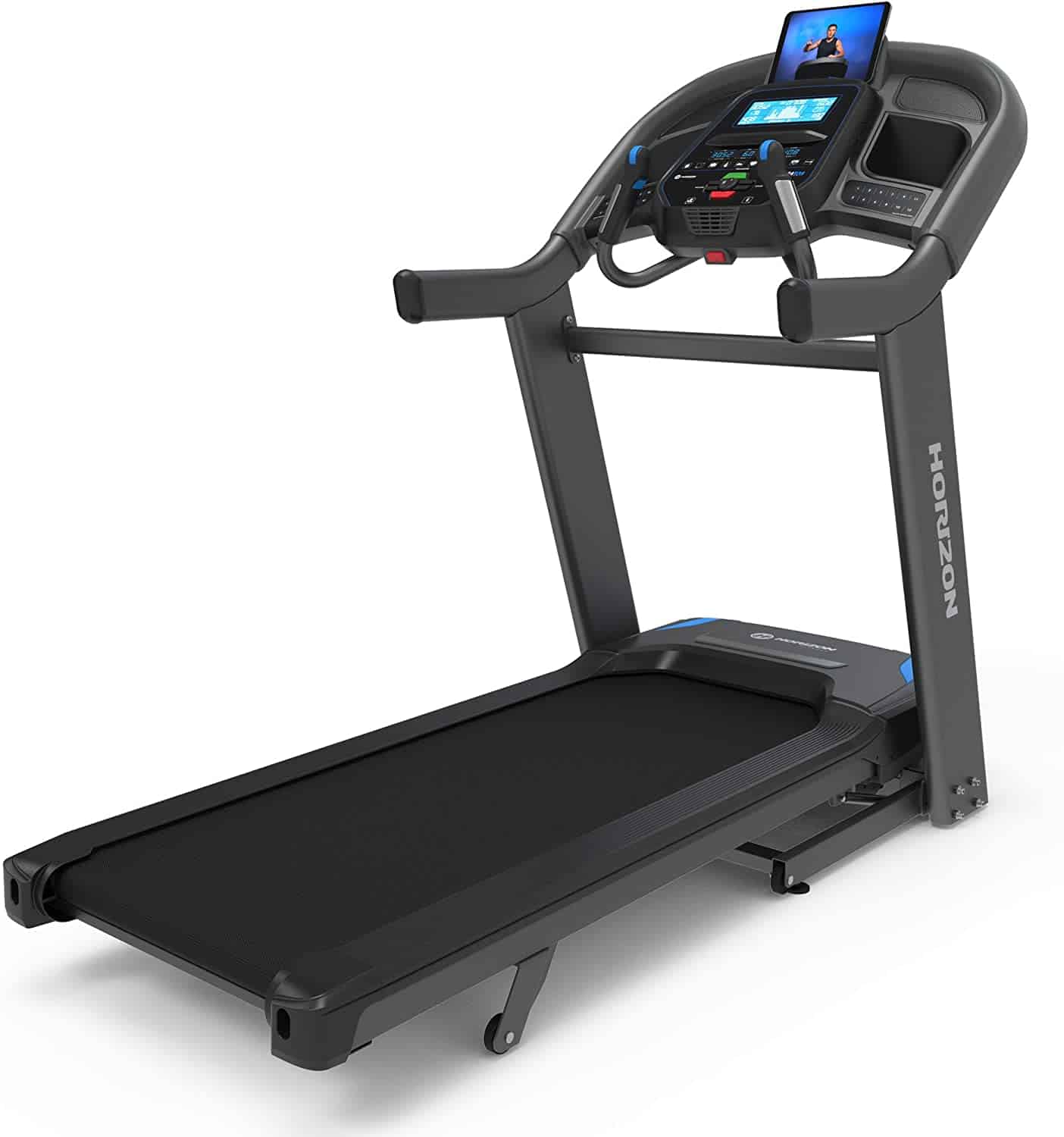
1. Overall Best Treadmill for Marathon Training: Horizon 7.4 AT
| Motor | 3.5 CHP |
| Belt / Deck Size | 22 × 60" |
| Top Speed | 12 mph |
| Incline | 0–15% |
| Weight Capacity | 375 lb |
| Warranty | Lifetime — frame & motor |
| Subscription | None required |
| Folds | Yes |
Most “no subscription required” treadmills earn that freedom by cutting something else — a shorter belt, a smaller motor, a stripped-down console. The 7.4 AT is the rare one that doesn’t cut either. It sits well above the 3.0 CHP floor, and its 22 x 60-inch belt is full commercial length — long enough that your stride can fully extend at marathon pace, which matters more than most runners realize until they’ve trained on something narrower.
This isn’t just a spec-sheet claim. Yahoo Life’s fitness reviewer logged extended mileage on the 7.4 AT and specifically called out the quick-adjust incline and speed dials as standout features for real training use, though she noted the console screen itself is basic and best paired with your own phone or tablet for anything beyond workout stats.
Bluetooth FTMS connects to Zwift, Peloton, or any app you already use — or none at all, since the console runs fully standalone. Frame and motor are covered by a lifetime warranty.
Where it loses to the NordicTrack below: if you already know solo long runs are where your training plan falls apart — not your fitness, your adherence — paying nothing for a subscription doesn’t help you if you stop showing up. That’s a real trade-off, not a knock on this machine.
This is the best treadmill for marathon runners who wants zero compromises and zero recurring costs — a treadmill that just works, out of the box, for the length of an entire training cycle and beyond.
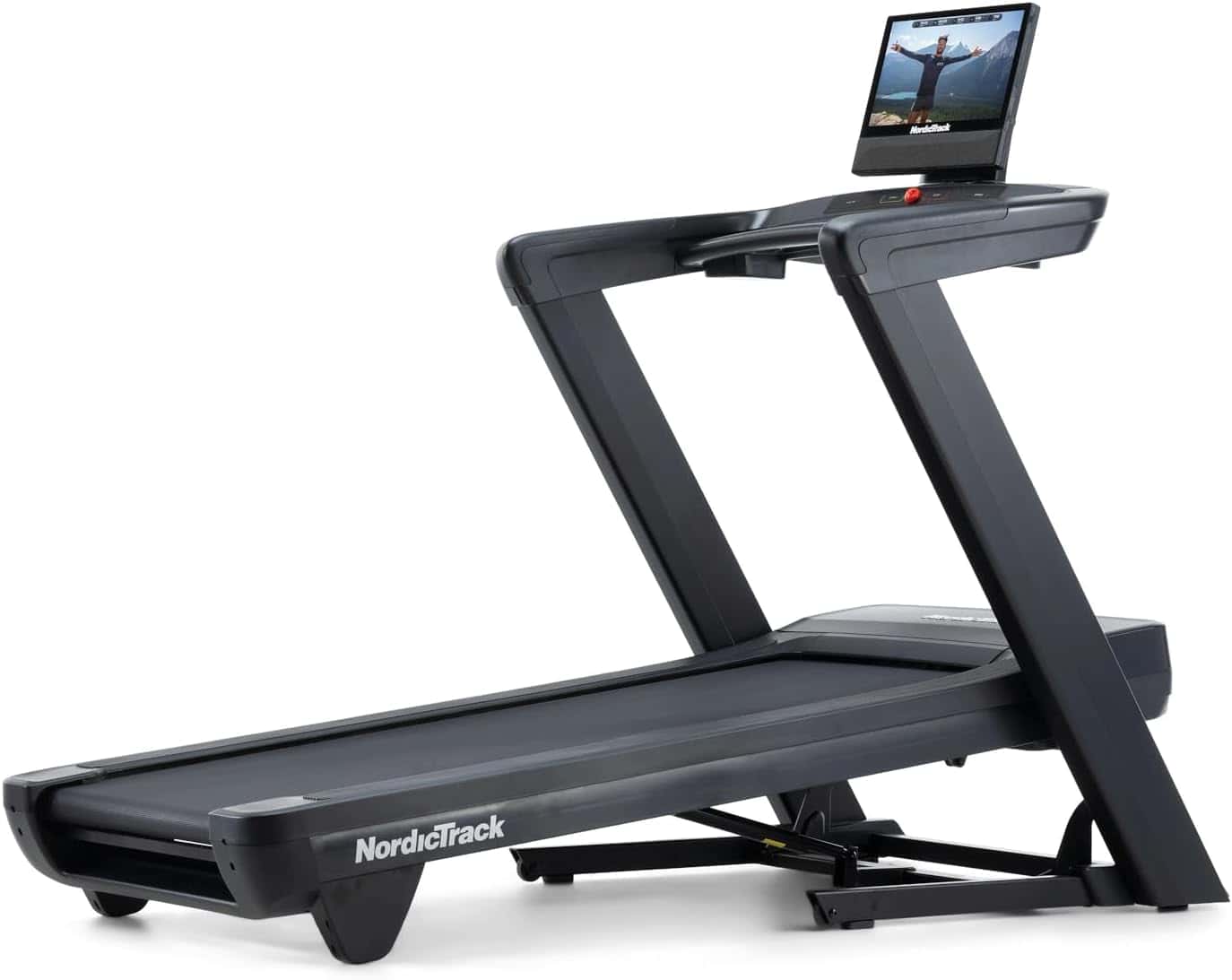
Check Price on Amazon →2. Best for Guided Training: NordicTrack Commercial 1750
| Motor | 4.25 CHP |
| Belt / Deck Size | 22 × 60" |
| Top Speed | 12 mph |
| Incline / Decline | -3% to 12% |
| Weight Capacity | 400 lb |
| Warranty | Standard — tiered by component |
| Subscription | iFIT, ~$39/mo (trial included) |
| Folds | Yes |
Most runners who quit marathon training don’t quit from injury — they quit because 18 miles alone on a treadmill, staring at a wall, is genuinely hard to keep showing up for. If adherence, not fitness, is your real risk factor, this is the treadmill built to solve for it, and it’s worth being honest that no amount of motor headroom fixes a training block you abandoned in week 9.
The 4.25 CHP motor gives real headroom on the same 22 x 60-inch deck as the Horizon above. What sets it apart is the -3% to 12% incline/decline range paired with a 16-inch swiveling touchscreen: SmartAdjust auto-adjusts speed and grade in real time to match a trainer-led run or mapped route, removing the guesswork from pacing long runs correctly — one of the more common ways training blocks quietly go off the rails.
Owner reviews back this up in practice: one verified buyer training for a marathon specifically credited the guided runs and decline range with letting her simulate race-specific terrain she couldn’t otherwise access, describing the machine as “rock solid” after regular use. Worth knowing on the reliability side: assembly needs two people, and a small number of owners have reported needing to replace the electronic controller board shortly after purchase — a fair trade-off to weigh against an otherwise strong track record.
The real cost isn’t the machine, it’s the subscription. iFIT isn’t optional here in any meaningful sense — without it, this is a manual treadmill with an expensive screen. With it, expect roughly $39/month, though a trial period is included with purchase. If you already run disciplined, self-paced long runs, you’re paying monthly for a feature you won’t use, and the Horizon 7.4 AT above is the better fit at a lower total cost.
This is for the runner whose biggest risk isn’t fitness, it’s showing up — someone who needs a coach’s voice and auto-adjusting terrain to actually finish 18 weeks of training.
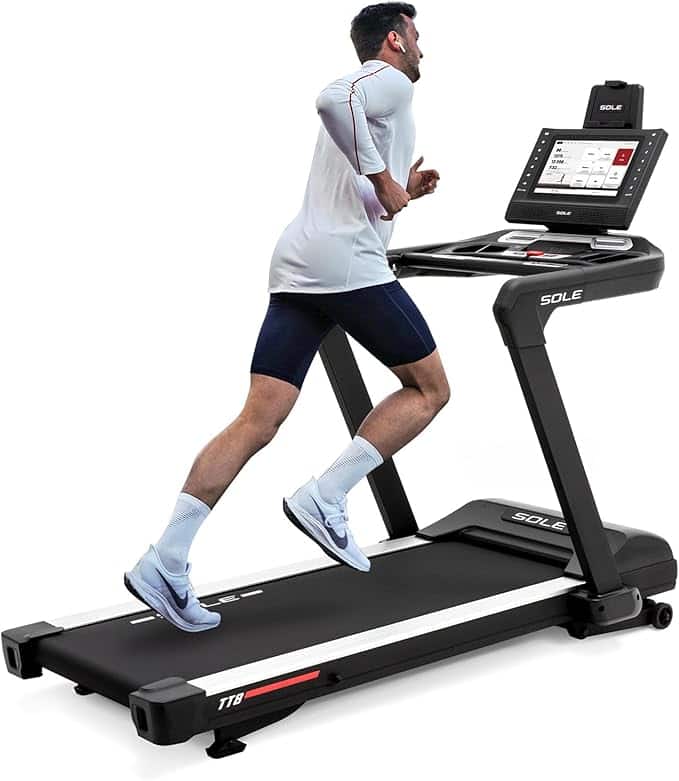
Check Price on Amazon →3. Best Heavy-Duty: SOLE TT8
| Motor | 4.0 CHP |
| Belt / Deck Size | 22 × 60" (est. commercial deck) |
| Top Speed | 12 mph |
| Incline / Decline | -6% to 15% |
| Weight Capacity | 400 lb |
| Warranty | Lifetime — frame |
| Subscription | None required |
| Folds | No — fixed frame |
The SOLE TT8 doesn’t fold — and that single design choice is what lets it do what it does. Without a hinge to engineer around, SOLE built a single rigid frame with a 400 lb capacity and a -6% to 15% incline/decline range, the widest of any treadmill here – the best treadmill for long runs.
That decline range isn’t a spec-sheet flex — it’s the one feature on this list that trains a muscle group most marathon plans ignore entirely. If your race has real net elevation loss (Boston is the obvious example), quads that haven’t trained eccentrically for downhill running pay for it late, usually around mile 20.
This is grounded in exercise physiology, not marketing copy: downhill running places sustained eccentric load on the quadriceps, which act as brakes to control your descent rather than propel you forward. Outside magazine’s breakdown of Boston’s course explains that these eccentric contractions cause cumulative micro-damage in the muscle fibers over the race, which is exactly why courses with significant net downhill — like Boston’s first 16 miles — tend to humble even experienced runners by the later stretch.
Research on marathon-specific quad fatigue similarly points to accumulated eccentric muscle damage from early downhill sections as a direct contributor to the “dead legs” feeling many runners hit around mile 18–22. The TT8’s decline function is one of the few ways to rehearse that specific demand in training instead of meeting it cold on race day.
SOLE has a track record of supplying treadmills to light-commercial settings like hotel fitness centers, and the TT8 is built to that standard — a welded steel frame rated for sustained, high-volume use in a way a typical home treadmill isn’t engineered for. It’s a 4.0 continuous horsepower treadmill, runs up to 12 mph without strain across months of accumulating mileage, and the cushioned deck is designed to reduce joint impact relative to pavement. No subscription required, and it comes with a lifetime frame warranty.
The trade-off is permanent floor space. No folding means a permanent footprint, and reviewers are consistent on this point — it’s a large, heavy machine that isn’t going anywhere once assembled. If you’re training out of a studio apartment or need to reclaim floor space between sessions, the Horizon or 3G Cardio below are the realistic options.
This is for the runner training for a downhill-heavy course, or logging years of heavy mileage, who wants a treadmill built like it belongs in a gym, not a living room.
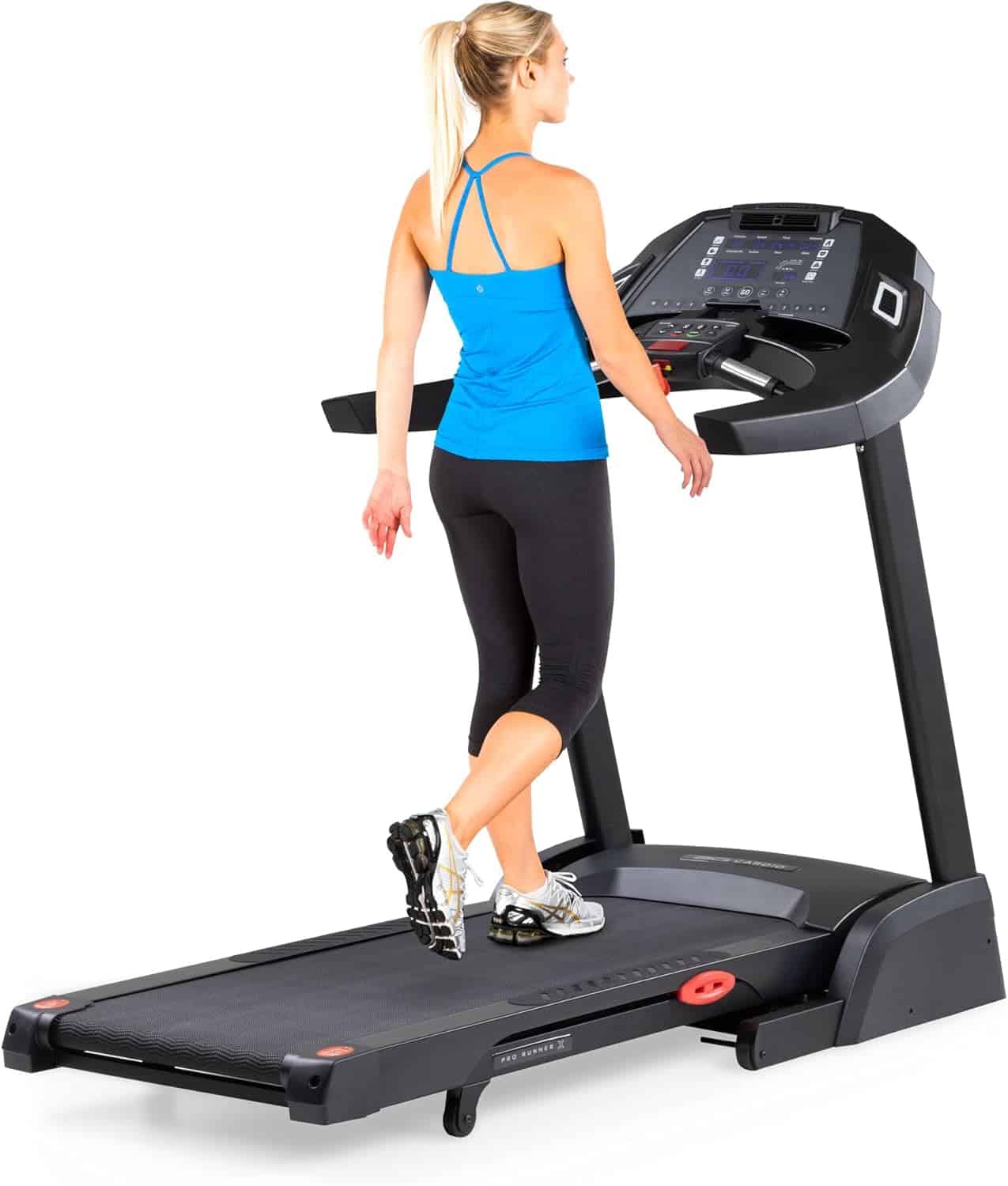
Check Price on Amazon →4. Best Without Subscription: 3G Cardio Pro Runner
| Motor | 3.0 CHP |
| Belt / Deck Size | 22 × 60" |
| Top Speed | 12 mph |
| Incline | 0–15%, no decline |
| Weight Capacity | 350 lb |
| Warranty | Lifetime motor & frame, 5yr parts, 1yr labor |
| Subscription | None — ever (FreeSync + your own app) |
| Folds | Yes |
Before buying any connected treadmill, it’s worth asking: does it still work if the company disappears, or you simply stop wanting to pay? For most connected treadmills, the honest answer is “sort of.” For the 3G Cardio Pro Runner, it’s simply “yes.”
FreeSync uses Bluetooth FTMS to turn your own phone or tablet into the display, for free, using whatever app you already run — no proprietary ecosystem, no feature locked behind a monthly fee. 3G Cardio has been vocal about this as a deliberate business decision, pointing to cases where other manufacturers’ proprietary apps were discontinued or bricked after acquisitions, leaving owners with hardware that could no longer access its own features.
Specs hold up for marathon mileage too: a 3.0 CHP motor clears the sustained-load threshold, 12 mph top speed, 15 incline levels, and an Ortho Flex Shock belt built to soften foot-strike impact over hundreds of cumulative training miles. Independent reviewers have specifically praised the low 6.5-inch step-up height, unusually low for a treadmill in this class and worth noting if you have any mobility limitations or low ceiling clearance.
Warranty: lifetime on the drive motor and frame, 5 years on all parts, and 1 year of in-home labor including setup — one of the strongest warranty packages on this list. It also folds despite genuinely commercial-grade internals, which is rare at this build quality.
What it can’t do: there’s no decline function, so hill-and-downhill-heavy courses are better served by the SOLE TT8. And if you actually want auto-adjusting guided workouts rather than a bare display, this hardware deliberately doesn’t do that — that’s the NordicTrack’s job, not this one’s.
This is for the runner who never wants to depend on an app, a subscription, or a company staying in business — just a reliable machine that runs on your terms.
Check Price on Amazon →5. Best Budget: Horizon 7.0 AT
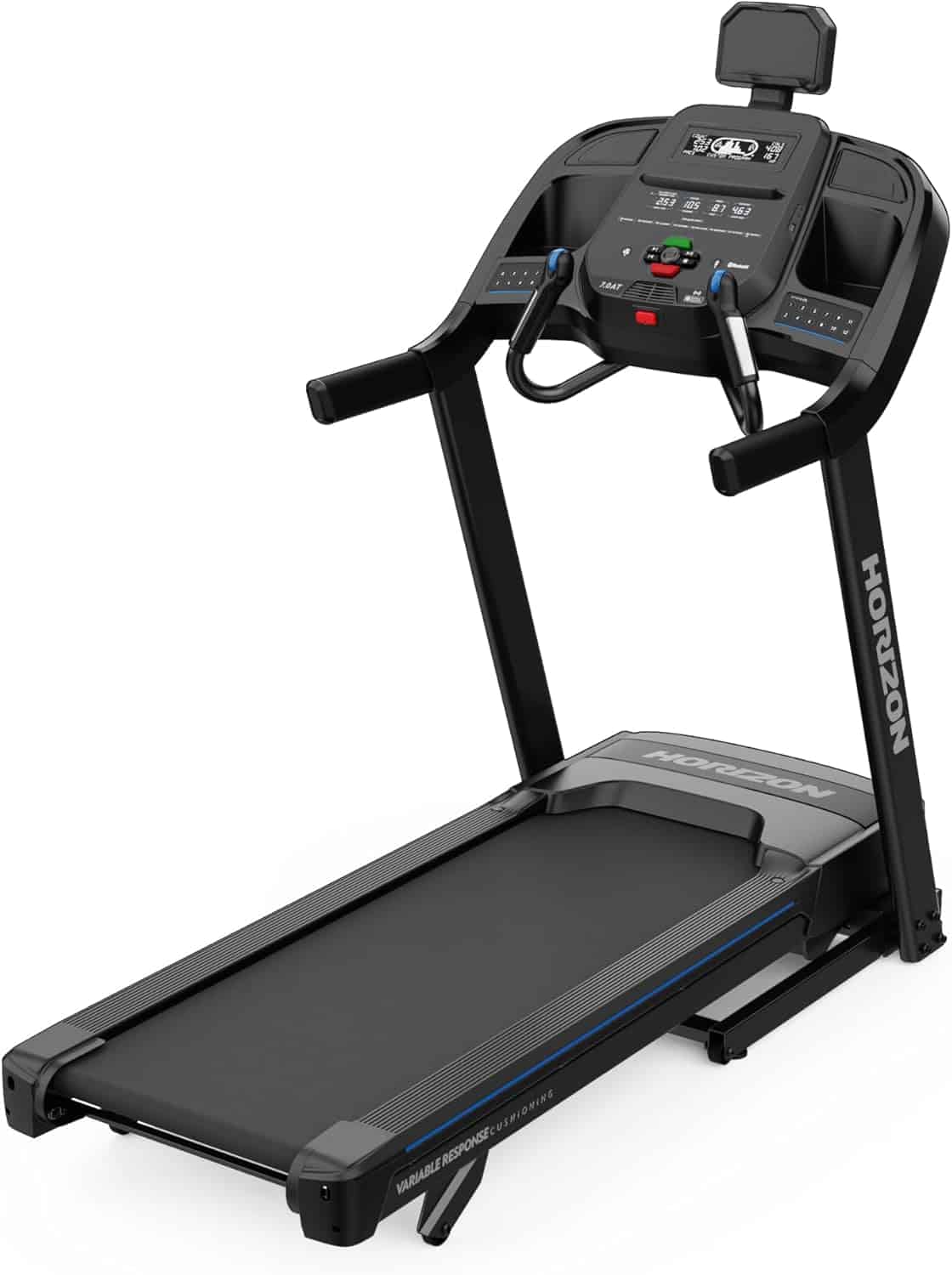
| Motor | 3.0 CHP |
| Belt / Deck Size | 20 × 60" |
| Top Speed | 10 mph |
| Incline | 0–15% |
| Weight Capacity | 325 lb |
| Warranty | Lifetime — frame & motor |
| Subscription | None required |
| Folds | Yes |
The Horizon 7.0 AT shares its motor family with our overall pick, at a significantly lower price, and is the only treadmill on this list under $1,500. It’s the entry point into real marathon-capable training, not a compromise dressed up as one.
This is the one machine on this list with genuine long-term, third-party validation rather than a single review cycle: Runner’s World kept a test unit of the 7.0 AT in their own office for extended, ongoing use by staff of varying skill levels — easy runs, shakeouts, intervals — the kind of repeated, real-world load that reveals reliability issues a short review period wouldn’t catch. They assessed that its overall stability and build quality held up well against machines costing roughly twice as much, with the main knock being a deck that runs slightly narrower than they’d prefer.
Its 3.0 CHP motor clears the marathon-training threshold on a full 60-inch belt — the same length as machines costing over $2,000 — with an incline up to 15%, the same as the pricier 7.4 AT, which matters if hill work is a bigger part of your plan than top-end speed. Eight built-in programs cover pacing, hills, and heart-rate work, so you’re not training blind even without a subscription. It carries the same lifetime warranty as Horizon’s higher-tier machines — the company isn’t building this one to a lower confidence level, just a lower price.
Where the savings run out: if you already know you’ll be putting years of heavy, multi-marathon mileage on this treadmill, the SOLE TT8’s steel frame is built for that level of long-term abuse in a way this narrower-belt model isn’t designed for.
This is for the new marathoner who wants to test their commitment to training without overspending on features they may not need yet.
Check Price on Amazon →Frequently Asked Questions
What is a good CHP for marathon training?
3.0 CHP is generally the minimum. Runners with frequent long runs or higher weekly mileage may prefer 3.5–4.25 CHP for extra headroom and a longer motor lifespan.
Do I need incline and decline for marathon training?
Incline builds strength and is useful for hill days regardless of your race’s terrain. Decline is more specific — it mainly matters if your race includes real net elevation loss, since it trains the eccentric quad strength that downhill running demands. This is a documented physiological adaptation, not a nice-to-have: unaccustomed eccentric loading from downhill running is a well-established cause of quadriceps muscle damage and delayed-onset soreness, and gradually building tolerance to it in training is one of the more evidence-backed ways to blunt that damage on race day.
Should I buy a folding treadmill for marathon training?
Folding treadmills save floor space and suit apartments or shared rooms well. Non-folding models, like the SOLE TT8, generally use the freed-up engineering space for a more rigid frame and higher weight capacity, suited to heavier, multi-year training use.
Is a subscription treadmill (like iFIT) worth it?
It depends on why you struggle with consistency. If solo long runs are hard to stick with, guided coaching can meaningfully help adherence — real owners training for marathons on the NordicTrack 1750 specifically cite this as the reason it works for them. If pacing and motivation aren’t your issue, a subscription is an ongoing cost for a feature you may not use.
How much should I spend on a treadmill for marathon training?
Treadmills that clear the 3.0+ CHP threshold start around $1,099. Higher price points generally buy a stronger motor, wider incline/decline range, higher weight capacity, or built-in guided coaching — not necessarily better core reliability.
Bottom Line
Every treadmill here clears the CHP threshold that actually matters for marathon training. The real decision isn’t “which is best” — it’s which trade-off fits you: guided coaching, maximum durability, zero recurring cost, or the lowest price of entry. If your race has real elevation change, weigh that heavily. If it’s flat, prioritize motor headroom and belt length instead.