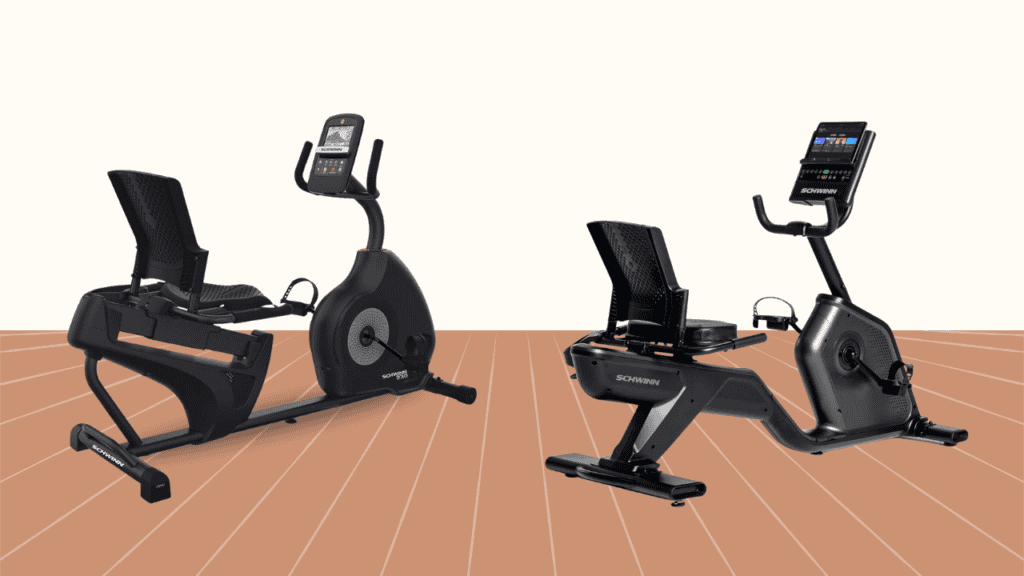
The Schwinn 230 vs 290 decision comes down to one question: what does the extra $300 buy? The two look like the same recumbent bike. They share the same step-through frame, 13 built-in workouts, magnetic resistance, and warranty, but the 290 lists for $300 more on Amazon. So the real question is whether you’ll use what that $300 buys.
I’m a NASM-certified personal trainer, and below I compare them the way I’d help a client choose. No single winner here: each bike is right for a different kind of rider.
Quick verdict
- Get the Schwinn 230 if: you want simple, steady, low-impact cardio (including injury recovery or easing back into exercise), you ride at your own pace with TV or music, and you weigh comfortably under 300 lb.
- Get the Schwinn 290 if: you want the JRNY app to coach you and change the resistance for you, you do intervals or rides of 45 minutes or more, or you’re close to 300 lb or above it (up to 330 lb).
- Over 330 lb? Neither is rated for you. Look at the Niceday RC88, rated for 400 lb.
- Sale shrinks the gap to about $150 or less? Take the 290.
Schwinn 230 vs 290 at a glance
The bold rows are the whole decision; most of the rest match.
| Spec | Schwinn 230 | Schwinn 290 |
|---|---|---|
| Resistance | 16 magnetic levels; up/down buttons | 25 magnetic levels; plus 10 quick keys |
| Apps | Explore the World, Zwift (you change resistance) | JRNY, Zwift (JRNY can change resistance for you) |
| Seat | Hard contoured plastic, vented back (not padded) | Padded seat, vented back |
| Rated for | 300 lb | 330 lb |
| Console | 5.5″ LCD: time, speed, distance, calories, RPM, heart rate | 7″ LCD: adds watts, cadence, burn rate |
| Heart rate | Pulse grips in handles; chest strap compatible (not included) | Bluetooth heart rate, strap sold separately; grip sensors not listed |
| Extras | Sliding seat, tablet shelf, bottle holder, transport wheels | Same, plus Bluetooth speakers and USB charging |
| Built-in programs | 13 | 13 |
| Frame | Recumbent, step-through | Recumbent, step-through |
| Size (L × W × H) | 64″ × 27.7″ × 44″ | 66.4″ × 28″ × 47″ |
| Bike weight | 81.6 lb | 107.6 lb |
| Warranty | 10 yr frame, 2 yr mechanical parts, 1 yr electronics, 90 days labor | Same |
| App cost (optional) | Explore the World $9.99/mo or $59.99/yr | JRNY $11.99/mo or $99/yr (2-month free trial) |
| Check price | Check Price → | Check Price → |
Prices change often; check today’s prices before you buy. Specs are from Schwinn’s US product pages; where Amazon’s listing disagrees (it lists the 230 at 49.9″ tall and the 290 at 26.3″ wide), I’ve used Schwinn’s figures.
What’s the same on both
You get the same core recumbent bike either way, so neither one is a bad buy.
- Recumbent position: you sit low in a bucket seat with back support, with the pedals out in front. That’s easier on your back and knees than an upright bike.
- Step-through frame: you don’t swing a leg over a high bar to get on.
- Resistance type: both use quiet magnetic resistance with a belt drive and a perimeter-weighted flywheel.
- Built-in workouts: both have 13 programs, so neither needs a subscription to work.
- Extras: both have a seat that slides on a rail, weighted strapped pedals, a tablet shelf, a bottle holder and front transport wheels.
- Apps: both work with Zwift (separate subscription), and both can pair with a heart-rate chest strap, which isn’t included.
- Warranty: both get 10 years on the frame, 2 years on mechanical parts, 1 year on electronics, and 90 days on labor.
So the decision comes down to four differences: resistance, apps, comfort, and size.
Difference #1: resistance (16 vs 25 levels)
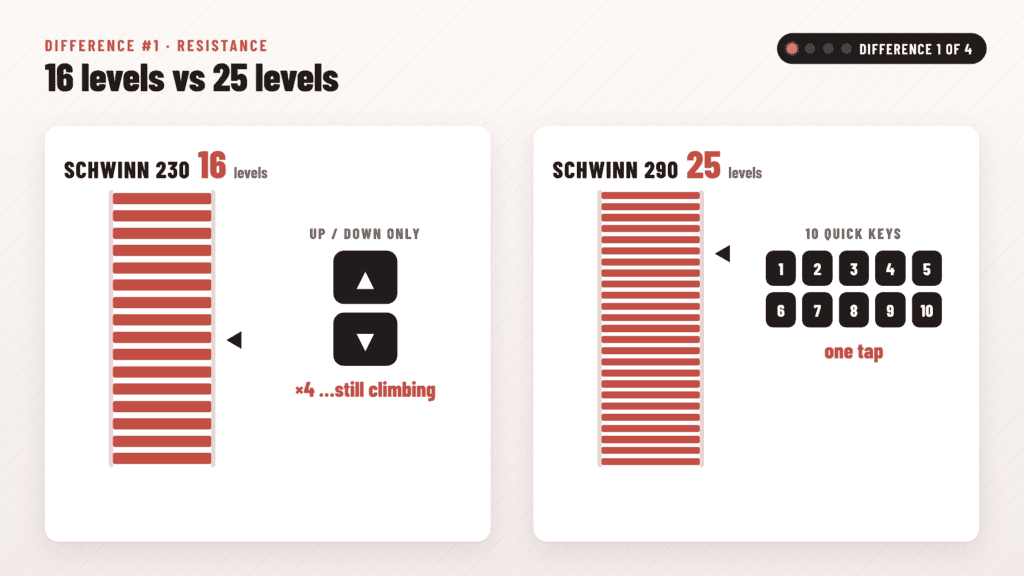
The 290 has 25 resistance levels to the 230’s 16, plus quick keys that make interval training easier. Schwinn doesn’t publish how hard the top level is on either bike, so don’t read “25” as “much harder.” What you definitely get is smaller steps between levels, so you can fine-tune your effort.
The bigger practical difference is the controls. The 290 has 10 quick keys that jump straight to a resistance level. The 230 only has up and down buttons. In an interval workout, that matters: on the 290 you tap one key to go from easy to hard, while on the 230 you press “up” several times while you’re already breathing hard.
My trainer’s test: if you’ll mostly ride at a steady, comfortable pace, 16 levels is plenty. If you like intervals, or you’re building fitness week by week and want small jumps, the 290’s 25 levels and quick keys are a real upgrade.
Difference #2: apps (the one most buyers miss)
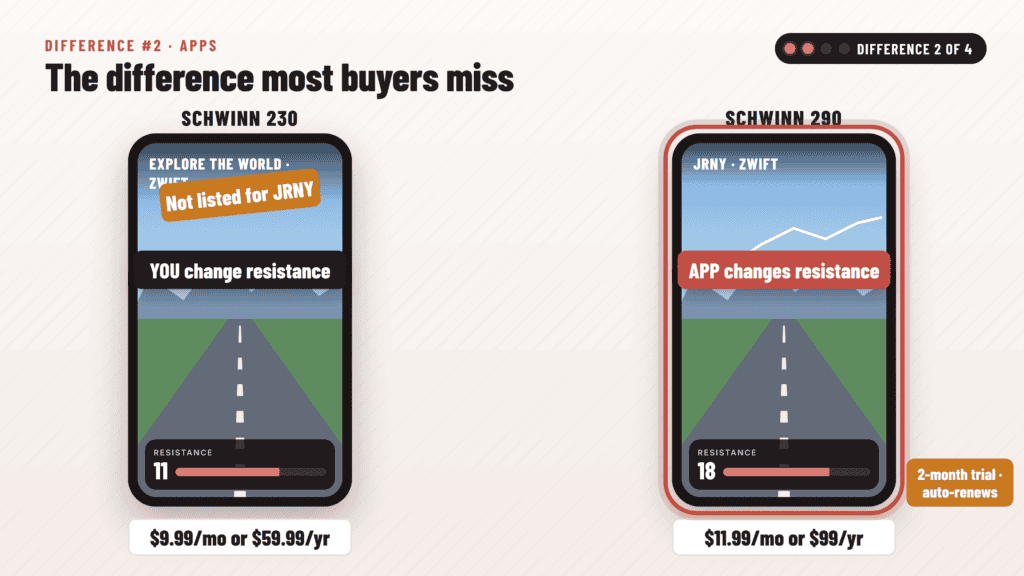
With the 290’s JRNY app, the app can change the bike’s resistance for you; with the 230’s apps, you change it yourself. Both bikes connect to your own phone or tablet over Bluetooth; neither has a built-in touchscreen.
- Schwinn 230: Explore the World and Zwift. Explore the World plays scenic route videos that speed up and slow down with your pedaling, but you still adjust the resistance by hand. It costs $9.99 a month or $59.99 a year.
- Schwinn 290: JRNY and Zwift. With JRNY, adaptive workouts adjust to your fitness, and on its scenic routes, Terrain Control raises the resistance on hills automatically. JRNY costs $11.99 a month or $99 a year, and the 290 comes with a 2-month free trial. The trial renews automatically, so set a reminder if you don’t want to keep it.
Schwinn doesn’t list the 230 as JRNY compatible. If JRNY is the reason you’re buying, get the 290.
My trainer’s test: if being guided is what keeps you showing up, the 290 is worth it. If you’ll just hop on and ride with a show on, you don’t need it.
Difference #3: seat, console, and heart rate
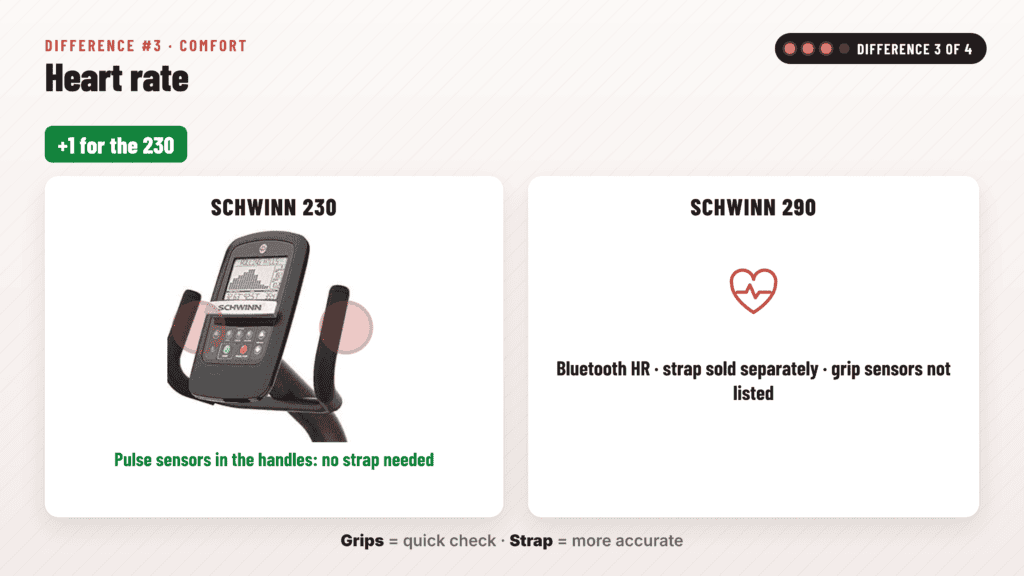
The 290 is the more comfortable bike for long rides; the 230 has one advantage in built-in pulse grips.
Seat. The 290’s seat has a padded bottom and a vented back. The 230’s seat is hard, contoured plastic with a large vented back, and it isn’t padded. It’s a frequent complaint in owner reviews, and many owners add a gel seat cover. For a 20-minute ride, that’s usually fine; if you’ll ride 45 minutes or longer, the 290’s padding makes a real difference.
Console. The 230 has a 5.5-inch display with the basics: time, speed, distance, calories, RPM, and heart rate. The 290 has a 7-inch display that adds watts, cadence, and burn rate, plus Bluetooth speakers and a USB port to keep your tablet charged during long rides.
Heart rate. The 230 has pulse sensors in its handles, so you can check your heart rate without a strap. For the 290, Schwinn lists Bluetooth heart rate with the strap sold separately and doesn’t mention grip sensors. Honestly, grip sensors give a rough reading and a chest strap is more accurate, but for a quick check, the 230 does it out of the box.
My trainer’s test: if most of your rides will be 45 minutes or longer, the 290’s seat alone is worth weighing. For short daily rides, the 230’s seat and console do the job.
Difference #4: weight limit and size
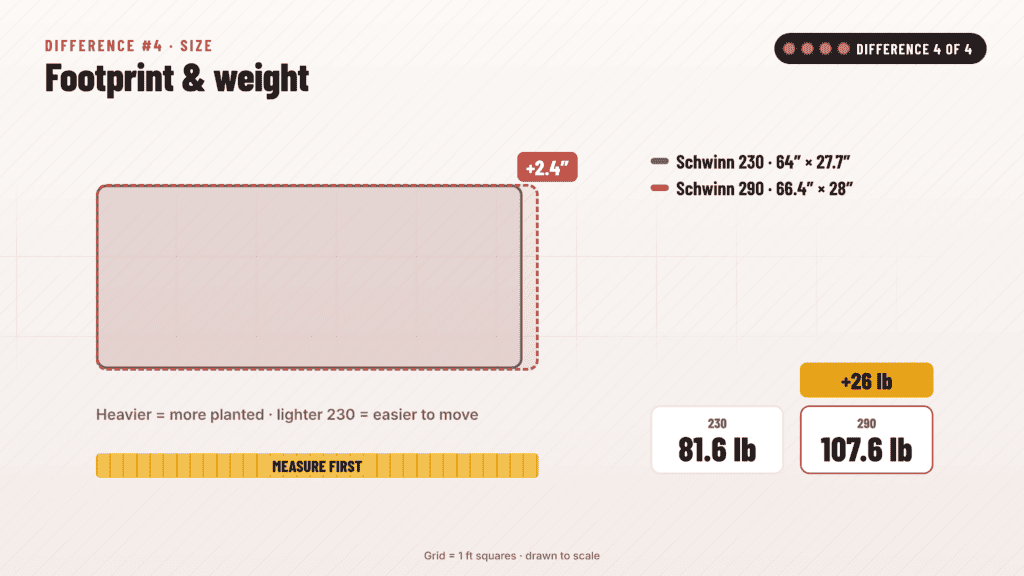
The 290 is rated for 30 lb more and is the bigger, heavier bike.
Weight limit. The 230 is rated for 300 lb and the 290 for 330 lb. On a recumbent bike, you’re seated with your back supported, and there’s almost no impact, so the rating itself is your guide (unlike a treadmill for running, where I leave about 25 lb of headroom). If you’re comfortably under 300 lb, either bike fits you. If you’re close to 300 lb or above it, get the 290.
Size and bike weight. The 290 is 66.4″ long and weighs 107.6 lb; the 230 is 64″ long and weighs 81.6 lb. That’s about 2.5″ longer and 26 lb heavier. The extra weight helps the 290 feel planted, but if you’ll roll the bike in and out of a corner often, the 230 is easier to move. Either way, measure first: recumbent bikes are long.
Related: MERACH S19 Recumbent Bike Review
The price: is the 290 worth $300 more?
On Amazon, the 230 lists at $599 and the 290 at $899: a $300 gap, or 50% more. Spread over five years of riding, that’s about $5 a month. It’s worth paying only if you’ll use what it buys: the finer resistance control and quick keys, JRNY coaching, the padded seat, or the higher weight limit.
If a sale changes the gap, this is the rule I’d use:
| Price gap today | Get the | Why |
|---|---|---|
| About $150 or less | Schwinn 290 | Every upgrade for very little |
| About $300 (list prices) | Depends on you | Take the 290 only if you’ll use JRNY, intervals, long rides or the 330 lb rating |
Prices change often, so check both before you buy: Schwinn 230 on Amazon · Schwinn 290 on Amazon
App costs (optional on both)
Neither bike needs a subscription: both work with their 13 built-in programs. The apps are extras.
- Schwinn 230: Explore the World is $9.99 a month or $59.99 a year.
- Schwinn 290: JRNY is $11.99 a month or $99 a year after the 2-month free trial, which renews automatically.
- Both: Zwift needs its own subscription.
Skip the apps, and neither bike costs anything more after you buy it.
Who should buy which
Get the Schwinn 230 if you:
- Want easy, steady, low-impact cardio, including injury recovery or easing back into exercise
- Ride at your own pace with TV or music, without an app guiding you
- Want a lighter bike (81.6 lb) that’s easier to move
- Weigh comfortably under 300 lb
Skip it if you’ll ride 45 minutes or more most days and don’t want to add a seat cover. Check the Schwinn 230 price
Get the Schwinn 290 if you:
- Want JRNY to coach you and change the resistance for you
- Do interval workouts, or ride 45 minutes or longer and want the padded seat, speakers, and USB charging
- Are close to 300 lb or above it, up to 330 lb
Skip it if you’ll ride at a steady pace with a show on and never use an app. Check the Schwinn 290 price
Still not sure? The 3-question test
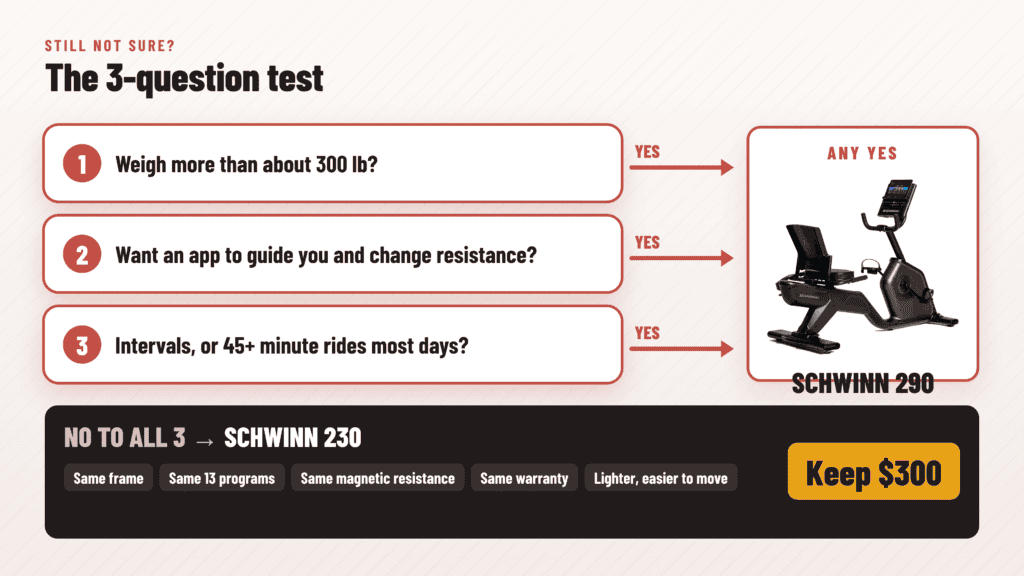
One “yes” is enough to choose the 290.
- Do you weigh more than about 300 lb? Yes → Schwinn 290.
- Do you want an app to guide your workouts and change the resistance for you? Yes → Schwinn 290.
- Will you do interval workouts, or ride 45 minutes or longer most days? Yes → Schwinn 290.
No to all three? Get the Schwinn 230. You get the same frame, the same 13 programs, the same quiet magnetic resistance and the same warranty, plus a lighter bike, and keep $300 in your pocket.
One exception: riders over 330 lb
If you weigh more than 330 lb, neither Schwinn is rated for you. Look at the Niceday RC88 instead.
- Rated for 400 lb
- 16 levels of magnetic resistance, set with a knob
- About $400 on Amazon
It’s simpler than either Schwinn, and no app changes the resistance for you. One honest note: the Amazon listing doesn’t state a manufacturer warranty, so read it before you buy, and consider Amazon’s optional protection plan. Make sure the listing says RC88, not the newer RC88E, which is a different bike.
Frequently asked questions
Is the Schwinn 290 worth $300 more than the 230?
Only if you’ll use what the $300 buys: JRNY coaching that changes the resistance for you, 25 levels with quick keys for intervals, a padded seat for long rides, or the 330 lb rating. If you’ll ride at a steady pace with a show on, the 230 does the same job for less.
Do you need a subscription for either bike?
No. Both work without one, using their 13 built-in programs. Explore the World ($9.99/mo or $59.99/yr) on the 230, JRNY ($11.99/mo or $99/yr) on the 290, and Zwift on both are optional.
Does the Schwinn 230 work with JRNY?
Schwinn doesn’t list the 230 as JRNY compatible; it lists Explore the World and Zwift. If JRNY matters to you, get the 290.
What’s the weight limit on the Schwinn 230 and 290?
The 230 is rated for 300 lb and the 290 for 330 lb. On a seated recumbent bike, the rating is a fair guide: if you’re close to 300 lb or above it, choose the 290. Over 330 lb, look at a bike rated for 400 lb, like the Niceday RC88.
Is the Schwinn 230 seat padded?
No. It’s hard, contoured plastic with a vented back. Many owners add a gel or foam seat cover. The 290’s seat is padded.
How much space do they need?
The 230 is 64″ long and 27.7″ wide; the 290 is 66.4″ long and 28″ wide. Measure your space first, since recumbent bikes are long.
Is the warranty different?
No. Both get 10 years on the frame, 2 years on mechanical parts, 1 year on electronics, and 90 days on labor.
Final verdict
There’s no single winner between the Schwinn 230 and 290; the right one depends on how you’ll ride. Choose the Schwinn 230 for steady, simple, low-impact cardio if you weigh comfortably under 300 lb: you get the same frame, programs, resistance type, and warranty and keep $300.
Choose the Schwinn 290 if you want JRNY to coach you and change the resistance, you do intervals or long rides, or you’re close to 300 lb or above it. If a sale brings the gap to about $150 or less, take the 290.