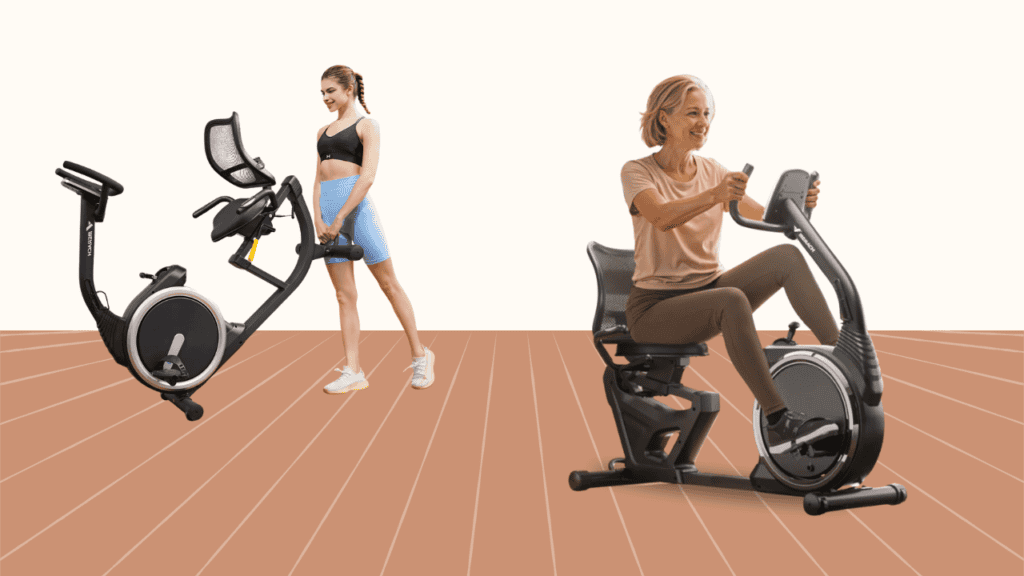
If you’ve been searching for a recumbent bike that won’t punish your knees, your lower back, or your wallet, you’ve probably already come across the MERACH S19. At around $379, it’s positioned as one of the better budget options in the recumbent bike category — but “budget” doesn’t always mean “good,” so let’s break down whether it actually earns that recommendation.
As a NASM-Certified Personal Trainer, I get asked constantly by clients — especially older clients and anyone managing joint pain — which home cardio equipment is actually worth buying versus which ones are marketing dressed up as fitness gear. This MERACH S19 review breaks down the way I’d walk a client through it: what the specs actually mean for your body, who it genuinely fits, and where the trade-offs are.
Quick answer: If you want low-impact, joint-friendly cardio with a genuinely comfortable seat, quiet operation, and basic performance tracking — and you don’t need commercial-gym-level resistance — the S19 [check today’s price on Amazon] is one of the strongest options under $500.
MERACH S19 Review: Who It’s For
Recumbent bikes aren’t for everyone, and no single bike fits every goal. The S19 makes the most sense for:
- People with joint pain or mobility limitations who need cardio that doesn’t load the knees or hips the way an upright bike or treadmill does
- Older adults or anyone shopping for an aging parent, thanks to the seated, low-transfer design and stable frame
- Anyone easing back into activity after an injury or a long break — always confirm with your doctor or physical therapist first, but low-impact recumbent cycling is a common recommendation for this exact situation
- Apartment dwellers or anyone in a noise-sensitive household who needs quiet equipment
- Beginners who want a low-intimidation entry point into consistent cardio without a steep learning curve
If you’re training for competitive cycling or want a machine that scales into serious high-resistance interval work, this isn’t the category for that — recumbent bikes generally aren’t built for that use case, regardless of brand or price.
Comfort: Where the MERACH S19 Earns Its Reputation
The single biggest factor in whether home cardio equipment actually gets used isn’t motivation — it’s comfort. I see this constantly with clients: the equipment that gets used consistently is rarely the one with the most features. It’s the one that doesn’t hurt to sit on.
The S19’s seat is noticeably thicker than what’s typical in this price bracket, paired with a breathable mesh backrest and 8 adjustable seat positions to accommodate different heights and leg lengths (MERACH lists a recommended height range of 5’2″–5’10”, with a seated leg length range of roughly 28–35 inches). For anyone with lower back sensitivity, a wider, well-padded seat with proper back support meaningfully reduces the strain that flat, minimal-padding seats put on the lumbar spine during longer sessions.
The frosted, textured handlebar grips are a small but practical detail — cheaper bikes often use slick plastic that gets uncomfortable or slippery once your hands sweat, so this is a thoughtful upgrade for the price point.
Bottom line: for a $379 bike, the comfort engineering here is genuinely above what you’d expect at this price tier.
Resistance System & Noise Level
The S19 uses an 8-level magnetic resistance system controlled by a car-style shifting lever — a simpler, more intuitive mechanism than the dial or button systems found on some competitors. Magnetic resistance systems are generally quieter and require less maintenance than friction-based systems, which matters both for longevity and for shared-space use.
Combined with a dual-belt drive and a 6.6 lb weighted flywheel, the design prioritizes smooth, quiet operation — an important consideration if you’re working out early in the morning, late at night, or in an apartment with shared walls. Eight resistance levels is a reasonable range for low-to-moderate intensity training, steady-state cardio, or rehab-style movement, though it won’t satisfy someone looking to replicate high-resistance spin-class intervals.
Tracking & App Integration
The onboard LCD display covers the fundamentals: time, distance, speed, calories, and heart rate. It’s not a flashy touchscreen experience, but for most users — especially those using this bike for general cardio or low-impact rehab-style movement — these are the metrics that actually matter.
The bike connects via Bluetooth to MERACH’s own app, which adds real-time stat tracking and a gamified mode through FantomFit. There’s also a built-in tablet holder, which is a small but genuinely useful addition for anyone who wants to stream a show during longer sessions — a detail that, in my experience, meaningfully increases how long people actually stay on cardio equipment.
Heart rate tracking is worth calling out specifically: staying within a target heart rate zone is one of the more effective ways to get consistent cardiovascular benefit from low-impact movement, and having that feedback built in — rather than needing a separate chest strap — is a nice inclusion at this price.
Setup, Build Quality & Warranty
The S19 ships 80% pre-assembled with an included installation video, and most users report completing setup in about 30 minutes without needing extensive tools or experience. It supports users up to 330 lbs and comes with a 1-year manufacturer’s warranty covering defects — and per MERACH’s own warranty page, registering your product shortly after purchase extends that to a full 2 years of coverage. It’s worth registering right away so you don’t miss the window.
None of this is flashy, but it reflects a company that’s thought about the full ownership experience — not just the marketing spec sheet.
MERACH S19 at a Glance
| Resistance | 8-level magnetic, car-style lever |
| Drive System | Dual-belt, 6.6 lb flywheel |
| Seat Adjustability | 8 positions |
| Display | Time, distance, speed, calories, heart rate |
| Connectivity | Bluetooth, MERACH app, FantomFit |
| Weight Capacity | 330 lbs |
| Assembly | ~80% pre-assembled, ~30 min setup |
| Warranty | 1 year standard, 2 years with product registration |
| Recommended Height | 5’2″–5’10” |
Pros and Cons: MERACH S19 Recumbent Bike
Frequently Asked Questions
Is the MERACH S19 good for seniors?
Yes — the seated position, adjustable seat, low-impact movement pattern, and quiet operation make it a reasonable option for older adults looking for safe, joint-friendly cardio. As always, anyone with existing health conditions should check with a doctor before starting a new exercise routine.
Is the MERACH S19 good for bad knees or joint pain?
Recumbent bikes in general place significantly less stress on the knees than upright bikes, treadmills, or running, because of the seated position and reduced range of motion under load. The S19’s resistance range and seat comfort make it a reasonable low-impact option, though anyone with a specific injury should get guidance from a physical therapist or doctor on appropriate intensity.
How does the MERACH S19 compare to other bikes under $500?
At this price point, many competitors cut corners on seat comfort or use louder, less durable drive systems. The S19’s combination of seat quality, quiet operation, and included app tracking is a stronger overall package than most alternatives in the same price bracket.
Is 8 resistance levels enough?
For most low-to-moderate intensity training — including general cardio, rehab-style movement, and steady-state workouts — 8 levels is sufficient. Advanced users looking for high-resistance interval training may find the ceiling limiting.
Final Verdict
The MERACH S19 isn’t trying to be a premium spin bike, and it doesn’t need to be. What it does well — comfort, quiet operation, ease of use, and genuinely useful tracking — are the things that actually determine whether a piece of home fitness equipment gets used consistently or ends up as a clothes rack. For anyone shopping under $500 for low-impact, joint-friendly cardio, it’s one of the strongest options available right now.