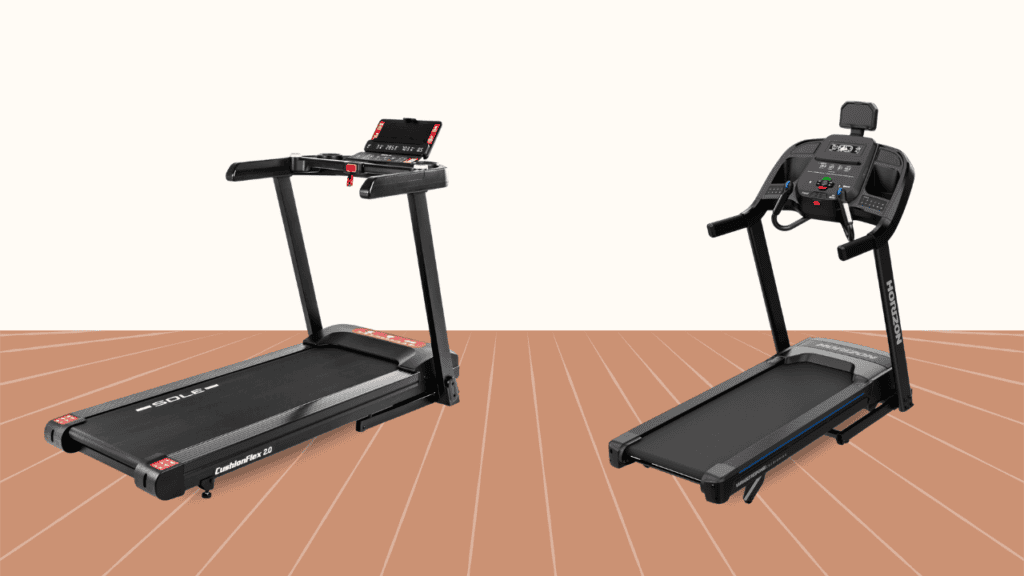
Twelve miles per hour. Fifteen levels of incline. A 20″ x 60″ deck, a 325 lb weight limit, and a lifetime frame and motor warranty. That describes the Sole F63, and it also describes the Horizon 7.0 AT. On paper, they’re almost twins. So why does the Sole typically cost about $100 more, and which one should you actually buy?
This comparison covers the new 2026 Sole F63, with its brushless motor, not the older model most reviews still describe. As a NASM-certified personal trainer and Precision Nutrition Level 1 coach, I compared them the way I’d help a client choose: round by round, scored honestly, with no forced winner.
Quick verdict: Sole F63 vs. Horizon 7.0 AT
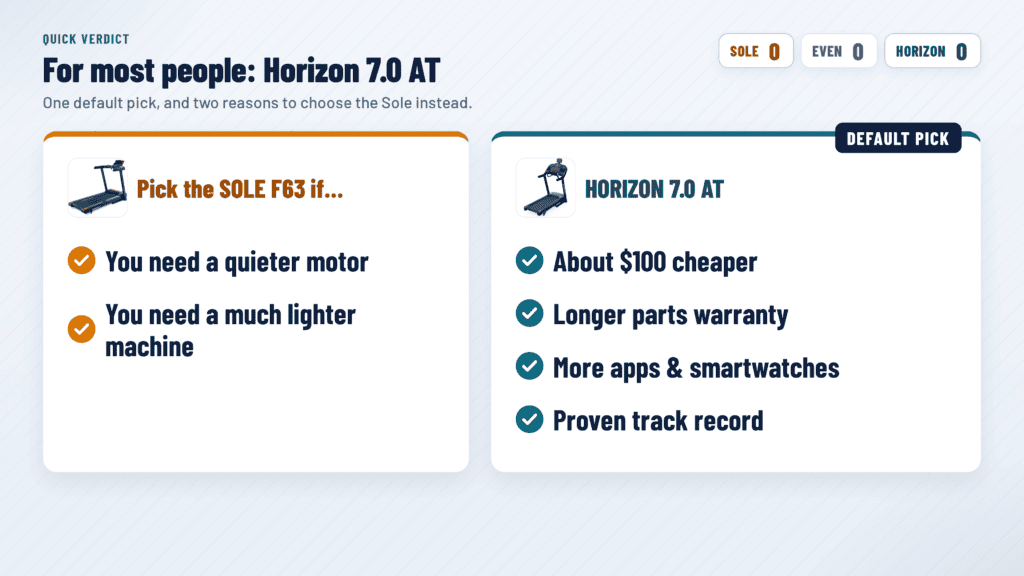
For most people, the Horizon 7.0 AT is the smarter buy. It typically costs about $100 less, has a longer parts warranty, works with more apps and smartwatches, and has a proven track record.
Choose the Sole F63 if:
- A quieter motor matters most. Its new brushless motor is built around low noise, which suits apartments, upstairs rooms, and early-morning runs.
- You need a much lighter machine. At about 187 lb, it’s roughly 90 lb lighter than the Horizon, which helps with stairs and tight entries.
Sole F63 vs. Horizon 7.0 AT: Specs side by side
| Sole F63 (2026) | Horizon 7.0 AT | |
|---|---|---|
| Motor | 3.0 HP brushless | 3.0 CHP, Rapid Sync drive |
| Speed | 0.5–12 mph | 0.5–12 mph |
| Incline | 15 levels | 0–15% |
| Running Deck | 20″ x 60″ | 20″ x 60″ |
| Deck / Belt | 18 mm deck, 1.6 mm belt | 18 mm deck, 1.6 mm belt |
| Rollers (Front / Rear) | 2.36″ / 1.8″ | 2.36″ / 1.8″ |
| Max User Weight | 325 lb | 325 lb |
| Display | White LED, dial controls in the hand grips | LCD + LED windows, QuickDial controls |
| Apps | Free SOLE+ app (shares to Strava) | Peloton, Zwift, Apple Watch, Samsung Galaxy Watch |
| Heart Rate | Chest strap or armband only | Hand grips + Bluetooth HR, target-HR program |
| Unit Weight | ~187 lb | ~277 lb |
| Size (L x W x H) | 75″ x 34″ x 52″ | 76″ x 35″ x 67″ |
| Folded (L x W x H) | 42″ x 34″ x 71″ | 44″ x 35″ x 68″ |
| Warranty | Lifetime frame & motor, 2 yr parts, 1 yr labor | Lifetime frame & motor, 3 yr parts, 1 yr labor |
| Check Price | Check Price → | Check Price → |
Specs from Sole’s and Horizon’s official product pages. Prices change often; check the links for today’s price.
What’s identical
Before the differences, here’s what you get either way:
- Speed: 0.5 to 12 mph on both
- Incline: 15 levels on both. Horizon lists its top incline as 15 percent; Sole simply lists 15 levels.
- Running surface: 20″ x 60″, enough room for taller runners to take a full stride
- Max user weight: 325 lb
- Folding: both fold with hydraulic assist
- Warranty: lifetime coverage on the frame and motor
Even the parts that shape how the deck feels match: the same deck thickness (18 mm), the same belt thickness (1.6 mm), and the same roller sizes. So on paper, these two perform the same for walking, jogging, or running. The decision comes down to everything else.
Round by round
Nine rounds, scored honestly. Ties are marked as ties where the specs genuinely match.
Round 1: Price (winner: Horizon)
The Sole F63 typically sells for around $1,199, and the Horizon 7.0 AT for around $1,099. Both go on sale often, but the Horizon typically sells for about $100 less.
Round 2: Motor and noise (winner: Sole)
The 2026 F63’s headline upgrade is a brushless motor. Brushless motors have fewer moving parts, and Sole says that makes the F63 quieter, smoother, and more durable.
The Horizon uses a 3.0 continuous-horsepower motor with Johnson’s Rapid Sync drive, built to change speed and incline quickly, which is great for interval training.
Both are rated around 3 horsepower, but the brands measure horsepower differently, so I won’t call either one stronger. If noise is your biggest concern, though, the brushless motor is the one designed around it. Just know that it’s new, so long-term owner feedback is still limited.
Round 3: Cushioning and ride feel (even)
Horizon advertises three-zone cushioning, but the deck, belt, and rollers match the Sole’s. Without a tested difference, this round is even.
Round 4: Console and controls (even)
Neither has a touchscreen. Both use simple LED-style displays, dial controls for speed and incline, quick-touch keys, speakers, a fan, and a tablet holder. Different layouts, same idea.
Round 5: Apps, watches and heart rate (winner: Horizon)
This is the biggest real difference between them.
- Horizon 7.0 AT: connects over Bluetooth to apps like Peloton and Zwift, and syncs with an Apple Watch or Samsung Galaxy Watch. Using Peloton classes requires Peloton’s App+ membership.
- Sole F63: built around Sole’s own free SOLE+ app, which can share your workouts with apps like Strava. Sole itself says the F63 doesn’t support the full two-way connection that interactive training apps need.
Heart rate follows the same pattern. The Horizon reads your heart rate through hand grips or a Bluetooth monitor, and has a target-heart-rate program. The F63 has no hand grips, so you’ll need a chest strap or armband.
Round 6: Warranty (winner: Horizon)
| Sole F63 (2026) | Horizon 7.0 AT | |
|---|---|---|
| Frame | Lifetime | Lifetime |
| Motor | Lifetime | Lifetime |
| Parts | 2 years | 3 years |
| Labor | 1 year | 1 year |
The only difference is parts coverage, and it favors the Horizon. So the cheaper treadmill also has the longer parts warranty.
Round 7: Size and folding (even)
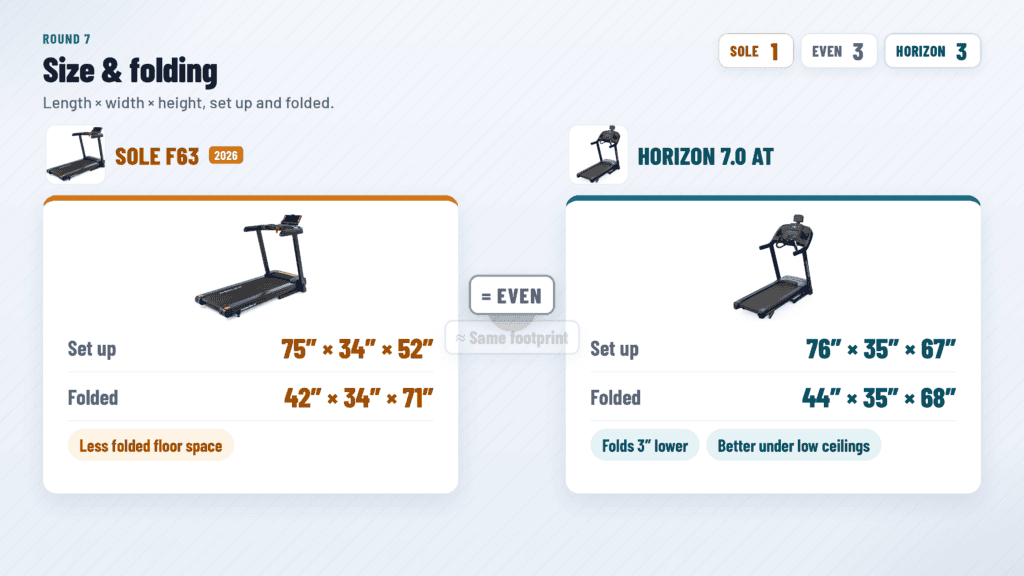
- Set up: the Sole is about 75″ x 34″, and the Horizon is about 76″ x 35″. Almost the same floor space. By each brand’s listed dimensions, though, the Sole stands about 52″ tall versus about 67″ for the Horizon, largely because of the Horizon’s taller console. That’s worth knowing if it will sit under a window or a sloped ceiling.
- Folded floor space: the Sole takes slightly less, about 42″ x 34″ versus 44″ x 35″.
- Folded height: the Horizon folds about 3 inches lower, 68″ tall versus 71″. That matters if you’re storing it under a low ceiling or a shelf.
Overall, it’s a wash.
Round 8: Weight and moving it (winner: Sole)
The Sole weighs about 187 lb, and the Horizon about 277 lb. That’s roughly 90 lb lighter, which makes the Sole much easier to get through a narrow doorway, up stairs, or roll across a room.
In fairness, there’s a trade-off. A heavier frame generally feels more planted and stable at higher speeds, and from a training standpoint, that’s what I prefer for regular running. So the Horizon’s extra weight isn’t just a downside. For moving it, though, the Sole wins.
Round 9: Track record (winner: Horizon)
The 2026 F63 is brand new, so there isn’t much real-world owner feedback yet. The current Horizon 7.0 AT has been on sale since 2024, and the 7.0 AT name goes back years before that, so there’s far more owner feedback to go on. When the specs are this close, a proven track record counts.
Final scoreboard
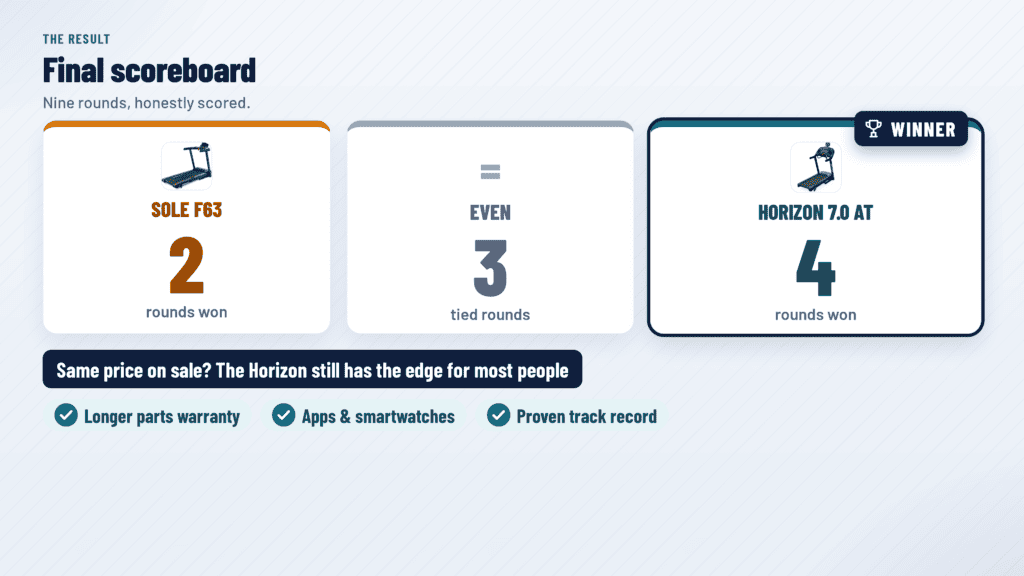
| Result | Rounds |
|---|---|
| Horizon 7.0 AT: 4 | Price, apps and heart rate, warranty, track record |
| Sole F63: 2 | Motor and noise, weight and moving it |
| Even: 3 | Cushioning, console, size and folding |
Even if a sale brings them to the same price, the Horizon keeps its edge for most people. The longer parts warranty, the app and smartwatch support, and the track record don’t go away.
A trainer’s take
From a training standpoint, it’s simple:
- If you walk or jog, either treadmill works.
- If you run fast and often, I lean toward the Horizon. Its heavier frame generally feels more planted at higher speeds.
- If noise matters most, choose the Sole.
Before you buy
- Delivery. The F63’s Amazon listing says it ships by freight, curbside only. Plan for the same with the Horizon, whose box weighs over 300 lb, and have a second person ready.
- Setup and power. Unless you pay for assembly, you’ll put it together yourself. Plug it straight into a grounded wall outlet, not an extension cord.
- Returns. Buying on Amazon gives you a 30-day return window on either treadmill. Check the return shipping terms on the listing first, since heavy, bulky items usually aren’t free to send back.
Which one is right for you? The 3-question test
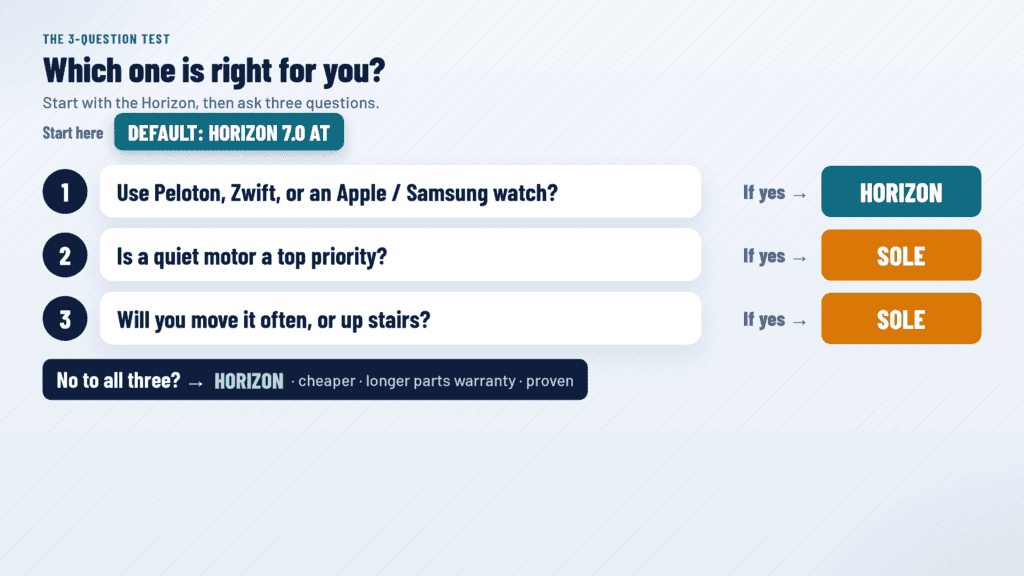
Start with the Horizon as your default, then ask three questions:
- Do you train with apps like Peloton or Zwift, or track workouts on an Apple Watch or Samsung Galaxy Watch? If yes, get the Horizon.
- Is a quiet motor a top priority (you live in an apartment, run upstairs, or work out while others sleep)? If yes, look at the Sole.
- Will you move it often, or does it need to go up stairs or through a tight entry? If yes, look at the Sole.
No to all three? Get the Horizon. It’s the cheaper one, with the longer parts warranty and the proven track record.
Answered yes to more than one?
- Apps and quiet: go with the Horizon. A treadmill mat helps with noise and vibration, but app support can’t be added later.
- Apps, but it has to go up stairs: the Sole’s lighter weight is a real advantage. Or get the Horizon and pay for professional delivery and assembly.
Frequently asked questions
Is the Sole F63 or the Horizon 7.0 AT better?
For most people, the Horizon 7.0 AT. It has the same core specs, typically costs about $100 less, has a longer parts warranty, and works with more apps and smartwatches. The Sole F63 is the better pick if you need a quieter motor or a much lighter machine.
What’s new in the 2026 Sole F63?
The headline upgrade is a brushless motor, which Sole says is quieter, smoother, and more durable. The 2026 model’s console is a white LED display, with dial controls for speed and incline built into the hand grips.
Does the Sole F63 work with Peloton or Zwift?
The F63 is built around Sole’s free SOLE+ app, which can share workouts to apps like Strava. Sole says it doesn’t support the full two-way connection that interactive apps like Peloton and Zwift need. If you use those apps, the Horizon 7.0 AT is the better choice.
Does the Horizon 7.0 AT work with Peloton?
Yes. It connects to the Peloton app over Bluetooth, though Peloton classes require an App+ membership. It also works with Zwift and syncs with Apple Watch and Samsung Galaxy Watch.
Which treadmill is quieter?
The Sole F63’s brushless motor is designed for quieter operation. Because the 2026 model is new, there’s limited owner feedback so far, but if noise is your top priority, it’s the one built around it.
Do the Sole F63 and Horizon 7.0 AT have touchscreens?
No. Both use simple LED-style displays with dial controls and a tablet holder for your own device.
Which has the better warranty?
The Horizon 7.0 AT. Both have lifetime frame and motor coverage and 1 year of labor, but the Horizon covers parts for 3 years versus 2 on the Sole.
Which is easier to move?
The Sole F63. At about 187 lb, it’s roughly 90 lb lighter than the Horizon 7.0 AT, which weighs about 277 lb.
How much space do they need?
Set up, the Sole is about 75″ x 34″ and the Horizon is about 76″ x 35″. Folded, the Sole uses slightly less floor space (42″ x 34″ vs. 44″ x 35″), but the Horizon folds about 3 inches lower (68″ vs. 71″). The Sole also stands lower when set up, about 52″ tall versus 67″.
Final verdict
For most people, the Horizon 7.0 AT is the one to buy: same core specs, about $100 less, a longer parts warranty, and more apps. Choose the Sole F63 if a quieter motor or a much lighter machine matters more to you than that.
Still not sure? Leave a comment with how you’ll use it and where it’s going, and I’ll tell you which one I’d pick.